
Clipping Agency Canada: Helping Good Content Reach More People
Why Canadian creators, founders, agencies, and brands are turning long videos into short clips built for modern discovery.
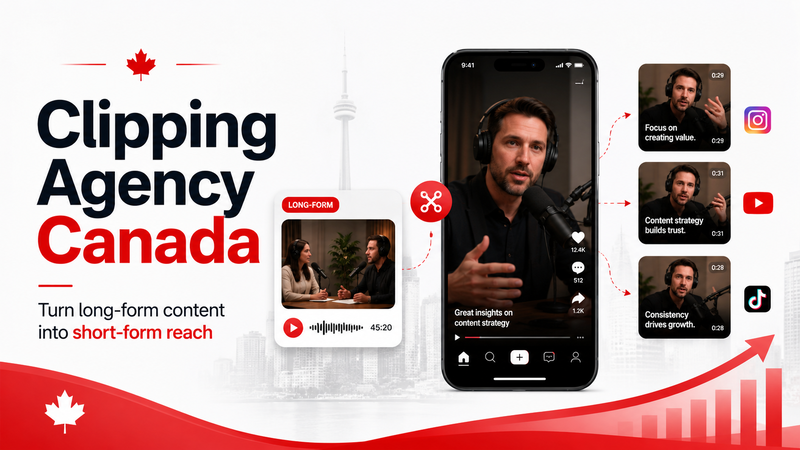

A lot of Canadian businesses are not short on ideas.
They have founders who can explain the market clearly. They have podcasts with strong guest moments. They have webinars that answer real customer questions. They have product demos, tutorials, livestreams, customer stories, interviews, and long-form videos that could build trust if more people actually saw them.
The issue is not always the quality of the content.
The issue is that the best parts are often hidden inside long videos.
A useful idea may sit halfway through a podcast. A strong quote may be buried near the end of an interview. A clear explanation may live inside a webinar replay that very few people will open. A customer story may exist, but only as part of a longer recording that never gets reused properly.
That is where clipping becomes useful.
A Clipping Agency Canada service helps creators and brands turn long-form content into short clips that are easier to publish, easier to share, and easier for new audiences to discover. The goal is not simply to make videos shorter. The goal is to turn the right moments into short-form assets that can build reach, trust, followers, engagement, and brand visibility over time.
For Canadian brands trying to grow in a crowded online space, that matters.
The Problem With Publishing Once and Moving On
Many teams work hard to create long-form content and then use it only once.
A podcast episode goes live. A webinar is shared with a small email list. A YouTube video is posted. A founder interview gets mentioned on LinkedIn for a day or two. Then the team moves on to the next thing.
That is normal, but it leaves a lot of value behind.
Long-form content usually contains several smaller moments that could work on their own. A single recording can include a lesson, a story, a mistake, a customer problem, a strong opinion, a piece of proof, and a useful explanation. Each of those moments could become a short clip if selected and edited properly.
Without clipping, those moments stay trapped.
With clipping, they become new entry points.
That is the real benefit. A good clipping workflow helps content travel beyond the people who already know the brand.
Short Clips Make Discovery Easier
People do not always discover brands by searching for them directly.
Sometimes they find a brand through one short clip. They hear a founder explain something clearly. They see a podcast guest make a point that feels relevant. They watch a customer problem being explained in simple language. They see a quick tutorial and realize the account is worth following.
That first touchpoint does not need to say everything.
It only needs to give the viewer a reason to care.
This is why short-form content works so well as a discovery layer. A viewer may not be ready to watch a full webinar, listen to a full podcast, or read a long case study. But they may watch a short clip that answers one question or makes one idea easier to understand.
Once that happens, the brand becomes more familiar.
Over time, these small moments can build trust, especially when the clips are consistent and connected to the same message.
A Good Clip Needs a Clear Purpose
Not every short video is a useful clip.
This is where a lot of brands go wrong. They take a section from a long video, crop it vertically, add captions, and post it. The clip may look like short-form content, but it may not work for a new viewer.
It might start too slowly. It might need too much background. It might include several ideas at once. It might feel like the middle of a private conversation. It might be interesting to the team, but not clear enough for the audience.
A strong clip usually has one clear purpose.
It might:
Explain one problem
Share one useful lesson
Answer one common question
Show one proof point
Highlight one mistake
Share one clear opinion
Tell one short story
Create curiosity about the full content
Show personality or credibility
Make a complex idea easier to understand
When a clip has a clear purpose, it is easier to watch and easier to remember.
That is the difference between posting clips and building a short-form content system.
Clip Selection Comes Before Editing
Editing matters, but selection matters first.
If the chosen moment is weak, the final clip will still feel weak. Captions, zooms, transitions, and music can make it look more active, but they cannot always make the idea stronger.
A good clipping process starts by reviewing the original content with the audience in mind.
The question is not only, “Is this part interesting to us?”
The better question is, “Would someone who has never heard of this brand stop for this moment?”
That question helps remove a lot of filler.
A good clip should be able to stand on its own. It should make sense without the viewer needing to watch the full video first. It should also connect to what the brand wants to be known for.
This is where outside perspective helps. Creators and founders are often too close to their own content. They may overlook a strong line because it feels obvious. They may choose a detailed section when a new viewer would respond better to a simple, direct point.
A clipping team can watch like the audience and find the moments most likely to connect.
Canadian Brands Need More Than Occasional Posting
A lot of Canadian businesses do good work but do not show enough of it online.
A local company may have strong customer stories but no short-form process. A B2B company may run useful webinars but never turn them into clips. A podcast may publish full episodes but not enough short content to bring in new listeners. A founder may have strong ideas but only shares them when there is time.
This makes the brand less visible than it should be.
Short-form clipping helps create consistency without forcing the team to produce brand-new content every day.
Instead of asking, “What should we post from scratch?” the team can ask, “What strong moments already exist in our content?”
That is a much easier way to build momentum.
A single recording can become:
A TikTok clip
An Instagram Reel
A YouTube Short
A LinkedIn video
A Facebook Reel
A newsletter asset
A landing page clip
A sales follow-up video
A podcast teaser
A short proof-based video
This gives the brand more ways to stay visible without constantly starting over.
Editing Should Make the Message Easier to Understand
Good editing should help the idea land. It should not hide the idea.
A clip needs to work on a phone screen. The speaker should be easy to see. Captions should be readable. The crop should make sense. The pacing should keep the viewer engaged without making the clip feel rushed. If there is a screen recording, important details should be visible. If two people are speaking, the layout should be easy to follow.
Different clips need different editing styles.
A founder explaining a serious market problem may need a clean professional edit. A podcast clip may need clear speaker framing. A tutorial may need simple callouts. A customer story may need space to feel real. A livestream moment may need to keep some of its natural energy.
Not every clip needs heavy effects, loud transitions, or constant movement.
The best edit supports the message. If the viewer remembers the graphics but not the point, the edit is doing too much.
Clipping Helps Build Brand Memory
Views are helpful, but views alone are not the whole goal.
A clip can get attention and still do little for the brand if people do not remember who posted it or why it mattered. This happens when brands chase random trends or post clips that do not connect to their audience, offer, or point of view.
A better clipping strategy builds memory.
The audience should slowly begin to understand what the brand talks about, who it helps, what problems it understands, and why it is worth following.
For a Canadian SaaS company, that may mean explaining a painful workflow problem in plain language. For a coach, it may mean turning longer advice into practical short lessons. For a podcast, it may mean turning guest insights into discovery clips. For an agency, it may mean showing how the team thinks about growth, content, and distribution.
Good clips help people remember the brand for something specific.
That is what turns short-form posting into brand building.
What a Clipping Agency Canada Service Should Do
A proper clipping service should do more than trim videos and add subtitles.
That can be part of the work, but the full process matters. The service should help with clip selection, structure, editing, formatting, captions, batching, distribution support, and performance learning.
A strong clipping workflow may include:
Reviewing podcasts, webinars, interviews, livestreams, tutorials, and long videos
Finding moments that can stand alone
Cutting unnecessary setup
Improving the first few seconds of each clip
Editing for pacing and clarity
Formatting clips for vertical platforms
Adding readable captions
Writing natural hooks and post captions
Creating batches of short-form clips
Organizing a consistent publishing rhythm
Tracking views, saves, shares, comments, and profile visits
Using performance data to improve future clips
This is the difference between basic editing and a real content distribution system.
A few edited clips can fill a calendar. A proper clipping workflow can keep the brand visible with content that supports long-term growth.
Why Outsourcing Makes Sense
Most creators and businesses can technically make clips themselves.
The challenge is doing it well every week.
Someone has to watch the full video, choose the best moments, cut the clips, format them, add captions, write post copy, export the files, publish consistently, and review performance. Doing that once is manageable. Doing it every week while also running a business is much harder.
Outsourcing helps separate content creation from content distribution.
The founder, creator, or marketing team can focus on recording strong ideas, serving customers, hosting interviews, teaching, selling, or building the product. The clipping team can focus on turning that content into short-form assets that keep the brand active and visible.
There is also value in having someone outside the business review the content. They can often spot the moments that feel obvious to the creator but useful to the audience.
That outside view can make the clips stronger.
What to Look For in a Clipping Agency
Not every short-form editing service is built for growth.
Some services can make clips look polished, but they may not understand audience behavior, platform pacing, positioning, or content strategy. A useful clipping agency should understand why a clip is worth posting, not only how to edit it.
Before choosing one, it helps to ask:
Can they find strong moments from long-form content?
Do they understand short-form pacing?
Can they keep the message clear?
Do they edit for mobile viewing?
Can they write hooks and captions that sound natural?
Do they avoid making every clip look identical?
Can they create a consistent publishing rhythm?
Do they review performance over time?
Can they connect clips to the wider content strategy?
Do they understand the audience and offer?
The right agency should help create clips that are watchable, useful, and memorable.
Final Thoughts
Canadian creators and businesses do not always need to create more content from scratch.
Many already have valuable ideas sitting inside podcasts, webinars, interviews, livestreams, tutorials, customer stories, and long videos. The challenge is making those ideas easier to discover.
A Clipping Agency Canada service helps turn long-form content into short clips that can build reach, followers, trust, engagement, and visibility across multiple platforms.
The goal is not simply to publish more short videos.
The goal is to make the strongest parts of your content easier to find, easier to watch, and easier to remember.

Comments
No comments yet. Be the first to comment!