
Clipping Marketing Is a Distribution Strategy
Why short-form content works better when it is part of a real system

Introduction
Clipping marketing matters because most creators and brands do not actually struggle with content creation as much as they think they do. In many cases, the real weakness appears after the content is already made. A podcast is recorded, a webinar is uploaded, or an interview goes live, but only a small part of that material is ever reused properly. One or two clips get posted, usually the easiest ones to extract, and the rest of the recording loses value almost immediately.
That is where clipping marketing becomes useful. It treats long-form content as a source of repeatable distribution rather than a one-time asset.
What Clipping Marketing Actually Means
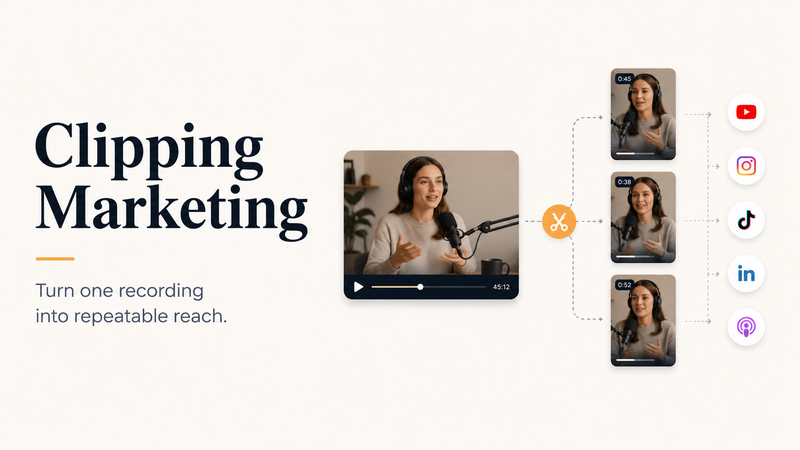
At its core, clipping marketing is the process of turning long-form content into short-form assets that are built for visibility, reach, and continued use across multiple platforms.
The source material may come from:
podcasts
interviews
webinars
livestreams
founder videos
educational recordings
event footage
long-form YouTube content
The output is then adapted for channels such as:
TikTok
Instagram Reels
YouTube Shorts
LinkedIn
X
Facebook
The goal is not simply to make videos shorter. The goal is to increase the amount of usable content that comes from one strong recording and to distribute that content in the places where people are most likely to discover it.
Why Clipping Marketing Works
Most audiences do not encounter a brand through a full-length video first. They usually come across a single short moment that gives them a reason to pay attention.
That moment may be:
a useful insight
a sharp opinion
a clear explanation
a statement strong enough to stop the scroll
Short-form content works because it creates more entry points into the same message. Instead of relying on one upload to do all the work, clipping marketing spreads the substance of that content across several smaller assets. Some of those assets generate attention. Others build familiarity. Some simply keep the brand visible long enough to become recognizable.
A lot of growth online comes from repetition. Not one great post.
Where Most Teams Get It Wrong
Many teams assume the hardest part is making the content itself. Sometimes that is true, but often the more expensive problem appears later. The team records something worthwhile, publishes the full version, and then fails to build a proper repurposing system around it.
This is why many brands look active on paper but still struggle to build real momentum. They are producing content, but too much of its value remains locked inside long-form recordings that never get translated into enough short-form output.
In that situation, the problem is not a shortage of ideas. It is a shortage of extraction and follow-through.
Clipping Marketing Is Not the Same as Editing
Editing is part of the process, but the two are not interchangeable.
Editing focuses on improving a piece of content as a single asset. Clipping marketing focuses on identifying the parts of that content that are strong enough to stand alone, shaping them for specific platforms, and using them as part of a larger distribution system.
Editing usually asks:
How do we make this video cleaner?
How do we improve pacing?
How do we make the final asset more polished?
Clipping marketing asks:
Which moments are strong enough to stand on their own?
What hook will make this clip worth watching?
Where should this clip be posted?
How does it support the wider content flow?
A technically polished clip can still perform poorly if the underlying moment is weak or if the packaging does not fit the channel. A more strategic clip, built around the right insight and presented with the right framing, will usually do more work than a clean edit that lacks purpose.
What Strong Clipping Marketing Usually Includes
Strong clipping marketing starts with judgement. It is not just a production task.
Better Clip Selection
Not every section of a long video deserves to become a clip. Weak short-form content often starts when teams cut whatever is easiest, safest, or most convenient instead of selecting the part that actually carries value on its own.
Good clips tend to do one thing clearly. They explain, teach, challenge, or create curiosity without asking the audience to watch the full source material first.
If a clip depends too heavily on missing context, it usually does not hold attention for long.
Platform Fit
A clip that works on TikTok may feel lifeless on LinkedIn. A YouTube Short may need a different pace than an Instagram Reel. Captioning, framing, pacing, and even the amount of context included in the first few seconds can change how well a clip performs.
Good clipping marketing respects those differences. It does not treat distribution as a copy-and-paste exercise. It adapts content to the environment where that content will actually be consumed.
Consistent Output
Many creators and brands disappear between major content pieces, not because they have nothing to say, but because the production cycle is heavy. One good recording session can take significant time and effort, which makes it difficult to maintain visibility if every new post depends on starting from scratch.
Clipping marketing reduces that pressure by extending the working life of one long-form asset. A single strong recording can support days or weeks of short-form distribution when handled properly.
Better Use of Existing Content
This is one of the most practical but least discussed benefits. Many brands are sitting on useful material that has never been repurposed properly.
That often includes:
old podcasts
webinar recordings
founder conversations
event sessions
interviews
internal videos
Clipping marketing brings that material back into circulation in formats people are more likely to consume. That is not just efficient. It is commercially sensible.
Who Clipping Marketing Is For
Clipping marketing is relevant to more than influencers or media personalities.
It makes sense for:
podcasters
founders
coaches
agencies
consultants
course creators
personal brands
B2B teams
education brands
media companies
If long-form content already plays a role in the business, then short-form distribution should usually play a role as well. Otherwise, too much effort goes into content that stops working far too early.
Why Random Clips Are Not Enough
Random clips can create activity, but they rarely create momentum. A few clips posted here and there may generate some views, but they usually do not build the repetition that makes a brand familiar.
People rarely remember a brand because they saw one decent clip on a random day. They remember it because they keep seeing useful content from that brand often enough for it to register.
That is why clipping marketing works best when each clip has a role.
Each clip should:
fit the platform
support the broader content flow
contribute to a pattern of visibility
feel deliberate rather than accidental
Without that, clipping becomes content clutter. With that, it becomes part of a real marketing system.
Final Thoughts
Clipping marketing works because it fixes a leak that many teams do not notice until late. They are already doing the expensive part. They are recording, planning, publishing, and showing up. But once the long-form piece goes live, too much value is left behind.
A podcast should not produce one upload and then disappear. A webinar should not be useful for a single day. A strong interview should not sit untouched because no one had time to turn it into more.
That is wasted reach.
Clipping marketing solves that problem by turning one source asset into repeatable short-form output that can keep supporting visibility, distribution, and growth long after the original upload.
That is why it matters.
Better distribution usually beats more content.

Comments
No comments yet. Be the first to comment!