
Podcast Clipping Agency: Why Top Shows Win on Video Feeds
How modern creators turn full-length studio discussions into high-retention vertical clips that recruit loyal listeners from social discovery feeds.
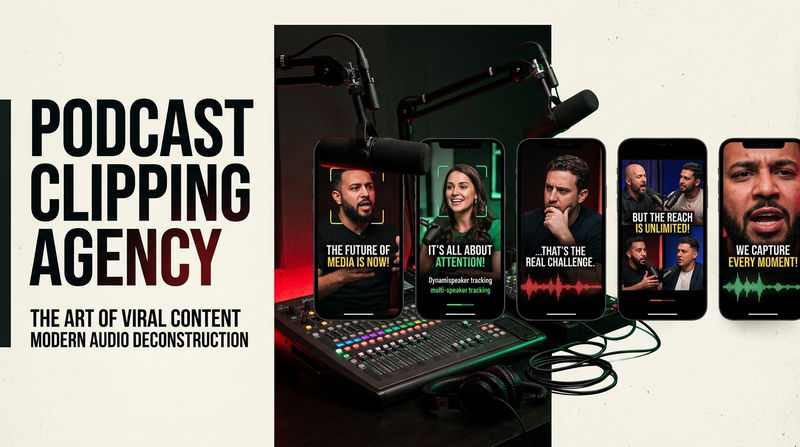

Look at the shows currently breaking download records across major listening platforms, and an inescapable truth becomes clear: almost none of them built their audience inside audio directories.
For years, launch strategies followed a predictable, comfortable pattern. You bought studio microphones, invited knowledgeable guests, recorded two hours of discussion, and published an audio file on a set day every week. The assumption was that directory search algorithms and listener recommendations would eventually build a following.
That passive growth model has vanished completely:
Over three million shows are registered across RSS feeds, saturating directories with unvetted content.
Directory charts remain dominated by legacy media networks and celebrity productions.
Modern media consumers refuse to risk an hour of commute time on an unfamiliar voice without upfront proof of value.
Static quote cards and audiogram soundbites fail to generate real engagement on fast-moving social feeds.
Listener discovery has migrated entirely into vertical short-form video feeds. A potential fan scrolls through their phone, catches a forty-second debate or an insightful career confession, and evaluates the host chemistry within seconds. If the insight lands, they immediately search for the full interview.
Yet manually sifting through two hours of studio recording to find, cut, reframe, subtitle, and distribute twenty short clips every week creates a massive operational bottleneck. That workload is why fast-growing shows and media organizations partner with a specialized Podcast Clipping Agency. Instead of burning out their internal team on repetitive editing tasks, they run a turn-key media pipeline that converts raw studio footage into compounding audience reach.
The High Barrier of Long-Form Audio
The primary hurdle facing any emerging or mid-tier podcast is the size of the initial ask. Convincing someone to invest an hour of their attention requires immense upfront trust.
If an audience member has never seen your face, heard your speaking cadence, or evaluated your perspective, they naturally stick with established shows they already know:
Directory algorithms prioritize shows that already boast massive download counts and deep back catalogs.
Pure audio files cannot move virally across discovery algorithms, which are engineered around visual retention.
Discovery feeds on TikTok, Reels, and Shorts reduce that initial friction down to zero seconds.
A short clip acts as an interactive trailer. It proves the value of the conversation upfront, allowing casual viewers to sample an idea during a thirty-second break before deciding to subscribe to the full show.
What Makes a Studio Moment Go Viral?
Not every thoughtful observation made in a studio works as a standalone vertical clip. Hosting a relaxed ninety-minute conversation requires completely different skills than stopping a scrolling thumb in under two seconds.
High-retention clips rely on clear psychological triggers that create immediate curiosity:
The counterintuitive claim: A guest challenges widely accepted industry beliefs in their opening sentence, forcing the viewer to pause and evaluate the premise.
The unresolved story: A speaker begins an intense personal story at the point of maximum tension, making it impossible to swipe away before hearing the resolution.
The vulnerable admission: An expert drops corporate polish to share a major financial blunder, career setback, or personal dilemma.
The authentic disagreement: Two respected guests debate a high-stakes topic with genuine conviction, creating compelling narrative friction.
Finding these moments demands sharp editorial instinct. An editor must listen past polite banter to isolate the emotional center of the conversation, extracting a self-contained story that delivers value in forty-five seconds.
Five Pillars of an Agency Production Pipeline
Transforming raw studio footage into a consistent stream of viral short-form content requires an organized process across five distinct phases.
1. Narrative Hook Extraction
Automated clipping tools look for volume spikes, which almost always produces disjointed, awkward clips. Human editorial curation remains essential:
Curators review full episode transcripts and timeline recordings to pinpoint three to six distinct standalone moments.
Each extracted clip is trimmed to have a clear beginning, middle, and conclusion without requiring outside context.
Opening sentences are edited to eliminate filler words so the core idea lands within the first three seconds.
2. Multi-Cam Dynamic Reframing
Standard horizontal video looks awkward and unreadable when squeezed onto a vertical phone screen. Professional editors re-engineer the entire visual canvas:
Wide studio angles are converted into native 9:16 vertical compositions with active speaker tracking.
Split-screen layouts are deployed during heated exchanges to capture both the speaker delivery and the listener reaction.
Subjects remain centered in the optimal optical zone so the composition feels natural on mobile displays.
3. Kinetic Typography and Visual Styling
Over seventy percent of mobile users watch videos on mute while commuting, taking work breaks, or traveling on public transit:
Captions use clean typography, disciplined line breaks, and colored emphasis words that match the rhythm of speech.
Supporting B-roll clips, archival photos, and simple diagrams are woven in to illustrate abstract points visually.
Visual safe zones are maintained, ensuring text never collides with platform buttons, sound tags, or account handles.
4. Studio Sound Optimization
A video can survive modest camera quality, but poor audio kills viewer retention immediately on mobile feeds:
Vocal recordings are cleaned to remove room reflections, air conditioner hum, and microphone bleed.
Multiband compression and equalization are applied to give voices rich, broadcast-quality clarity.
Final audio files are mastered to platform loudness standards so dialogue sounds balanced through phone speakers without distortion.
5. Multi-Platform Syndication Architecture
Producing great clips achieves nothing if nobody sees them. Modern clipping teams manage the distribution apparatus:
Video assets are formatted and scheduled across TikTok, Instagram Reels, YouTube Shorts, and LinkedIn simultaneously.
Platform-specific descriptions, relevant keyword tags, and conversation-starting pinned comments are written for each upload.
Release windows are staggered across morning, midday, and evening commuter peaks to capture diverse demographic attention.
Strategic Applications Across Different Show Formats
Different podcast genres require distinct visual approaches to connect with their natural audiences across short video feeds.
Business and Tech Shows
Business operators and tech executives look for tactical edges and fresh market perspective:
Frame discussions around revenue numbers, startup failures, and management principles.
Use clean, minimalist typography and discreet branding that communicates professional authority.
Syndicate clips across LinkedIn and YouTube Shorts to reach working professionals during business hours.
Comedy and Pop Culture Formats
Entertainment-driven podcasts depend on timing, energy, and unvarnished banter:
Focus on quick punchlines, funny guest reactions, and bizarre real-life stories.
Utilize dynamic zoom cuts and subtle sound design to emphasize humorous moments.
Prioritize high-velocity platforms like TikTok and Instagram Reels where comedy spreads through shares and direct messages.
Niche Educational and Science Podcasts
Deep-dive educational shows frequently deal with complex subjects that can intimidate casual viewers:
Break down difficult concepts into simple mental models using on-screen diagrams and charts.
Open with provocative questions that connect abstract theories to common daily frustrations.
Target curious communities on YouTube Shorts where thoughtful content regularly builds loyal subscriber bases.
The In-House Production Bottleneck
Many independent teams try to handle vertical video in-house by giving the assignment to their sound engineer or an entry-level intern. That approach almost always stalls out:
Mismatched skillsets: Sound engineers specialize in audio cleanup, not the rapid visual pacing needed for viral retention.
Severe time drain: Scrubbing two hours of video, cutting eight vertical assets, designing captions, and writing tags takes fifteen to twenty hours per episode.
Inconsistent scheduling: When recording schedules get busy, promotional editing is the first task postponed, killing algorithmic momentum.
Hiring a dedicated clipping agency removes this friction entirely. Your internal team focuses on booking great guests and having meaningful conversations, while an experienced visual team turns your source recordings into dozens of polished assets every week.
Frequently Asked Questions
How many short clips should be extracted from an episode?
A typical sixty-minute interview yields between four and eight strong standalone segments. Spreading these assets across multiple platforms gives you enough content to post daily without needing to record new episodes every single day.
Will publishing short clips reduce full-episode listenership?
No, the effect is the exact opposite. Short clips serve as an interactive trailer. When an unfamiliar viewer hears a gripping insight in a thirty-second video, they head to Apple Podcasts or Spotify to hear the complete discussion.
Can old catalog episodes be repurposed?
Yes. Discovery algorithms do not evaluate the recording date of a video clip. An insightful conversation recorded two years ago is completely new to someone who has never heard your show. Repurposing evergreen catalog discussions is one of the fastest ways to build content volume without recording new episodes.
Building Compounding Show Equity
The modern media landscape rewards omnipresence. If your podcast only exists as a quiet link on an audio directory, you are fighting an uphill battle against millions of competing voices.
By developing a systematic short-form video workflow, you turn every recording session into an automated audience acquisition engine. You meet prospective listeners directly on the feeds they scroll every day, demonstrate immediate value, and build the kind of compounding awareness that transforms an emerging show into an essential industry staple.

Comments
No comments yet. Be the first to comment!