
A Better Way for Creators to Repurpose Content
How to turn podcasts, videos, livestreams, and written ideas into useful content without making every post feel recycled.
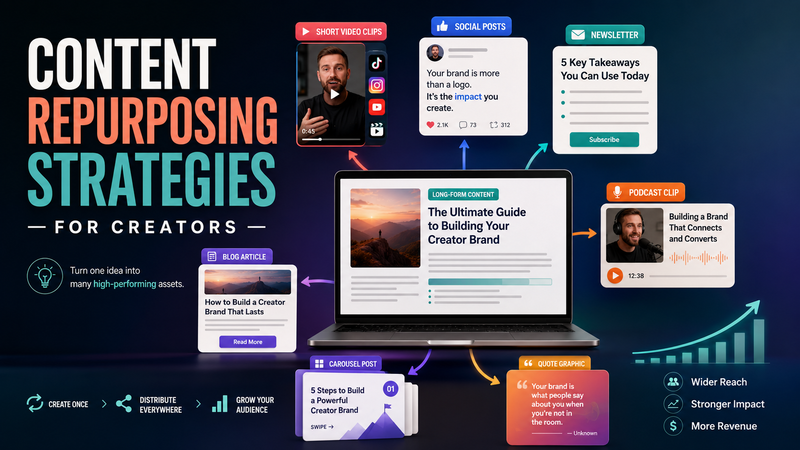

A creator’s archive is often more valuable than the next blank content calendar.
Inside old recordings, finished podcast episodes, forgotten livestreams, newsletters, interviews, and long-form videos, there are usually dozens of ideas that never received enough attention. Some were buried halfway through a conversation. Others appeared briefly in a video that only reached a small part of the audience. A few may have performed well at the time but were never developed further.
The usual response is to keep creating. Record another video. Write another post. Find another topic. Stay active and hope the volume eventually creates momentum.
That approach can work, but it can also turn content creation into an endless race. The creator remains busy, yet much of the strongest material already produced is left behind.
Content repurposing offers a more sustainable approach. It helps creators take one substantial idea and develop it into several useful pieces, each designed for a different format, audience habit, or stage of discovery. The goal is not to recycle the same post until people lose interest. The goal is to uncover more value inside the original work.
When done well, repurposing reduces pressure without reducing quality.
Repurposing works best when the idea comes first
The most effective Content Repurposing Strategies for Creators begin with a strong idea, not a list of platforms.
It is easy to start with the wrong question. A creator may ask, “How can I turn this into a Reel, a carousel, a LinkedIn post, and a newsletter?” before deciding whether the original idea is strong enough to deserve all those versions.
A better question is, “What is the most useful or memorable point inside this content?”
That point might be:
A lesson learned through experience
A clear answer to a recurring audience question
A mistake that changed the creator’s approach
A useful process
An unpopular opinion supported by experience
A story that reveals something important
A simple explanation of a difficult subject
A result that others would find relevant
Once the idea is clear, the creator can decide which formats will serve it best.
Some ideas need depth. They belong in a video, article, newsletter, or podcast. Others are sharper and work well as a short clip or social post. A visual process may suit a carousel. A personal lesson may be stronger in a written story. A practical checklist may work as a downloadable resource.
The format should follow the idea, not the other way around.
The original asset is a source, not a finished endpoint
A podcast episode, long-form video, livestream, article, or interview may feel complete when it is published. From a repurposing perspective, however, it is also a source document.
That source contains smaller pieces with different levels of value.
A creator discussing how they built a business, for example, may cover pricing, client communication, hiring, mistakes, burnout, and marketing in one conversation. The full episode gives the audience the complete story, but each subject can also become its own piece of content.
The pricing section could become a short clip. The hiring mistake could become a written post. The burnout discussion could become a newsletter. The client communication advice could become a carousel. A useful quote could become a graphic or the opening line of a future article.
The source provides the depth. Repurposed content gives individual ideas more opportunities to be discovered.
This is one reason long-form content remains valuable even in an era dominated by short clips. Long-form content creates the material from which short-form content can be selected. Without a substantial source, creators often end up producing isolated posts that lack depth or connection.
Review before you repurpose
The strongest repurposing usually begins with a proper review.
Creators often rely on memory and choose the parts they remember most clearly. That can work, but the most useful moment may not be the loudest or funniest one. Sometimes it is a short explanation, a sentence that captures the entire topic, or a practical example that quietly makes the lesson easier to understand.
During the review, creators can mark moments that fit a few useful categories:
Educational moments explain something clearly.
Story moments make the creator more relatable.
Opinion moments show a clear point of view.
Practical moments give the audience something they can use.
Emotional moments create connection.
Proof moments show a result, lesson, or change.
This makes the selection process more deliberate. It also creates a healthier mix of content. If every repurposed asset is a tutorial, the creator may appear useful but distant. If everything is personal, the content may feel relatable but lack direction. A balanced archive gives the audience several reasons to keep paying attention.
Short-form clips need their own structure
A strong moment from a long conversation does not automatically become a strong short video.
The original recording may include a slow introduction, references to earlier points, pauses, repetition, or language that only makes sense in context. A useful clip needs to be shaped into a standalone experience.
The viewer should understand the subject quickly. The main point should be easy to follow. The ending should feel intentional.
A good clip usually includes:
A clear opening that introduces the subject
One central idea
Enough context for a first-time viewer
Natural pacing
Captions that are easy to read
A useful, memorable, or entertaining conclusion
The edit can remove unnecessary words and pauses, but it should not remove the speaker’s personality. Overediting can make every creator sound the same. Constant zooms, loud effects, and oversized captions may suit some audiences, but they are not universal requirements.
The editing style should support the creator’s voice.
A calm educator may need clean captions and simple cuts. A comedian may benefit from faster timing. A business creator may need clear examples on screen. A storyteller may need enough room for the emotional point to land.
Written repurposing deserves more than a transcript
Spoken content is a strong source for articles, newsletters, posts, and carousels, but raw transcripts rarely make good reading.
People repeat themselves when they speak. They change direction. They leave sentences unfinished. They use filler words and explain ideas in the order they remember them rather than the order that is easiest to understand.
Written repurposing should improve the structure.
A spoken answer can become a strong article when the ideas are grouped under useful headings. A podcast story can become a social post when the setup is shortened and the main lesson is brought forward. A video tutorial can become a checklist. A livestream discussion can become a newsletter once the strongest example is added and the repeated points are removed.
Useful written formats include:
Blog articles
Newsletter editions
Detailed social posts
Threads
Carousels
Checklists
Frequently asked questions
Downloadable guides
Video scripts
Resource pages
The written version should feel complete in its own right. It should not read like a transcript with punctuation added.
One theme can support several distinct angles
Creators sometimes avoid repurposing because they worry that the audience will become tired of the topic. That usually happens when the same angle is repeated, not when the same theme is explored properly.
One subject can support several different questions.
A creator discussing productivity, for example, could cover:
The habit that wastes the most time
Why a popular productivity system failed
How to plan a realistic workday
The difference between being busy and making progress
A personal period of burnout
A simple weekly review process
Tools that help and tools that create more work
All of these pieces belong to the same broader theme, but they do not feel identical.
This approach helps creators build stronger topic ownership. The audience begins to recognize that the creator has depth in a particular area. Instead of posting disconnected ideas, the creator develops a body of work.
The theme creates consistency. The angle creates variety.
Adapt the content instead of duplicating it
Different platforms encourage different kinds of attention.
A person reading a newsletter may be willing to follow a longer explanation. Someone watching a short video needs the central point quickly. A blog reader may be looking for a complete answer. A social media user may respond better to a specific observation or personal story.
The same idea can work in all these places, but it should not appear in exactly the same form.
A long video about audience growth could become:
A short clip about one mistake
A carousel showing five practical steps
A written post sharing a personal lesson
A newsletter explaining the full strategy
A blog article answering a search-based question
A poll asking the audience about their current challenge
Each version gives the idea a different purpose.
Before publishing a repurposed asset, the creator should consider:
What does this audience expect here?
How much context is required?
What is the strongest opening for this format?
Should this version teach, entertain, start a discussion, or direct people elsewhere?
Does it add something that the other versions did not?
Small changes in framing can prevent repetition and improve performance.
Build a content library, not just a schedule
A schedule tells the creator what needs to be published next. A content library gives the creator options.
The library can include marked video clips, strong quotes, useful stories, audience questions, case studies, statistics, visual ideas, unfinished drafts, and topics that deserve further development.
Over time, this becomes one of the creator’s most valuable assets.
Instead of starting with an empty document every morning, the creator can search the library for a relevant idea. A clip may be ready to edit. A quote may inspire a post. A question from an older podcast may become a new video. A newsletter paragraph may become the foundation for a longer guide.
A simple library can be organized by:
Topic
Format
Audience problem
Content stage
Date recorded
Status
Performance
Future potential
It does not need complicated software. A spreadsheet, project board, database, or organized folder system can work. The important thing is being able to find useful material again.
A practical repurposing workflow
A repeatable process makes repurposing easier to maintain.
One workable system is:
Create the source asset around one clear theme.
Review the finished content and mark useful moments.
Sort the moments by category or topic.
Select the strongest ideas rather than every possible idea.
Match each idea to the most suitable format.
Edit or rewrite the asset so it works independently.
Adapt the opening, length, and framing for the platform.
Schedule similar pieces far enough apart.
Track which subjects and formats create the best response.
Use those insights to shape future source content.
This creates a loop. Long-form content produces smaller assets. The performance of those smaller assets reveals what the audience cares about. Those signals then guide the next podcast, article, livestream, or video.
Repurposing becomes part of the content strategy rather than a separate task added at the end.
Avoid turning every sentence into content
A system can become too efficient.
Once creators see how much material exists inside one recording, there can be a temptation to publish everything. Every sentence becomes a clip. Every quote becomes a graphic. Every explanation becomes a post.
That usually lowers quality.
The audience does not need every moment. It needs the best moments.
A useful repurposed asset should do at least one meaningful job. It should explain, entertain, challenge, inspire, clarify, prove, or connect. If the asset only fills a calendar slot, it is probably not strong enough.
Creators should also avoid making content artificially longer or more dramatic to increase the number of possible clips. The source should still feel natural. Repurposing should support the creative process, not distort it.
Measure the quality of the response
High views can be encouraging, but they are not always the clearest measure of value.
A smaller post may generate thoughtful comments, newsletter signups, profile visits, enquiries, or sales. A clip may lead people to the full episode. A carousel may earn saves because people plan to use it later.
Useful metrics include:
Watch time
Completion rate
Shares
Saves
Comments
Profile visits
Link clicks
Newsletter signups
Enquiries
Sales
Repeat performance around the same topic
These signals help creators identify which ideas deserve further development.
A strong short clip may become a full video. A popular newsletter may become a podcast episode. A frequently saved carousel may become a downloadable guide. A discussion in the comments may reveal the next audience question worth answering.
Final thoughts
A creator’s best next idea may already exist inside something they published months ago.
Content repurposing is not a shortcut for avoiding original work. It is a way of respecting the work that has already been done. It gives useful ideas more than one format, more than one audience entry point, and more than one opportunity to create value.
The source asset provides the depth. The repurposed versions make that depth easier to discover.
When creators learn to review, select, adapt, and organize their content properly, they no longer need to treat every platform like a separate creative burden. One strong idea can support several valuable pieces without making the audience feel like it is seeing the same post again.
That is the real advantage of repurposing. It creates consistency without constant reinvention.

Comments
No comments yet. Be the first to comment!