
What Is Content Clipping? Turning Long Videos Into Short-Form Reach
A practical guide to how brands turn podcasts, webinars, interviews, and videos into short clips that travel across social platforms.
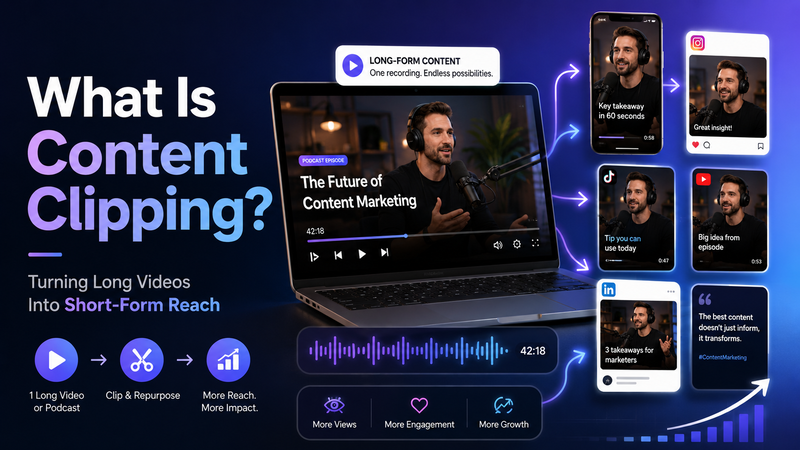

A one-hour webinar can feel like a finished asset once it has been recorded and uploaded. The slides are done, the replay link works, the email has gone out, and the team can finally move on. But inside that single recording, there may be ten smaller ideas that could reach far more people than the replay itself.
One section may explain a common customer problem. Another may contain a useful framework. A short answer near the end may be exactly what people are searching for. A founder comment may turn into the strongest social post of the week.
That is where content clipping comes in.
Content clipping takes long-form content and turns the best moments into short-form clips. These clips can then be shared across platforms like LinkedIn, Instagram Reels, TikTok, YouTube Shorts, Facebook, X, newsletters, and landing pages. Instead of treating one video as one piece of content, brands can turn it into several smaller assets that are easier to watch, easier to share, and easier to discover.
What is content clipping?
Content clipping is the process of taking longer video or audio content and turning it into shorter clips for distribution. The original content may be a podcast episode, webinar, founder interview, livestream, YouTube video, product demo, event recording, customer education session, or panel discussion.
The purpose is not to cut a long video into random pieces. That usually creates clips that feel unfinished or hard to follow.
Good content clipping is more selective. It finds moments that can stand on their own and turns them into short videos with a clear opening, one main idea, enough context, readable captions, and a useful takeaway.
For anyone asking What is Content Clipping, the short answer is this: it is a way to turn one long-form content asset into several short-form pieces that help the same ideas travel further.
The better answer is that content clipping is a distribution method. It helps useful content reach people who may never watch the full original recording.
Why content clipping is becoming more important
The way people discover content has changed. Someone may not begin by watching a full 50-minute podcast from a brand they do not know. They may not sit through a complete webinar replay. They may not read a full guide the first time they come across a topic.
But they might watch a 30-second clip if it gives them something useful quickly.
That clip can become the first touchpoint. It can introduce a problem, answer a question, show a useful opinion, or give people a reason to look deeper.
This is why content clipping works so well with long-form content. Long-form content gives depth. Short-form clips help that depth travel.
A full podcast can build trust. A short clip can help someone discover the episode. A webinar can explain a subject in detail. A short clip can introduce the best idea from that webinar to people who would never sign up for the replay.
The two formats work together.
What types of content can be clipped?
Almost any long-form content can be clipped if it contains useful moments. The source content does not need to be perfect. It does need substance.
Strong source material usually includes clear explanations, practical advice, opinions, stories, examples, questions, or natural conversation.
Brands can clip:
Podcast episodes
Webinars
Founder interviews
YouTube videos
Livestreams
Product demos
Event recordings
Customer education videos
Online courses
Training sessions
Panel discussions
Q&A sessions
Some of the best clips come from natural conversations. A founder explaining a market problem, a guest sharing a lesson, or an expert answering a common question can all become strong short-form content.
The key is to look for moments that make sense outside the full recording.
What makes a good content clip?
A good content clip should feel like a complete thought. It does not need to explain everything, but it should give the viewer enough to understand the point.
This is where weak clipping usually falls apart. A section gets pulled from a longer conversation because it sounds interesting to the team, but a new viewer has no context. The clip may be polished, captioned, and well-cut, but the idea still does not land.
A strong clip usually has:
A clear opening
One focused idea
Enough context to stand alone
Natural pacing
Captions that are easy to read
A clean visual format
A useful takeaway
A reason for the viewer to keep watching
The opening is especially important. People decide quickly whether to continue watching. If a clip starts with filler, vague context, or a sentence that depends on what came before, it usually loses people.
A weak opening might sound like:
“Yeah, exactly, and that connects to what we were saying earlier.”
That may work inside the full conversation, but it gives a cold viewer nothing useful.
A stronger opening gets closer to the idea:
“Long-form content does not fail because it is long. It fails when the best parts never get distributed.”
That gives the viewer a reason to care.
Content clipping is not just cutting videos shorter
There is a difference between making a video shorter and making a clip useful.
A random cut is just a piece of a longer video. A proper clip is a small content asset with a clear job. It might educate, introduce a topic, support a campaign, promote a podcast, build founder visibility, or drive attention toward a deeper resource.
That is why content clipping needs judgment. Someone has to choose the right moment, find the right starting point, remove unnecessary context, add captions, and prepare the clip for the platform where it will be posted.
Good clipping asks questions like:
Does this moment make sense without the full video?
Is the opening clear?
Is there one main idea?
Is the clip too slow?
Is the takeaway useful?
Which platform does this fit best?
What should the viewer understand after watching?
These questions matter because short-form content has very little room for confusion. If the clip takes too long to make sense, people move on.
How content clipping helps brands distribute content
A strong piece of content should not live in only one place. A podcast can support social posts. A webinar can support LinkedIn clips. A YouTube video can support Shorts, Reels, and email content. A founder interview can become a series of short posts around the same idea.
Content clipping makes this easier.
One long-form asset can become:
Several short video clips
Social media posts
Newsletter embeds
Podcast teasers
Founder-led LinkedIn content
Service page support
Educational clips
Campaign assets
This gives the original content more life. Instead of publishing once and hoping people find it, the brand creates several smaller entry points.
Some people may first discover a short clip. Others may later watch the full video. Some may visit the website. Some may simply remember the brand because they saw a useful idea more than once.
That repeated exposure is valuable.
How content clipping supports brand visibility
Brand visibility is built over time. One post rarely changes everything. Recognition usually comes from showing up repeatedly with useful ideas.
Content clipping helps create that consistency.
A company does not have to create something new from scratch every day. It can take one strong recording and turn it into multiple clips that support the same topic from different angles.
For example, one webinar could produce:
A clip explaining the main problem
A clip answering a common question
A clip sharing a practical framework
A clip with a strong founder opinion
A clip promoting the full replay
A clip pointing people toward a related guide
This makes the content feel more active and useful across different channels.
It also helps a brand become associated with a topic. When people keep seeing clips around the same problem or idea, they begin to connect that subject with the brand.
That is how content starts building memory.
Content clipping and SEO
Content clipping is usually treated as a social media tactic, but it can also support broader discovery.
People search for answers in many places now. They use Google, YouTube, TikTok, Instagram, Reddit, LinkedIn, and AI-assisted tools. They may want a full article, a short explanation, a video example, or a quick opinion. Different people prefer different formats.
That means content should not exist in only one form.
A written guide gives depth. A long video builds trust. A short clip introduces the idea quickly. Together, these formats create more ways for people to find the brand.
For example, a website guide can explain content clipping in detail. Short clips can answer related questions across social platforms. A full video can give deeper context. Each format supports the others.
The goal is not to choose between search and social. The goal is to build a content system where the same idea can be discovered in more than one place.
Common mistakes with content clipping
One common mistake is clipping moments that only make sense to the people who recorded the content. A team may know the context, but a new viewer does not. The clip has to work for someone seeing it for the first time.
Another mistake is focusing only on quantity. More clips do not always mean better results. A large batch of weak clips can create noise. A smaller batch of strong clips can do more if each one has a clear purpose.
Brands also make the mistake of posting every clip in the same way on every platform. A LinkedIn post may need a different caption than a TikTok video. A YouTube Short may need a stronger title. An Instagram Reel may need a clearer first frame.
Other common mistakes include:
Starting clips too slowly
Choosing clips with no clear takeaway
Using captions that are hard to read
Posting without consistency
Measuring only views
Ignoring saves, shares, comments, and watch time
Making every clip too promotional
Not connecting clips to a wider content plan
Most of these issues can be fixed with better selection and a repeatable workflow.
A simple content clipping workflow
A content clipping workflow does not need to be complicated. It just needs to be clear enough to repeat.
A practical workflow may look like this:
Choose one strong long-form asset
Review it for useful moments
Select clips based on audience and goal
Cut each clip around one clear idea
Remove unnecessary context
Add readable captions
Format the clip for the right platform
Write a relevant caption or title
Publish consistently
Track performance
Use the results to improve future clips
The goal is not to clip every possible moment. The goal is to clip the right moments.
Over time, the brand starts to learn which topics hold attention, which openings work best, and which platforms bring the strongest response.
Final thoughts
Content clipping is a practical way to make long-form content work harder. It turns podcasts, webinars, interviews, livestreams, YouTube videos, and other long-form assets into short clips that are easier to watch, share, and discover.
The real value is not more content for the sake of it. The real value is better distribution.
A useful idea should not stay buried inside a long recording that only a small number of people watch. Content clipping gives that idea more chances to be seen, understood, and remembered.
For brands that already create long-form content, this can be one of the simplest ways to improve visibility, support social growth, and build a stronger content presence without starting from zero every day.

Comments
No comments yet. Be the first to comment!