
A Podcast Clipping Agency Can Fix the Part Most Brands Ignore
The recording is rarely the weak point. The waste usually starts after the episode goes live.
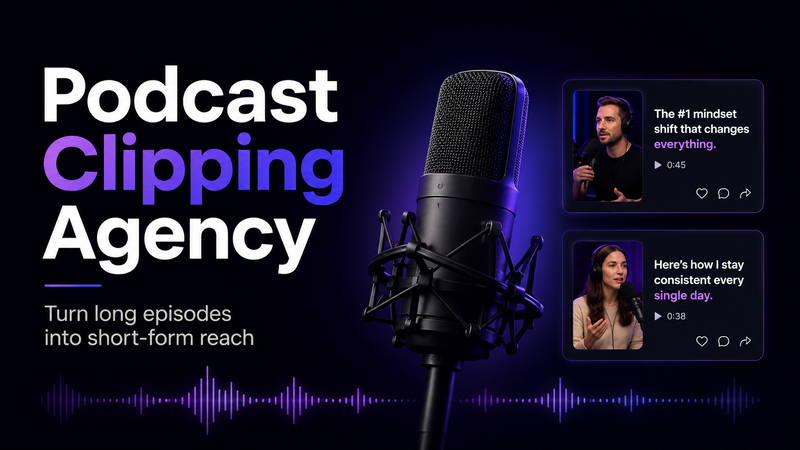

A lot of brands look at podcast performance the wrong way. They see a full episode get modest reach, assume the conversation did not land, and move on to the next one. In reality, the episode itself is often not the real problem. The guest may be strong, the host may ask smart questions, and the discussion may contain several moments that are genuinely useful, memorable, or commercially valuable. The issue is that those moments rarely travel very far on their own. They stay locked inside the full upload, which means only the most committed listeners ever hear them.
That is the gap a podcast clipping agency is built to close.
At its best, a podcast clipping agency helps creators, brands, and agencies get more value from conversations they have already recorded. Instead of treating one full episode as the final asset, it treats that episode as source material. A single long-form discussion can produce multiple clips, multiple entry points, and multiple chances to reach people who were never going to begin with the full version.
This is one reason podcasting feels more frustrating than it should for many teams. They are often doing the expensive part already. They are planning, recording, editing, coordinating guests, and publishing consistently. What they are not doing well enough is extracting the most useful moments after the episode is live. That weakens the return on the entire effort.
Most podcast content is underused
The simplest way to understand the value of clipping is this: most podcast episodes contain more usable content than the audience ever sees.
Inside one solid conversation, there might be a sharp opinion, a concise explanation, a lesson that can stand on its own, a personal story that adds credibility, and a short segment that would work perfectly as a feed-first clip. Yet none of that automatically becomes discoverable just because the full episode exists. Someone still has to go back, identify those moments, shape them properly, and publish them in a format people are actually likely to watch.
Without that step, a lot of value stays buried.
That is why a podcast clipping agency matters. It gives structure to the part of the workflow that many brands leave messy. It helps turn one long conversation into a system of smaller assets that can keep working long after the full upload has already started fading.
What a podcast clipping agency actually does
At first glance, the service sounds simple. A podcast clipping agency takes a long-form episode and cuts it into shorter clips. That is true, but it leaves out the part that actually determines whether the outcome is useful.
A weak clipping setup is mostly mechanical. Someone grabs a few timestamps, trims them, adds captions, exports the files, and moves on. The clips technically exist, but they often feel flat. The opening takes too long. The point is not clear enough. The clip depends too much on the surrounding context from the full episode. The captions are messy or distracting. The result is more output, but not necessarily more momentum.
A good podcast clipping agency works differently. It makes decisions, not just edits.
It reviews the episode with intent. It looks for moments with real pull. It asks which segment can stand on its own, which part needs tighter framing, and which idea has the best chance of working in a short-form environment. Then it reshapes that moment so it feels complete instead of chopped out. Slow setup is trimmed. Repetition is reduced. The pacing is tightened. Captions are added carefully. The end result is not just shorter content. It is more usable content.
A strong clipping workflow usually includes:
reviewing the full episode rather than skimming randomly
selecting moments with a clear point or emotional pull
trimming weak setup, filler, and repeated phrasing
shaping each clip around one main idea
adding captions that support readability
adapting the asset for the platform where it will appear
thinking about distribution, not only post-production
That final point matters more than people think. A folder full of clips is not a strategy. A real clipping system gives each clip a purpose.
Why podcast discovery works differently now
Long-form content still matters because it builds trust and gives people room to explain things properly. That is not going away. What has changed is the way people arrive.
Most people do not discover a new podcast by sitting down and choosing a one-hour episode from the start. They discover it through fragments. A quote in a feed. A short opinion. A clean explanation. A clip that gives them just enough value to pause and pay attention. The full episode usually becomes relevant only after that first moment has already done its job.
That shift changes the role of the podcast itself. The full episode remains important, but it is no longer the only asset that matters. In many cases, it is not even the first asset that matters.
That is why a podcast clipping agency has become more useful than it might have sounded a few years ago. It helps bridge the gap between long-form depth and short-form discovery. It gives the episode more than one way to perform.
The difference between clipping and lazy repurposing
A lot of brands say they are already repurposing content. Some are. Many are simply creating shorter versions of weak edits.
You have probably seen the pattern before. A random snippet gets posted because someone knew there should be “more short-form.” The clip starts too early, the speaker sounds like they are still warming up, the actual point arrives late, and the end feels abrupt because the editor cut by timestamp rather than by meaning. The content is technically shorter, but it is not more watchable.
Strong clipping feels different because it is intentional.
The clip gets moving earlier. It gives the viewer enough context without dragging. It focuses on one clear idea instead of trying to carry half the episode in 45 seconds. It feels like a standalone piece, not a leftover. That is where the real value sits.
ApproachWhat it usually looks likeLikely resultRandom repurposingFast timestamp cuts, weak openings, minimal shapingMore posts, limited tractionBasic editingCleaner visual treatment, but average selectionMixed performancePodcast clipping agencyStrong moment selection, tighter pacing, platform-aware framingBetter reach, stronger consistency
That difference is why a podcast clipping agency is not just an editing vendor. The real product is judgment.
Who benefits most from a podcast clipping agency
This service is useful for more than podcasters trying to grow a show. In reality, it helps anyone using long-form conversation as part of content strategy.
That can include creators publishing interviews, founders building authority through guest appearances, agencies handling client content, B2B brands producing webinars and expert discussions, consultants and coaches whose conversations contain teachable moments, and internal media teams trying to get more leverage from each recording.
The common thread is simple. If the long-form content already exists, there is usually more value inside it than the current system is extracting.
Why brands outsource it
On paper, clipping sounds easy enough to keep in-house. And sometimes it is, at least at the beginning. The trouble starts when the workflow needs to stay consistent.
Watching every episode properly takes time. Choosing the right moments takes instinct. Editing for short-form is a different skill from editing a full episode. Captions need care. Packaging needs consistency. Platform differences need to be understood. Once all of that becomes a recurring expectation, many internal setups start wobbling.
That is usually when brands realise they do not just need someone to edit faster. They need a better process.
Common reasons brands outsource clipping:
the internal team is already stretched
the quality is inconsistent from episode to episode
the clips feel too generic or too slow
the brand wants more from content it already paid to create
nobody owns the distribution side properly
The most important word here is leverage. A single episode should not get one chance to perform and then disappear into the archive. A podcast clipping agency helps that same episode create multiple chances to be seen.
What to look for before hiring one
The wrong question is usually the first one brands ask. “How many clips do we get each month?” sounds practical, but it tells you very little about whether those clips will actually work.
The better questions are harder and more useful.
Can they identify strong moments, not just obvious ones?
Do the clips feel natural or overworked?
Are the captions clean and readable?
Do they understand different platforms?
Can they show consistency across different episode types?
Are they thinking about performance or just output?
Cheap clipping can create a lot of files. That does not automatically create momentum.
Final thoughts
A podcast clipping agency is not a magic fix for weak conversations. If the guest says nothing memorable and the host never gets beneath the surface, there is only so much post-production can do. But when the source material is strong, clipping changes what that content can become.
It gives the episode a second life. It creates more doors into the same conversation. It makes sure useful moments do not stay trapped inside a full upload that most people were never going to finish in the first place. That is why more brands are starting to take this seriously. The issue is rarely that the conversation had no value. The issue is that the most valuable parts were never extracted properly.
The brands that get more from podcasting are usually not the ones recording more. They are the ones doing more with what they already recorded, and that is exactly the kind of shift Clipping Agency is built to support.
Comments
No comments yet. Be the first to comment!