
AI Clipping vs Human Clipping: Finding the Right Balance
A practical look at speed, judgment, context, and quality in short-form video editing
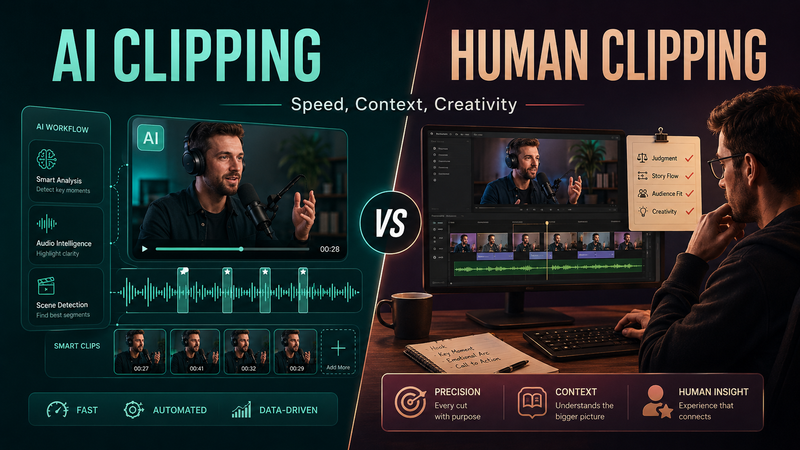

AI clipping tools have made short-form video production feel much easier. A creator can upload a podcast, webinar, livestream, YouTube video, or interview and get a batch of clips within minutes. The tool can detect possible highlights, add captions, resize the video, and create exports for platforms like TikTok, Instagram Reels, YouTube Shorts, and LinkedIn.
That speed is useful, especially for brands and creators who publish a lot of long-form content. Reviewing a full recording takes time. Finding the best moments takes even longer. Editing those moments into clean short-form clips takes another layer of work. When AI can handle some of that process, it is easy to understand why so many people are interested.
But clipping is not only a technical task. A good short-form clip is not just a smaller piece of a longer video. It needs to make sense on its own. It needs a clear opening, enough context, natural pacing, readable captions, and a reason for someone to keep watching. The clip also needs to fit the creator or brand behind it.
That is where human clipping still matters. Human editors bring judgment, taste, timing, context, and an understanding of the audience. They can see when a moment feels strong, when it needs more setup, when it should be cut tighter, and when it should not be used at all.
The real comparison between AI clipping and human clipping is not about which one sounds more modern. It is about which approach creates better content for the goal. Sometimes speed matters most. Sometimes quality matters more. In many cases, the best answer is a mix of both.
What AI clipping is good at
AI clipping is useful because it can remove a lot of repetitive work from the process. Instead of manually watching an entire recording from start to finish, a creator or brand can use AI to scan the content and suggest possible clips. That can save hours, especially when there is a lot of footage to review.
AI tools can often help with:
Finding possible highlights inside long videos
Detecting sections with strong speech or energy
Creating rough cuts
Generating captions
Reframing horizontal videos into vertical format
Sorting through long recordings faster
Producing draft clips for review
Helping teams manage a higher volume of content
This can be useful for podcasts, interviews, webinars, coaching calls, educational videos, founder recordings, and livestreams. If the source content is clear, structured, and easy to follow, AI may find several usable moments.
AI clipping works especially well as a first pass. It can give the team something to review instead of starting from a blank timeline. For creators who need a lot of clips quickly, this can be a helpful starting point.
The strongest advantage of AI is speed. It can move through content faster than a person and generate options quickly.
Where AI clipping can fall short
The problem is that speed does not guarantee quality. AI can find a section that looks like a highlight, but that does not mean the section will work as a short-form video. A clip can have good audio, movement, and captions, but still feel weak because it lacks context or does not make a clear point.
Short-form video depends heavily on viewer experience. A person scrolling through a feed may not know who the speaker is, what the original video was about, or what happened before the clip started. The clip has to stand on its own.
AI can struggle with:
Choosing the best starting point
Knowing when a clip needs more context
Understanding humour or emotional tone
Recognising whether an ending feels complete
Protecting the creator’s voice
Preserving brand tone
Avoiding clips that feel random
Knowing whether the audience will actually care
This is why some AI-generated clips feel almost right but not strong enough. They may be clean from a technical point of view, but the story is missing. The clip may begin after the important setup, or it may include too much setup before the useful part arrives. It may also select a moment that makes sense inside the full video but feels confusing when posted alone.
AI can help find possibilities. It does not always know which possibilities are worth publishing.
What human clipping adds
Human clipping takes more time, but it brings judgment. A skilled editor does not only look for sections that can be cut. They look for moments that should be turned into clips.
That difference matters because good short-form content depends on more than trimming. It depends on understanding what the viewer needs to hear first, what can be removed, what should stay, and what makes the clip feel complete.
Human editors can improve clips by:
Choosing stronger openings
Keeping the right amount of context
Removing slow or repetitive sections
Preserving the speaker’s natural tone
Shaping the clip around one clear idea
Making the pacing feel natural
Avoiding clips that feel generic
Protecting the brand or creator’s reputation
A human editor can also understand the purpose behind the clip. Is it meant to educate? Build trust? Show personality? Support a campaign? Drive people to the full video? Answer a common objection? These goals affect how the clip should be selected and edited.
Good human clipping is not just editing. It is content judgment.
Why context matters so much
Context is one of the biggest differences between AI clipping and human clipping. A short clip has to give the viewer enough information to understand what is happening, but not so much that the clip becomes slow.
This balance is difficult.
If a clip starts too early, it may feel boring. If it starts too late, it may feel confusing. If it includes too much background, people may scroll before the main point arrives. If it removes too much, the clip may lose meaning.
Human editors are often better at finding this balance because they can think like the viewer. They can ask whether someone who has never seen the full video would understand the clip.
A good clip should answer questions like:
What is being discussed?
Why should the viewer care?
What is the main idea?
Does the clip make sense without the full video?
Does the ending feel complete?
AI can identify speech patterns and possible highlights, but context requires judgment. That is where human review becomes valuable.
Why the best clips are not always obvious
Many people think the best clips are the loudest, funniest, or most energetic moments. Sometimes they are. But many strong clips are quieter and more specific.
A founder might explain a customer problem in one sentence. A podcast guest might share a short story that makes a complex topic easier to understand. A creator might make a small point that their audience immediately relates to. A brand expert might answer a common question in a simple and practical way.
These moments may not always stand out to an AI tool. They may not have dramatic energy or obvious keywords. But a human editor can recognise when a moment has meaning.
The best clips often create:
Clarity
Curiosity
Trust
Recognition
Practical value
Emotional connection
A reason to watch more
This is why human clipping can produce stronger content, even if it takes longer. It can find the moments that matter, not just the moments that look active.
AI clipping vs human clipping for creators
Creators often rely on personality, timing, humour, trust, and audience connection. These are not always easy for AI to understand.
AI clipping can help creators when they need:
Fast drafts
Basic captioned clips
Quick highlight suggestions
More output from long videos
A first pass through podcasts or livestreams
Simple clips for regular posting
Human clipping is usually better when creators need:
Stronger hooks
Better storytelling
Natural pacing
Brand deal quality
Personal voice preserved
Stronger audience connection
Clips that support long-term growth
For a creator posting casually, AI may be enough for some clips. For a creator building a serious personal brand, human editing usually makes the clips feel sharper and more intentional.
The difference is not only polish. It is whether the clip feels like something the creator would actually want representing them.
AI clipping vs human clipping for brands
Brands need to be even more careful because a weak clip can affect trust. If a clip makes the company sound unclear, generic, or too promotional, it may hurt more than it helps.
Brand clips often feature founders, executives, product experts, customers, or team members. These clips need to preserve credibility and tone. They also need to support a clear marketing goal.
AI can help brands with:
Reviewing long recordings
Finding possible clip moments
Creating draft clips
Generating captions
Speeding up the production workflow
Human clipping helps brands with:
Choosing moments that support the message
Protecting brand voice
Avoiding confusing edits
Improving pacing and structure
Making clips useful instead of promotional
Supporting campaigns and content strategy
Ensuring the final clip feels credible
A professional approach to AI Clipping vs Human Clipping is about understanding when automation saves time and when human judgment is needed to protect quality, context, and brand voice.
For brands, this balance is important. The goal is not just to create more clips. The goal is to create clips that make the brand easier to understand and trust.
The hybrid workflow often works best
The strongest approach is often not AI or human. It is both.
AI can help with the first pass. It can scan the content, create transcripts, suggest possible highlights, and generate rough clips. Then a human editor can review those suggestions and shape the final output.
A practical hybrid workflow might look like this:
AI scans the full recording
Possible clips are suggested
Captions are generated
A human editor reviews the best options
Weak clips are removed
Strong clips are improved
Openings and endings are adjusted
Captions are cleaned up
Clips are checked for tone and context
Final versions are prepared for publishing
This approach gives teams speed without giving up quality. AI handles some of the repetitive work. Humans make the final judgment.
For creators and brands with regular long-form content, this can be the most efficient system. It avoids the slowest parts of manual review while still keeping the quality control that short-form content needs.
What makes a clip worth publishing
Whether a clip is created by AI, a human editor, or both, it should pass a quality check before going live.
A strong clip should have:
One clear idea
A strong opening
Enough context for new viewers
Clean pacing
Captions that are easy to read
A natural ending
A tone that fits the creator or brand
A reason for the viewer to care
A purpose beyond filling the content calendar
This matters because more content is not always better. Posting weak clips can make a feed feel average. It can also reduce trust if the audience starts to expect low-value content.
Good clipping should create useful short-form assets, not just more files.
When AI clipping may be enough
AI clipping can be enough when the content is simple, the clips are low-risk, and the goal is speed. If the video is a clear talking-head recording and the speaker gives direct answers, AI may produce usable clips.
AI clipping can work for:
Simple educational videos
Quick rough drafts
Internal review
Basic captioned clips
Large content libraries
Testing content angles
Fast highlight extraction
Even then, a quick human review is still useful. AI can create a clip that looks finished, but that does not mean the clip is strong.
When human clipping is the better choice
Human clipping is better when the content needs strategy, taste, context, or careful handling. If the clip represents a brand, founder, expert, client, or sponsored campaign, human review becomes more important.
Human clipping is usually better for:
Founder-led content
Thought leadership
Brand campaigns
Customer stories
Sponsored creator content
Complex podcast conversations
Clips that need strong hooks
Content that must preserve personality
Short-form assets tied to growth goals
The more important the content is, the more human judgment matters.
Final thoughts
AI clipping has made short-form content faster to produce. That is useful. It can help creators, brands, and agencies process long videos, create rough drafts, and reduce repetitive editing work.
But speed is not the same as strategy. A good clip still needs context, timing, clarity, tone, and purpose. It needs to work for someone who may know nothing about the original video.
Human clipping remains valuable because it brings judgment, story sense, and audience understanding. It helps turn raw moments into clips that feel intentional and worth watching.
For many teams, the best answer is not AI or human. It is AI for speed and humans for quality. That balance creates short-form content that is faster to produce, but still clear, useful, and strong enough to publish.

Comments
No comments yet. Be the first to comment!