
Brand Clipping Campaign: How One Recording Becomes Repeat Visibility
A practical guide to turning podcasts, webinars, demos, interviews, and customer stories into short clips that build reach, trust, and recall.
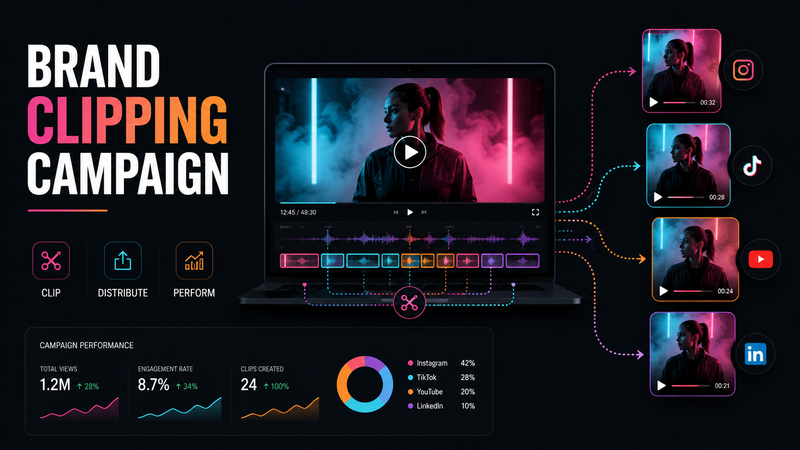

A 45-minute recording can contain more useful material than a brand uses in an entire week of posting. A founder might explain the problem better than a landing page. A customer might describe the value in a way that feels more believable than a case study. A webinar might answer objections that slow down sales calls. A product demo might show the exact moment where a prospect finally understands why the offer matters.
The problem is not that the content lacks value. The problem is that the best moments are usually hidden inside long recordings that most people will not watch in full.
A Brand Clipping Campaign is a planned way to turn long-form brand content into short clips that can be published across LinkedIn, TikTok, Instagram Reels, YouTube Shorts, email, website pages, and sales follow-ups.
The definition is simple. A brand clipping campaign takes one or more long recordings and turns the strongest moments into short, useful clips that support a clear business goal. That goal might be awareness, trust, lead generation, founder visibility, product education, sales enablement, or customer proof. It is not just cutting a video into smaller pieces. It is choosing the right moments, shaping them around one message, and distributing them with purpose.
Short Answer
A brand clipping campaign helps a business turn long-form content into a series of short clips that create repeat visibility. Instead of publishing a full podcast, webinar, interview, demo, or event replay once and moving on, the brand extracts the strongest moments and shares them as standalone clips.
The best campaigns are built around a clear message. A SaaS company may use clips to explain product value before a demo. A founder-led agency may use clips to build authority. A service business may use customer proof clips to create trust. A creator or media brand may use clips to bring new viewers back to the full episode.
The point is not to create as many clips as possible. The point is to create clips that help the audience understand the brand more clearly.
Why Brand Clipping Campaigns Work
People rarely trust a brand after one touchpoint. They usually need to see useful ideas, proof, explanations, and human presence several times before the brand feels familiar. Long-form content can support that, but only if people actually see the strongest parts.
A full webinar may contain ten useful moments, but most viewers will never search through the replay to find them. A podcast may include a strong founder insight, but it can disappear inside an hour-long episode. A customer interview may contain a quote that would help buyers trust the company, but it may never be seen beyond the original recording.
Short clips make those moments easier to discover. They give people smaller entry points into the brand. A viewer may not watch a 50-minute interview from a company they just found, but they may watch a 40-second clip that answers one relevant question.
Over time, those small moments build recall. The brand becomes associated with useful answers, clear thinking, and real proof.
Clipping Agency’s Angle: The Campaign Matters More Than the Clip Count
Clipping Agency’s view is that clipping should not be treated as a volume game. A brand does not win because it produced 40 clips from one recording. It wins when the clips make the brand easier to understand, easier to trust, and easier to remember.
That is why campaign thinking matters. Before editing begins, the brand should know what the audience needs to understand after seeing the clips for a few weeks. The answer might be:
This brand understands our problem.
This founder has a clear point of view.
This product solves a specific workflow issue.
This team has proof, not just claims.
This company explains things in a way that makes sense.
This service is built around a process, not guesswork.
Once the message is clear, clip selection becomes sharper. The team is not looking for random moments. It is looking for moments that support the campaign.
Step-by-Step Process
Step 1: Choose the Right Source Content
A brand clipping campaign begins with source material. The strongest source content is not always the most polished. It is usually the content that contains real explanations, customer proof, founder thinking, or answers to questions buyers already care about.
Useful source content can include:
Founder interviews
Podcasts
Webinars
Product demos
Customer testimonials
Event talks
Workshops
Livestreams
Sales explainers
Training sessions
Behind-the-scenes footage
A good recording does not need to produce dozens of clips. Sometimes six strong clips are more valuable than twenty average ones. The goal is to find moments that can stand alone and still make sense to someone who has never seen the full recording.
Step 2: Define the Campaign Message
Before cutting clips, the brand needs a clear campaign message. Without this, the content can feel scattered even if the editing looks polished.
A campaign message may focus on:
A customer problem the brand solves
A founder’s point of view
A common mistake in the market
A product category the audience misunderstands
A customer result
A repeated sales objection
A new service page
A process the brand wants to explain
For example, a brand might build a campaign around the idea that long-form content should not stop after one upload. Every clip can then support that idea from a different angle, such as wasted webinar value, missed founder insights, customer proof, sales support, and multi-platform reach.
Step 3: Select Moments That Work Alone
Clip selection is where many campaigns succeed or fail. A moment that sounds useful inside a full conversation may not work once it is removed from context. A good clip needs to feel complete.
A strong clip usually has:
One clear idea
A strong opening line
Enough context for a new viewer
Natural delivery
Clean audio
A useful takeaway
A reason for someone to save, share, comment, or click
The viewer should not feel like they joined halfway through a conversation. The clip should give them a complete thought, even if it also makes them curious about the full recording.
Step 4: Edit for the Platform
A clip should fit the place where it will be published. LinkedIn may need a cleaner business angle. TikTok may need a faster opening. YouTube Shorts may need a sharper topic. Instagram Reels may need stronger visual rhythm. A sales follow-up clip may need less styling and more direct explanation.
Good editing considers:
Clip length
Caption readability
Opening hook
Platform format
Speaker pacing
Brand style
Visual clarity
Call to action
Reuse across channels
The edit should support the message. It should not make a serious brand feel forced or distract from the idea being shared.
Step 5: Build the Publishing Sequence
A brand clipping campaign should not be posted randomly. The clips should be organised in a way that builds understanding over time.
A simple campaign might look like this:
Week 1: Problem awareness clips
Week 2: Founder point of view clips
Week 3: Customer proof clips
Week 4: Process and objection-handling clips
This structure gives the audience different ways to understand the brand. It also helps the team stay consistent without repeating the same point every day.
Step 6: Review and Reuse the Strongest Clips
A campaign should not be judged only by views. A clip with fewer views may still be valuable if the right people watched it, saved it, replied to it, clicked through, or mentioned it during a sales conversation.
Useful signals include:
Watch time
Retention
Comments
Saves
Shares
Profile visits
Website clicks
Demo requests
Sales team usage
Lead quality
The strongest clips can also be reused. A winning clip can become a paid social test, newsletter embed, landing page video, sales follow-up asset, or prompt for a new article.
Specific Examples
A SaaS company records a product webinar. The campaign turns the best moments into clips about workflow pain, onboarding mistakes, product use cases, and common objections. These clips support LinkedIn posts, YouTube Shorts, email nurture, and demo follow-ups.
A founder-led agency records a podcast. The strongest sections become clips about client expectations, content strategy, pricing mistakes, and campaign thinking. The clips help prospects understand how the agency thinks before they enquire.
A coaching business records a live workshop. The clips answer common questions, show the teaching style, and give potential customers small useful takeaways before they consider joining a paid programme.
A B2B service company records customer interviews. The clips focus on trust, decision-making, implementation, and results. These can be used on social platforms, website pages, email sequences, and sales follow-ups.
A media brand records long-form interviews every week. A clipping campaign turns each episode into short clips that keep the audience engaged between full releases and bring new viewers back to the original show.
Pros and Cons
Pros
Long-form content gets more value after the first upload.
The brand can publish consistently without filming every day.
Clips create more entry points for new audiences.
Founder insights, customer stories, and product explanations become easier to share.
Sales teams can use clips to answer questions and build trust.
The brand builds recall through repeated useful touchpoints.
Winning clips can be reused across organic, paid, email, and website channels.
Cons
Weak source material can limit the campaign.
Poor clip selection can make the content feel random.
Heavy editing can hurt credibility for serious brands.
Results often build over time rather than from one clip.
Posting clips without a message can create noise.
Cheap editing-only workflows may miss the strategic value.
The best results come when the campaign is built around both content quality and distribution strategy.
Common Mistakes
Brands often weaken clipping campaigns by thinking only about output. More clips do not automatically mean better results. A campaign needs clarity, repetition, and a reason for the audience to care.
Common mistakes include:
Cutting clips with no campaign message
Choosing moments that need too much missing context
Making every clip sound like a sales pitch
Copying creator-style edits that do not fit the brand
Using captions that are hard to read
Posting the same version on every platform
Ignoring watch time and retention
Measuring only views
Stopping after a few posts
Failing to connect clips to sales or website goals
A useful campaign should help the audience understand something about the brand. It should not exist only because the content calendar needs more posts.
Real Business Use Cases
For awareness, a brand clipping campaign can introduce the business to people who have never heard of it. Short clips are easier to discover than full recordings, especially when the topic is specific and useful.
For trust, clips can show how the team thinks. A founder explanation, customer story, or expert answer gives the audience a clearer sense of the people behind the business.
For lead generation, clips can point viewers toward a webinar, newsletter, demo, consultation, or service page. The call to action should be clear, but it should not interrupt the value of the clip.
For sales support, clips can answer objections about pricing, timelines, onboarding, process, delivery, and expected results. A short video often explains these points more naturally than a long email.
For brand recall, repeated clips help buyers remember the company before they are ready to enquire. This is one of the biggest advantages of clipping. It gives the brand more chances to be seen with useful ideas.
FAQs
What is a brand clipping campaign?
A brand clipping campaign is a planned series of short clips created from long-form brand content. It turns podcasts, webinars, interviews, demos, customer stories, or event recordings into short videos that support visibility, trust, lead generation, and sales.
How is a brand clipping campaign different from normal video editing?
Normal video editing focuses on creating a finished video. A brand clipping campaign focuses on selecting the strongest moments and distributing them as short clips around a specific message or business goal.
What content works best for clipping?
The best source content usually includes founder insights, customer proof, product education, real examples, buyer questions, common objections, or strong opinions. Webinars, podcasts, interviews, demos, and customer stories often work well.
How many clips can one recording create?
It depends on the quality of the recording. A strong 45-minute webinar may create 8 to 15 useful clips. A weaker recording may only create 3 to 5. Quality matters more than the total number of clips.
Can brand clipping campaigns help B2B companies?
Yes. B2B companies can use clipping campaigns to explain complex ideas, answer buyer questions, show customer proof, build founder authority, and support sales conversations.
Where should brands publish clipped videos?
Common channels include LinkedIn, TikTok, Instagram Reels, YouTube Shorts, email newsletters, landing pages, paid social campaigns, and sales follow-ups. The right mix depends on the audience and campaign goal.
What makes a clip perform well?
A strong clip has one focused idea, a clear opening, enough context, readable captions, clean pacing, and a useful takeaway. It should make sense even if the viewer has not watched the full recording.
Final Thoughts
A brand clipping campaign should not simply create more short videos. It should help the brand turn useful thinking into repeat attention.
When the campaign is planned properly, one recording can become several useful touchpoints. A founder insight can build authority. A customer story can build trust. A product explanation can support sales. A webinar answer can create demand. Each clip gives the audience another chance to understand the brand.
If your team already records podcasts, webinars, demos, interviews, or customer stories, the next step may not be more filming. It may be turning the strongest parts of what you already have into clips that travel further.
Clipping Agency can help brands turn long-form content into a repeatable clipping system built around visibility, trust, and business outcomes.

Comments
No comments yet. Be the first to comment!