
Clipping Agencies Explained: How Long Videos Become Short-Form Reach
A practical guide to what clipping agencies do, why creators and brands use them, and how short clips help long-form content travel further.
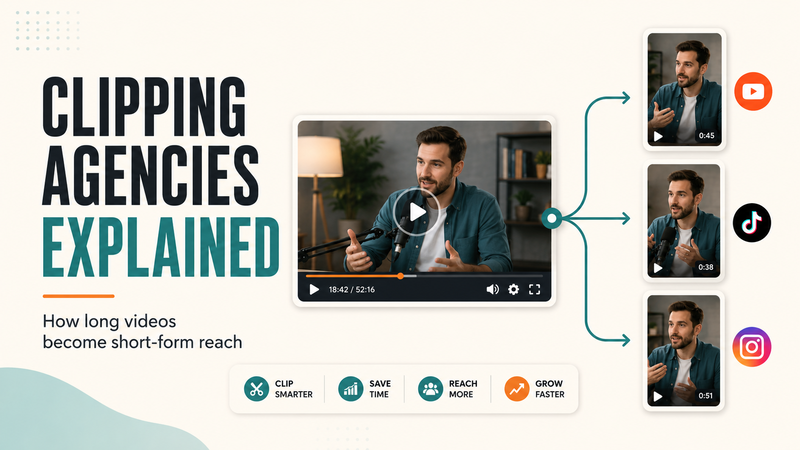

Most creators and brands already have more content than they think. It sits inside podcast episodes, webinars, interviews, livestreams, YouTube videos, online events, and long conversations that were useful when they were recorded, but never really got the reach they deserved.
That is not always because the content is weak. Sometimes the best parts are simply buried too deep.
A founder may explain a sharp idea 28 minutes into an interview. A podcast guest may share the most useful answer near the end of the episode. A webinar may have one clear explanation that would work perfectly as a short clip, but very few people will ever sit through the entire replay to find it.
This is where clipping agencies come in.
If you have ever wondered What is Clipping Agency, the simple answer is this: it is a service that turns long-form videos into short, engaging clips for social media. The better answer is that a clipping agency helps creators, founders, podcasts, and brands get more value from the content they already make.
A good clipping agency does not just cut video. It finds the moments that are actually worth watching, shapes them for short-form platforms, and helps the content reach people who would never have clicked on the full video first.
What a Clipping Agency Does
A clipping agency takes long-form video content and turns it into shorter clips for platforms like TikTok, Instagram Reels, YouTube Shorts, LinkedIn, Facebook, and X.
The source content can be almost anything long-form, including:
Podcast episodes
YouTube videos
Webinars
Founder interviews
Customer interviews
Livestreams
Online events
Educational videos
Coaching calls
Panel discussions
The agency reviews the full video, finds strong moments, edits those moments into short clips, adds captions when needed, and prepares the clips for social platforms.
At a basic level, this looks like video editing.
At a better level, it is content extraction.
That difference matters. A normal editor can cut a video into smaller pieces. A clipping agency should understand which parts are actually worth turning into standalone clips.
A useful clip is not just short. It has a point. It gives the viewer enough context. It feels clear without needing the full video. It also matches the tone of the creator or brand behind it.
That is why clipping is more than trimming footage. It is about turning one long piece of content into several smaller pieces that can actually travel.
Why Creators and Brands Use Clipping Agencies
Creators and brands use clipping agencies because long-form content takes a lot of effort to create, but it often gets used only once.
A podcast gets published. A webinar goes live. A founder interview is uploaded. A YouTube video is shared. Then everyone moves on to the next thing.
That is a waste.
Long-form content usually contains smaller moments that can work well on their own. The issue is that someone has to find them, edit them, caption them, format them, and prepare them for posting. That work takes time, and for many creators, it quickly becomes a bottleneck.
A clipping agency helps solve that problem.
The main benefits include:
Saving time on editing and clip selection
Turning one long video into several useful assets
Helping creators post more consistently
Giving long-form content a longer shelf life
Making content easier to discover on social platforms
Pulling out the strongest moments before they are forgotten
Helping brands stay visible without recording new content every day
For creators, this can mean more reach without spending every afternoon inside editing software.
For brands, it can mean more value from webinars, interviews, podcasts, and thought leadership content they already paid to produce.
In both cases, clipping helps content work harder.
The Clipping Process: How It Usually Works
A clipping agency usually follows a simple process, though the quality can vary a lot depending on the team.
The first step is reviewing the original video. This is where the agency watches or scans the content to understand the topic, the speaker, and the strongest sections. Good agencies do not just look for loud moments. They look for useful, clear, interesting, or emotionally strong moments.
The second step is selecting clips. This is probably the most important part of the process. Not every section of a long video deserves to become a short clip. Some moments need too much context. Some are too slow. Some are fine in the full conversation but weak on their own.
Strong clips usually include:
A direct answer to a question
A practical lesson
A mistake the audience can learn from
A short story with a clear point
A strong opinion
A useful explanation
A funny or relatable moment
A teaser that makes the full video more interesting
The third step is editing. The agency cuts the selected moments, removes unnecessary pauses, tightens the pacing, adds captions, and formats the clip for the platform.
The fourth step is platform adaptation. A clip for TikTok may need a faster opening. A LinkedIn clip may need a more thoughtful caption. A YouTube Short may need tighter pacing. An Instagram Reel may need a stronger first frame.
The final step is delivery. Some agencies only deliver the clips. Better agencies may also include posting notes, clip titles, caption suggestions, or labels that explain what each clip is meant to do.
What Makes a Good Clipping Agency
A good clipping agency is not defined by how many clips it can create from one video. It is defined by how well it understands what should become a clip in the first place.
This is where many agencies get it wrong. They promise volume, but volume does not always help. Thirty weak clips from one podcast can make a creator’s feed feel worse, not better.
A good clipping agency should be able to explain why a moment was chosen.
It should understand:
The creator’s voice
The audience
The platform
The topic
The purpose of the clip
The amount of context needed
The difference between a highlight and a useful standalone post
The agency should also know when not to clip something.
That sounds simple, but it matters. Some moments are better left inside the full video. Some ideas need more explanation. Some clips feel interesting only because of what happened earlier in the conversation.
A strong agency protects the quality of the feed. It does not treat every sentence as content.
Common Misconceptions About Clipping Agencies
One common misconception is that clipping agencies only cut videos into smaller pieces. That is the most basic version of the service, but it is not the full value.
The real value is in selecting the right moments and shaping them so they make sense outside the original video.
Another misconception is that clipping is only useful for big creators. Smaller creators can benefit too, especially if they already record podcasts, YouTube videos, or long-form educational content.
There is also the idea that clipping is only for viral content. That is not true. Clips can support many goals beyond views, including trust, awareness, education, lead generation, and community building.
Some people also think more clips always means better value. Again, not always. Ten strong clips are usually better than thirty average ones.
A good clipping agency knows the difference between filling a content calendar and improving a content system.
Those are not the same thing.
Real-World Examples of Clipping in Action
A podcast host may record a 60-minute episode and use a clipping agency to pull out six strong moments. One clip might be a guest’s practical answer to a common question. Another might be a short story. Another might be a strong opinion that starts a conversation on LinkedIn or X.
A founder-led brand may record interviews or internal thought leadership videos. A clipping agency can turn those into short clips that show the founder’s point of view, explain the company’s thinking, or make the brand feel more human.
A webinar team may host a 45-minute session but only a small percentage of registrants watch the full replay. Clipping can turn the best sections into social posts, giving the webinar a second life.
A YouTube creator may publish one long video per week. A clipping agency can help turn that video into Shorts, Reels, and TikToks that bring new viewers back to the original channel.
In each case, the goal is not to replace the long-form content.
The goal is to create more doors into it.
Best Practices for Working With a Clipping Agency
Creators and brands usually get better results when they give the agency a little direction at the start.
That does not mean micromanaging every cut. It means helping the agency understand what matters.
Useful guidance can include:
Who the audience is
Which platforms matter most
What topics should be prioritized
What tone should be protected
Which examples of clips you like
Which styles you want to avoid
Whether the goal is reach, trust, leads, or community
Any brand or caption preferences
It also helps to review the first batch carefully. The first batch teaches the agency what works and what does not. After that, the process should become smoother.
A good agency should improve over time. It should learn which topics get better responses, which openings feel natural, which formats fit the creator, and which clips bring the right kind of attention.
That is when clipping stops being a one-off editing task and becomes a repeatable content system.
Final Thoughts
A clipping agency helps turn long-form videos into short-form clips for social media. That is the simple definition.
The deeper value is that it helps creators and brands get more reach from the content they already make.
Good clipping is not random cutting. It is selection, editing, pacing, context, platform fit, and respect for the original voice.
The best agencies do not simply create more clips. They help good ideas travel further.
For creators, that can mean more consistency without constantly recording from scratch. For brands, it can mean better use of webinars, podcasts, interviews, and thought leadership content.
Long videos still matter. They build depth, trust, and authority.
Short clips help more people find them.
Comments
No comments yet. Be the first to comment!