What Creators Should Know Before Hiring a Clipping Agency
A practical guide to choosing a clipping agency that understands your voice, finds better moments, and helps long videos become consistent short-form content.
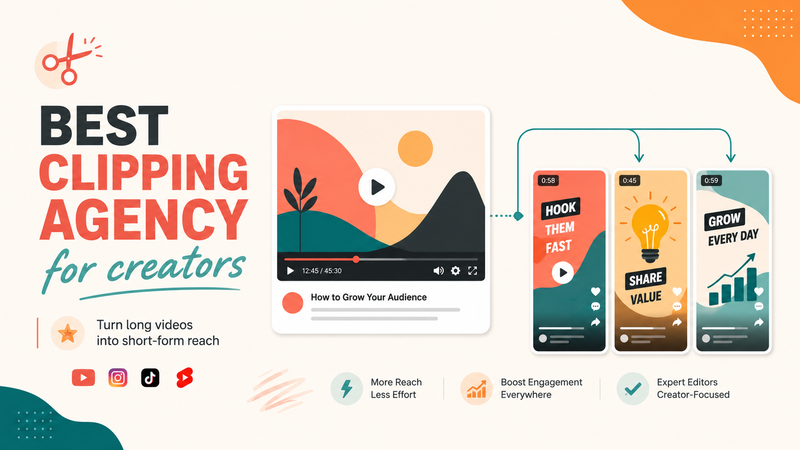

Most creators do not wake up thinking, “Great, I would love to spend the next three hours digging through my own podcast for clips.” The actual creative work is usually the fun part. Recording the episode, talking through an idea, interviewing a guest, going live, or filming a long YouTube video is where the energy goes. The hard part often starts later, when all that content has to be turned into short clips that people will actually watch.
That is the point where many creators slow down. They know there are good moments inside the full video, but finding them takes time. A sharp answer may be buried halfway through the recording. A funny line may happen during a side conversation. A useful lesson may appear after the creator has warmed up and stopped trying to sound too polished. The content is there, but it needs to be pulled out carefully.
This is why clipping agencies have become useful for creators. A good clipping agency helps turn long videos into short-form clips for TikTok, Instagram Reels, YouTube Shorts, LinkedIn, Facebook, and other platforms. It can save time, but the bigger value is judgment. The right agency knows what to clip, what to skip, how much context to keep, and how to make the creator’s content feel natural in a short-form feed.
Choosing the Best Clipping Agency for Creators is not about finding the team that promises the most clips. It is about finding the team that understands what makes your content worth watching in the first place.
The Best Agency Starts by Understanding the Creator
Before a clipping agency touches the timeline, it should understand the creator’s voice. This is where a lot of clipping work goes wrong. The agency may be able to cut video, add captions, and export files, but if it does not understand why people follow the creator, the clips can start to feel generic.
Some creators are followed because they explain difficult ideas clearly. Some are followed because they are funny. Some are followed because they are honest. Some are calm and thoughtful. Some are intense and energetic. Some build trust because they speak like a normal person rather than a polished brand account.
That style needs to survive the edit.
A weak agency can make every creator look the same. Same captions, same zooms, same opening style, same dramatic hook, same “you need to hear this” energy on every post. At first, it may look active. After a while, it starts to feel like the creator has been pushed through a template.
That is not what creators need.
A better clipping partner sharpens the content without replacing the personality. If the creator teaches calmly, the clips should not suddenly feel loud and fake. If the creator is naturally funny, the edit should not remove every pause and reaction. If the creator is trusted for practical advice, the clips should not become empty hype.
The goal is not to turn the creator into a trend. The goal is to make the creator’s strongest moments easier to watch and share.
Good Clip Selection Matters More Than Fancy Editing
The first thing to judge in a clipping agency is not the caption colour, the font, or how many effects appear in the sample clips. The first thing to judge is whether the agency can choose the right moments.
A long video may have many usable sections, but not every usable section should become a clip. Some moments are clear but not interesting. Some need too much background. Some make sense inside the full conversation but feel weak on their own. Some may be good for loyal followers but confusing for new viewers.
A serious clipping agency knows how to find moments that can stand alone.
Strong clip moments often include:
A direct answer to a common question
A useful lesson from experience
A mistake the audience can learn from
A short story with a point
A clear opinion
A simple explanation
A funny or relatable moment
A teaser that makes the full video more interesting
The clip should make sense to someone who has never seen the creator before. That is a useful test. If the viewer needs five minutes of background to understand the clip, it probably needs a better cut. In some cases, it may not be the right moment to use.
Good clipping is not just about cutting. It is about choosing.
More Clips Can Sometimes Mean Worse Content
Creators are often tempted by big numbers. Twenty clips from one podcast sounds better than eight. Thirty clips from a single long video sounds like a month of content solved in one go. It feels efficient, and sometimes it can be.
But more clips do not always mean better value.
A 60-minute podcast may have eight strong moments. That is fine. Eight strong clips are better than twenty weak clips that feel forced. A long video does not automatically become good short-form content just because it can be chopped into smaller pieces.
The better question is not, “How many clips can we get from this?”
The better question is, “How many strong clips are actually inside this?”
That question matters because weak clips are not harmless. They train people to ignore the next post. If followers keep seeing average clips, they may start assuming the creator’s content is average too. That is especially frustrating when the original long-form content is actually strong.
A good clipping agency should protect the creator’s feed. It should not just fill the calendar for the sake of volume.
Sometimes the honest answer is, “This video has six good clips.” That is more useful than forcing a package to look bigger than it really is.
A Clip Needs Context Without Becoming Slow
Short-form editing has a strange balance. A clip needs enough context to make sense, but not so much that the viewer leaves before the point arrives.
Cut too close to the best line and the clip feels random. The viewer hears a strong sentence but does not know what the creator is talking about. It feels like walking into a conversation halfway through and nodding anyway.
Keep too much setup and the clip becomes slow. The speaker takes too long to get to the useful part, and the viewer scrolls away.
A good clipping agency knows how to balance the two.
Sometimes one setup sentence is enough. Sometimes the clip should start with the question before the answer. Sometimes an on-screen title can provide the missing context. Sometimes the first half of an answer can be removed because the creator only becomes clear in the second half.
There is no single rule that works for every creator or every clip. That is why judgment matters.
The clip should feel complete without feeling slow.
Captions Should Support the Clip
Captions matter. Many people watch without sound, and captions help with clarity. They can also make a clip feel cleaner and easier to follow.
But captions are not the whole strategy.
A weak clip with captions is still weak. A boring answer with colourful subtitles is still boring. A vague point with animated text is still vague. It just looks like it is trying harder.
Good captions should be easy to read. They should match the creator’s style. They should not cover the speaker’s face, fight with the video, or turn every sentence into a flashing announcement.
Some creators need bold captions because their content is fast and energetic. Some need clean subtitles because their content is more serious or educational. Some need a very simple style because the idea matters more than the edit.
A good clipping agency will not force one caption style on everyone. It will match the edit to the creator, the audience, and the platform.
Platform Fit Should Not Be Ignored
A creator may want to post clips on TikTok, Instagram Reels, YouTube Shorts, LinkedIn, and Facebook, but the same exact clip may not work equally well everywhere.
The core moment can stay the same. The packaging may need to change.
TikTok often needs the point to arrive quickly. Instagram Reels may need a stronger first frame. YouTube Shorts may need tighter pacing. LinkedIn may need a more thoughtful written setup. Facebook may need a little more context in the caption.
This does not mean every clip needs five totally different edits. Small changes can be enough.
Useful adjustments might include:
A stronger first sentence for TikTok
A cleaner crop for Reels
A tighter version for Shorts
A more thoughtful caption for LinkedIn
A slightly longer setup for Facebook
A different first frame for visual appeal
These details matter because audiences behave differently on different platforms.
Posting the exact same version everywhere can work sometimes, but if every post feels copied and pasted, the content starts to lose its shape. The right agency knows how to adjust without making the process complicated.
The Agency Should Make Publishing Easier
A clipping agency should reduce work for the creator, not create a new pile of decisions.
Some agencies deliver a folder full of clips and stop there. No notes, no titles, no caption ideas, no suggested posting order, no platform guidance. The creator then has to open every file, remember what each clip is about, and figure out where it should go.
That is only half useful.
A better workflow makes publishing easier. The agency may label clips clearly, add short caption ideas, suggest hooks, include platform notes, or group clips by purpose.
For example:
Educational clip
Story clip
Opinion clip
Teaser clip
Proof clip
Founder clip
This does not need to be fancy. It just needs to save time.
Creators are already busy. If the agency delivers clips in a way that still requires an hour of sorting, the process is not as helpful as it could be.
A Strong Agency Learns Over Time
The first batch of clips is rarely perfect. That is normal.
A creator’s voice takes time to understand. The audience’s preferences take time to read. Some clips that look strong may underperform. Some simple moments may do surprisingly well. Sometimes the most casual line in a video gets the best response because it feels real.
A good clipping agency pays attention to that.
It should learn from saves, comments, shares, profile visits, clicks, and watch time. It should notice which topics work. It should understand which openings feel natural. It should improve the selection process over time.
That is why clipping works best as an ongoing system, not a one-off editing task.
The more the agency understands the creator, the better the clips should become. At that point, the agency is not just a vendor. It becomes a content partner.
Questions to Ask Before Hiring
Before hiring a clipping agency, creators should ask a few simple questions. The goal is not to make the conversation awkward. It is to avoid wasting time and money on a team that only understands the editing tool, not the content.
Ask how they choose clips.
If they cannot explain their selection process, that is a warning sign.
Ask whether they watch the full video.
Timestamps can help, but they should not replace judgment.
Ask if they adapt clips for different platforms.
If every platform gets the exact same file, the approach may be too basic.
Ask how they handle the creator’s style.
The clips should feel like the creator, not like a template.
Ask how many clips they usually recommend from one long video.
If the answer is always a high number, regardless of the source content, be careful.
Ask whether they provide captions, titles, posting notes, or hooks.
Even light support here can make publishing easier.
Ask how they measure what is working.
Views matter, but they are not everything. Saves, shares, comments, profile visits, and clicks can matter too.
These questions help reveal whether the agency thinks beyond the export button.
Red Flags to Watch For
Some clipping agencies look good at first but are not the right fit.
Be careful if every sample looks the same. Be careful if the agency talks only about quantity. Be careful if they do not ask about your audience. Be careful if they cannot explain why they chose a clip. Be careful if they rely too much on loud effects. Be careful if they promise results before understanding your content.
Also be careful if the clips look polished but feel empty.
That is more common than people admit.
A clipping agency does not need to be perfect, but it should be thoughtful. If the agency treats every creator the same, the clips will probably feel generic.
And generic content is easy to scroll past.
What the Best Clipping Agency for Creators Actually Does
The best clipping agency for creators does a few things well.
It protects the creator’s voice. It finds strong moments. It keeps enough context. It edits cleanly. It adapts clips for platforms. It makes publishing easier. It learns from performance. It knows when not to clip.
That is the real value.
Not just shorter videos.
A better system for using long-form content.
Creators already put time and energy into podcasts, YouTube videos, interviews, and livestreams. A clipping agency helps make sure those videos do not disappear after one upload. It gives the best moments more chances to be seen.
Why Clipping Helps Creators Grow
Clipping works because it turns one long video into several entry points.
A viewer may not watch a full podcast from a creator they just discovered, but they might watch a 40-second clip. If that clip is useful, they might watch another. Then they might check the profile. Then they might subscribe.
That is how discovery often works. Not in a straight line, usually. More like small touches over time.
A clip here. Another clip later. A useful moment remembered when the topic comes up again.
Clipping helps creators show up more often without constantly creating from scratch.
That consistency matters because people rarely become loyal after one post. They need to see enough useful content to trust the creator’s voice.
A strong clipping system helps build that familiarity.
Final Thoughts
Choosing the best clipping agency for creators is not about finding the team that promises the most clips.
It is about finding the team that understands what makes a clip worth watching.
The right agency should understand the creator’s voice, choose strong moments, keep enough context, edit cleanly, adapt for platforms, and help with consistent publishing.
Creators do not need more random content. They need better use of the content they already make.
A good clipping agency helps with that. It turns long videos into short-form clips that can reach new viewers, build trust, and keep the creator visible without making them record every single day.
The simple version is that a clipping agency cuts long videos into short clips.
The better version is that a good clipping agency helps creators turn their strongest ideas into moments people actually notice.
Comments
No comments yet. Be the first to comment!