
Clipping Campaigns: How One Video Becomes a Full Content Engine
A practical guide to using clipping campaigns to turn podcasts, interviews, webinars, and long-form videos into steady short-form reach.
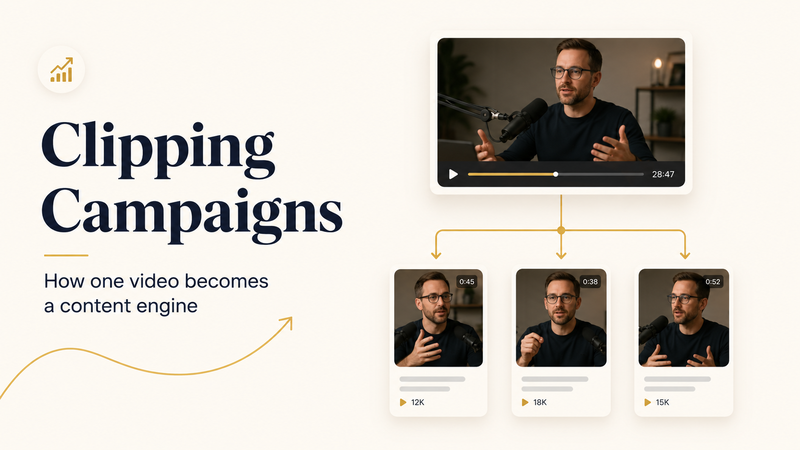

Most creators and brands spend too much time thinking about the next piece of content and not enough time thinking about what their existing content can still do.
A podcast episode gets published. A webinar gets hosted. A founder records a long interview. A YouTube video goes live. Everyone shares it once, maybe twice, and then the team starts asking what they should make next.
That is usually where the waste begins.
Inside almost every long-form video, there are moments that could work on their own. A sharp opinion. A useful explanation. A personal story. A lesson learned the hard way. A simple answer to a question the audience keeps asking. These moments often perform better as short clips than the original content does as a full piece.
This is why Clipping Campaigns have become so useful.
A clipping campaign is a planned system for turning long-form content into short-form clips that can be distributed across TikTok, Instagram Reels, YouTube Shorts, LinkedIn, Facebook, and other platforms. It is not just about cutting a video into smaller parts. It is about finding the strongest ideas, packaging them properly, and giving them more chances to reach the right people.
The difference is simple. Random clipping creates more posts. A clipping campaign creates more visibility.
What Are Clipping Campaigns?
Clipping campaigns are structured short-form content campaigns built from longer pieces of content. The source content can be a podcast, webinar, interview, livestream, online workshop, YouTube video, panel discussion, or recorded conversation.
At a basic level, the process looks simple. You review the long-form content, find the strongest sections, edit them into short clips, and publish them across relevant platforms. But a proper campaign needs more thinking than that.
A good clipping campaign considers the audience, the message, the platform, the hook, the edit, the posting schedule, and the performance data after publishing. Each clip should have a reason to exist. It should either educate, create interest, build trust, show proof, answer a question, or make the creator more memorable.
That is what separates a real campaign from a folder full of random clips.
A random clip says, “Here is a piece of our video.”
A clipping campaign says, “Here is a useful moment designed to help the right audience discover and understand us.”
That difference matters, especially when every platform is crowded and people are scrolling quickly.
Why Clipping Campaigns Matter Now
People do not discover content the same way they used to.
Most audiences are not starting with a full podcast episode or a 45-minute webinar. They are discovering people and brands through smaller moments. A 30-second clip. A quick opinion. A short story. A useful answer. A moment that feels relevant enough to stop the scroll.
That first clip might not sell anything. It might not even get someone to follow immediately. But it can create familiarity. Then the next clip adds another layer. Then another one builds trust. Over time, the audience starts to recognize the person, the brand, and the message.
This is how modern visibility compounds.
Clipping campaigns work because they turn one long-form asset into multiple touchpoints. Instead of asking the audience to commit to the full video right away, you give them smaller entry points that are easier to consume.
A single podcast episode might contain:
One strong personal story
Two useful teaching moments
A sharp opinion about the industry
A client example
A common mistake explained clearly
A practical framework
A moment that shows personality
A short answer to a high-intent question
Each one of those moments can become a clip. Together, they can become a campaign that keeps the original content working long after it was published.
Clipping Campaigns vs Basic Repurposing
Repurposing content is not new. Brands have been turning blog posts into newsletters and webinars into social posts for years. The problem is that a lot of repurposing is too casual.
Someone takes a long video, pulls a few sections, adds captions, and posts them. Sometimes that works. Often, it does not. The clips may be too slow, too vague, too disconnected, or too similar to everything else in the feed.
Clipping campaigns are more intentional. They treat long-form content as raw material for a larger distribution system.
Here is the difference:
Basic RepurposingClipping CampaignsPulls clips because they seem usableSelects clips based on audience, goal, and platformFocuses mainly on editingCombines strategy, editing, distribution, and testingPosts when content is readyFollows a planned publishing rhythmMeasures success mostly through viewsLooks at retention, saves, comments, follows, clicks, and leadsTreats each clip as separateConnects clips to a larger brand messageUsually stops after postingUses performance data to improve the next batch
A clipping campaign does not need to be complicated. It just needs structure. Without structure, short-form content becomes guesswork with captions.
What Makes a Strong Clipping Campaign?
A strong clipping campaign starts with good source material. That does not mean the original video has to look perfect. Some of the best clips come from natural conversations because they feel more human than heavily scripted content.
What matters is that the source content has substance. It should contain useful ideas, real examples, clear opinions, practical lessons, or moments where the speaker explains something in a way that feels simple and memorable.
The next step is clip selection. This is where many campaigns fail. Not every section of a video deserves to become a clip. Some moments need too much context. Some take too long to reach the point. Some sound useful inside the full episode but feel weak when viewed on their own.
A good clip usually does at least one of these things:
Teaches one clear idea
Answers one specific question
Challenges a common assumption
Tells a short story
Explains a common mistake
Shows proof or a result
Creates curiosity about the full content
Makes the speaker feel more relatable
Once the right moments are selected, editing becomes important. Good editing should remove friction. Captions should be easy to read. The pacing should feel natural but not slow. The first few seconds should make the topic clear. The clip should feel complete enough to stand on its own.
The goal is not to make every clip loud or overproduced. The goal is to make the useful part easier to watch.
The Role of Hooks in Clipping Campaigns
The hook is one of the most important parts of a short-form clip. If the opening does not give people a reason to stay, the rest of the clip barely matters.
A good hook does not have to be dramatic. It does not need fake controversy or clickbait. In fact, that kind of thing can make a brand look desperate. A good hook simply makes the viewer understand why the clip is worth their time.
For example, a weak opening might start with too much context:
“Yeah, so when we started working on this, we had a lot of things to figure out…”
A stronger opening might get to the point faster:
“Most creators waste their best podcast moments because they only post the full episode once.”
That second version gives the viewer a reason to keep watching. It identifies a problem and creates curiosity.
In a clipping campaign, hooks should be tested. Some audiences respond better to direct statements. Others respond to questions, mistakes, stories, or strong opinions. Over time, the campaign should reveal what holds attention best.
Types of Clips That Work Well
A strong clipping campaign usually includes a mix of clip types. This keeps the content from feeling repetitive and helps the brand reach people from different angles.
Educational Clips
Educational clips teach one useful idea. These work well for founders, consultants, agencies, coaches, creators, and B2B brands because they demonstrate expertise without asking the viewer for too much time.
Story Clips
Story clips use real experiences, founder lessons, client examples, or behind-the-scenes moments. These clips help the audience connect with the person behind the brand. People remember stories more easily than abstract advice.
Opinion Clips
Opinion clips are built around a clear point of view. They work because specific opinions are more memorable than generic tips. The opinion does not need to be extreme. It just needs to feel honest and specific.
Proof Clips
Proof clips show results, examples, case studies, screenshots, testimonials, or before-and-after situations. These are useful when the campaign supports business growth, lead generation, or sales conversations.
Objection-Handling Clips
Objection-handling clips answer the doubts people already have. For example, someone might wonder if clipping campaigns work for small creators, whether short-form content makes sense for B2B, or how many usable clips can come from one podcast episode.
A balanced campaign uses these formats together. It educates, builds trust, shows personality, and answers questions without turning every clip into a sales pitch.
A Simple Clipping Campaign Workflow
A clipping campaign becomes easier to manage when it follows a clear workflow.
StepWhat HappensWhy It MattersSource reviewThe long-form content is reviewed in fullFinds the strongest moments before editing startsClip selectionThe best sections are chosenPrevents weak clips from filling the campaignAngle planningClips are grouped by purpose or themeKeeps the campaign focused and intentionalEditingClips are trimmed, captioned, and formattedImproves watch time and platform fitPublishingClips are posted across selected platformsGets the content in front of the right audienceTrackingPerformance is reviewedHelps improve future clips and campaigns
The tracking step is where the campaign becomes smarter. If educational clips get more saves, that is useful. If story clips create more comments, that matters. If one hook style keeps improving retention, the next batch should use that insight.
A proper clipping campaign does not just publish content. It learns from the response.
Common Mistakes to Avoid
One of the biggest mistakes is trying to force too many clips from one piece of content. More clips do not always mean better results. If a podcast has ten strong moments, make ten strong clips. Do not stretch it into thirty weak clips just because the number sounds better.
Another mistake is starting too slowly. Short-form content needs context quickly. If the viewer cannot understand the topic or value within the first few seconds, they will likely scroll away.
A third mistake is using the same style everywhere. A clip that works on TikTok may need a different opening for LinkedIn. A YouTube Short may need a clearer title. An Instagram Reel may need a stronger first frame. The core idea can stay the same, but the packaging should fit the platform.
The biggest mistake is treating clipping as a one-time task. A campaign should improve over time. The first batch gives you content. The next batch should use what the first batch taught you.
That is how clipping turns into a system instead of a chore.
Where Clipping Agency Fits In
For creators, founders, podcasts, and brands that want a more organized approach, Clipping Agency helps turn long-form content into managed short-form distribution through structured Clipping Campaigns.
The value is not just cutting videos. The value is building a repeatable system around the strongest moments inside existing content. That includes finding the best clips, shaping them for short-form platforms, and helping each one support a larger visibility or growth goal.
This is especially useful for people who already create valuable content but do not have the time, team, or process to turn it into consistent short-form output. A podcast may contain excellent ideas, but if nobody clips and distributes them, most of those ideas stay buried. A webinar may be full of useful teaching, but without short-form distribution, only a small audience benefits from it.
A well-run clipping campaign helps one piece of content travel further. It gives the audience more chances to discover the brand, understand the message, and remember the person or company behind it.
Final Thoughts
Clipping campaigns are becoming one of the most practical ways to grow online visibility because they match how people consume content now. Most people do not discover a creator or brand by watching a full episode first. They discover a short clip, then another, and maybe the full version later.
That is why long-form content and short-form distribution work so well together. Long-form content gives depth. Short-form clips create reach. A clipping campaign connects both.
The brands and creators that benefit most are not simply posting more. They are building systems around their best ideas. They know what to clip, how to frame it, where to publish it, and how to learn from the results.
One video can disappear after one post, or it can become the start of a full content engine.
That is the real value of clipping campaigns.

Comments
No comments yet. Be the first to comment!