
Clipping Campaigns: Turning Existing Content Into Everyday Visibility
How brands can use podcasts, webinars, demos, interviews, and customer stories to create short-form assets that keep working across channels

A brand can have a strong content library and still feel invisible. That sounds strange, but it happens all the time. The team may have recorded webinars, published podcast episodes, filmed founder interviews, hosted events, created product demos, and collected customer stories, yet only a small part of that content ever reaches the wider audience.
The content exists. The ideas are useful. The problem is that most of the best moments are trapped inside long-form assets that are promoted once and then left behind.
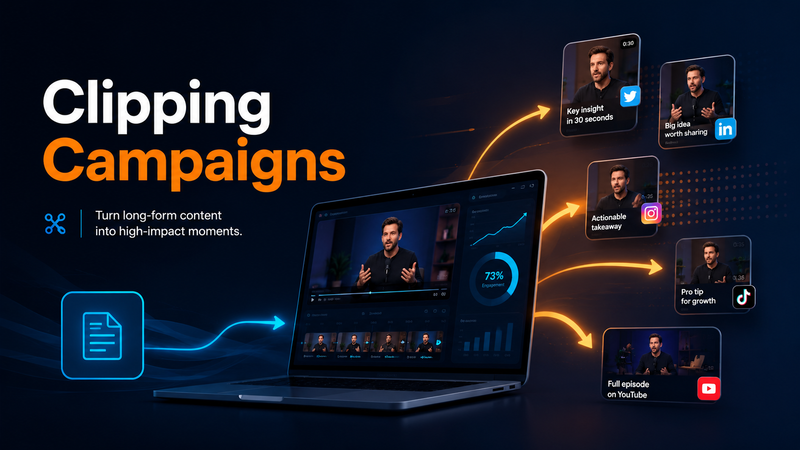
This is where clipping campaigns become useful. A clipping campaign takes long-form content and turns the strongest moments into short, focused clips that can be used across social media, email, landing pages, sales follow-ups, and other content channels. It gives existing content more ways to move, instead of asking the brand to create something new every single time it needs visibility.
A proper campaign is not just a folder of edited clips. It is a distribution system. It helps brands identify the moments that matter, shape them into useful short-form assets, and publish them with enough consistency to build trust, awareness, and momentum.
For brands that already invest in content, this can be one of the simplest ways to get more value from work they have already done.
The problem is not always content creation
Many brands assume they need more content. More videos. More posts. More ideas. More recording sessions. More campaigns. Sometimes that is true, but often the real issue is not creation. It is usage.
A single webinar can contain several useful moments. A podcast episode can include expert insight, founder opinion, customer language, and practical advice. A product demo can answer questions that prospects are already asking. A customer interview can include proof, emotion, results, objections, and real-world context.
When those assets are only published in their full format, a lot of value stays hidden.
Most people will not watch everything in full. They may not have the time, interest, or trust yet. A new audience member may not watch a 45-minute webinar, but they may watch a short clip that explains one useful idea. A prospect may not sit through a full product demo, but they may stop for a quick clip that answers one objection. Someone may not read a complete case study, but they may remember a customer proof clip.
That is why clipping campaigns matter. They make the strongest ideas easier to find.
What clipping campaigns actually involve
A clipping campaign starts with long-form content and turns it into shorter assets that can stand on their own. These clips are usually designed for platforms such as LinkedIn, Instagram Reels, TikTok, YouTube Shorts, Facebook, X, email newsletters, landing pages, and sales follow-ups.
The source content can include:
Podcasts
Webinars
Founder interviews
Customer stories
Product demos
Event recordings
Expert panels
Tutorials
Livestreams
Case study interviews
Educational videos
Internal recordings that can be adapted for public content
The process is simple in theory, but it needs care. The content has to be reviewed properly. The strongest moments need to be selected. Each clip has to be edited around one clear idea. Captions need to be readable. The format should fit the platform. The publishing rhythm should match the campaign goal.
The best clipping campaigns are built around purpose, not volume. The goal is not to create as many clips as possible. The goal is to create clips that help the brand explain, educate, build trust, and stay visible.
Why campaigns work better than one-off clips
One-off clips can help, but they often lack direction. A team may cut a few moments from a webinar, post them on social media, and then move on. That creates activity, but not always momentum.
A campaign works differently because it connects the clips to a larger goal.
A clipping campaign might be designed to:
Build awareness around a key topic
Support a product launch
Increase founder visibility
Turn a webinar into several weeks of content
Keep a podcast active between full episodes
Highlight customer proof
Explain a service in smaller pieces
Help sales teams answer common objections
Build trust through repeated education
Create a consistent content rhythm from existing assets
This changes how clips are selected. The team is not just looking for anything that sounds interesting. It is looking for moments that support the brand’s message and the audience’s needs.
That is why a campaign usually performs better than random repurposing. It gives every clip a job.
The best clips feel complete on their own
A strong clip should not feel like a random piece cut from the middle of a longer video. It should feel like a small, complete asset. The viewer should understand the point without needing to watch the full recording first.
This is where many brands get clipping wrong. They choose moments that only make sense with missing context. The clip starts too slowly. The speaker refers to something from earlier in the conversation. The ending feels unfinished. The captions are difficult to read. The clip may look polished, but the message does not land.
A useful clip usually has:
A clear opening
One focused idea
Enough context for a new viewer
Natural pacing
Captions that are easy to read
A practical takeaway
A clean ending
A tone that fits the brand
The best clips often answer one question, explain one problem, show one result, or share one point of view. They do not try to cover everything. They simply make one idea easy to understand.
How clipping campaigns support awareness
Awareness is not only about being present online. It is about being remembered for something useful.
Clipping campaigns help brands become more visible because they turn long-form ideas into smaller moments that can show up repeatedly across different channels. A short clip from a webinar can explain a problem. A founder clip can share a strong opinion. A customer story clip can make the brand feel more credible. A product demo clip can show value quickly.
Over time, these clips help the audience understand what the brand talks about, what it believes, and what problems it can solve.
Awareness clips can include:
Founder opinions
Industry observations
Common mistakes
Webinar highlights
Podcast takeaways
Short educational tips
Customer pain points
Simple explanations of complex topics
This kind of repeated exposure matters. People rarely trust a brand after seeing it once. They need to see useful ideas again and again before the brand becomes familiar.
How clipping campaigns build trust
Trust is built through clarity, consistency, and proof. A clipping campaign can support all three.
A brand can use clips to explain complicated topics in simple ways. It can show real customers describing problems and results. It can share founder thinking. It can answer objections openly. It can turn expert conversations into useful teaching moments.
Trust-building clips may include:
Customer proof
Product walkthrough moments
Expert explanations
Founder insights
Honest objection answers
Case study highlights
Practical lessons
Behind-the-scenes thinking
This is especially useful for B2B brands, SaaS companies, consultants, agencies, coaches, and education-focused businesses. Their audiences often need more than one touchpoint before they act. Short clips create those touchpoints without asking people to watch full recordings every time.
A helpful clip can build more trust than a generic promotional post because it shows the brand thinking clearly.
How clipping campaigns support sales
Clips are often treated as social content, but they can also support sales. This is one of the most practical uses of a clipping campaign.
A sales team can send a short clip after a call instead of asking the prospect to watch a full demo. A customer proof clip can support a proposal. A founder explanation can help a buyer understand the company’s point of view. A webinar answer can respond to an objection in a more direct way.
Useful sales clips can include:
A quick feature explanation
A product workflow
A customer result
A common objection answer
A short case study moment
A comparison between approaches
A founder explanation
A useful webinar Q&A answer
This makes the sales process feel more helpful. Instead of overwhelming prospects with long resources, the team can share the exact moment that answers the question.
How to plan clipping campaigns properly
A strong clipping campaign needs a repeatable workflow. Without a workflow, clipping becomes inconsistent. One week the brand publishes several clips, then nothing happens for a month. That kind of content activity rarely builds lasting momentum.
A simple campaign workflow can look like this:
Choose the long-form content that supports the campaign goal
Review the full asset carefully
Mark moments that can stand alone
Group clips by topic, audience need, or funnel stage
Edit each clip around one clear idea
Add readable captions and clean formatting
Adapt each clip for the right platform
Write captions that match the channel
Schedule the clips consistently
Review performance
Use the results to improve the next batch
For brands that want a more structured system, Clipping Campaigns can turn existing long-form content into repeatable short-form assets that support reach, trust, education, and distribution across channels.
The workflow should be simple enough to repeat every time the brand creates a strong webinar, podcast, demo, interview, customer story, or event recording.
Where clipped content can be used
A good clipping campaign should not be limited to one platform. The same idea can often be adapted for different places, as long as the format fits the channel.
Clips can be used on:
LinkedIn
Instagram Reels
TikTok
YouTube Shorts
Facebook
X
Email newsletters
Landing pages
Blog posts
Sales follow-ups
Community posts
Paid retargeting
The packaging should change depending on the platform. A LinkedIn clip may need a thoughtful caption. A YouTube Short may need a stronger opening. A landing page clip may need to support a specific proof point. A sales follow-up clip may need to be simple and direct.
The idea can stay the same, but the presentation should match the audience and channel.
Mistakes that weaken clipping campaigns
A clipping campaign can look active and still fail to create impact. More clips do not automatically mean better results. The campaign needs selection, structure, and consistency.
Common mistakes include:
Clipping moments that do not stand alone
Starting clips too slowly
Keeping too much setup before the main point
Making every clip too promotional
Using captions that are hard to read
Posting without a clear theme
Making every clip look identical
Ignoring platform differences
Treating clips as filler content
Not reviewing performance
The strongest campaigns are selective. They do not turn every minute of content into a clip. They choose the moments that teach, explain, prove, clarify, build trust, or create curiosity.
What to review after publishing
Publishing the clips is not the final step. A good campaign improves over time.
Brands should review which topics hold attention, which openings work best, which clips earn comments, and which formats feel natural for the audience. It is also important to look beyond views. A clip with fewer views but stronger engagement from the right audience can be more useful than a viral clip that attracts the wrong people.
Useful signals include:
Watch time
Retention
Saves
Shares
Comments
Clicks
Profile visits
Newsletter engagement
Landing page engagement
Sales team usage
Lead quality
These signals help shape future campaigns. Over time, the brand learns which long-form assets produce the strongest clips and which topics deserve more attention.
Final thoughts
Clipping campaigns help brands get more value from the content they already create. They turn podcasts, webinars, demos, founder interviews, customer stories, tutorials, and event recordings into short-form assets that can keep working across multiple channels.
This is not about creating more content just to stay busy. It is about making strong ideas easier to find, easier to understand, and easier to reuse.
For brands that already invest in long-form content, clipping can become one of the most efficient ways to build reach. It extends the life of every strong recording, creates more useful touchpoints, and helps the brand stay visible without starting from zero every week.
When planned properly, clipping campaigns become more than simple repurposing. They become a practical distribution engine for ideas that deserve to travel further.

Comments
No comments yet. Be the first to comment!