
YouTube Shorts Clipping Campaign: Build More Reach From Every Long Video
A practical look at how creators and brands can turn podcasts, webinars, interviews, tutorials, and demos into short clips that keep working
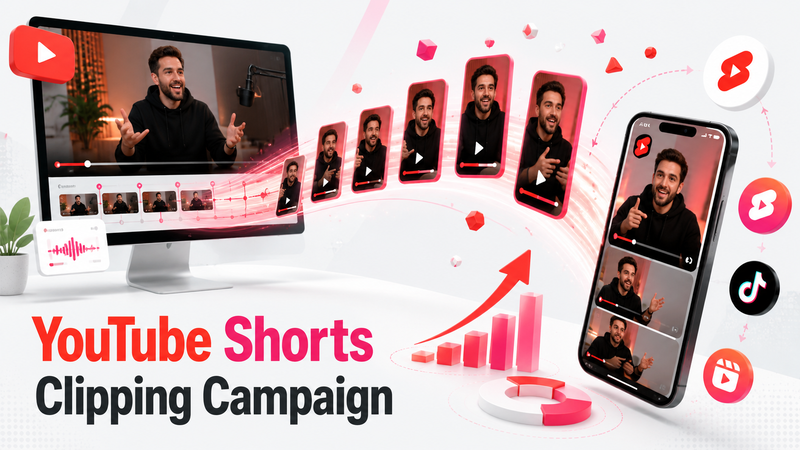

A long video usually contains more value than one upload can carry. A podcast might include a strong opinion, a useful lesson, a funny exchange, and a moment that explains the whole topic in a simple way. A webinar might include a full framework, several audience questions, a product example, and a line that would make a great short clip on its own. A tutorial might have one section that solves a common problem better than the rest of the video.
The issue is not that the long video lacks value. The issue is that the best moments are often buried inside the full recording.
That is where a YouTube Shorts clipping campaign becomes useful. It takes the clearest and most interesting moments from long-form videos and turns them into short vertical clips designed for discovery, reach, and repeat viewing. Instead of waiting for people to find and watch the full video, the campaign creates smaller entry points that can introduce the content to more people.
This is especially important for creators, podcasts, educators, coaches, SaaS companies, agencies, consultants, and brands that already produce long videos. A good clipping campaign helps them get more mileage from content they have already recorded, edited, and published.
It is not about cutting every possible moment into a Short. It is about finding the right moments and shaping them so they can stand on their own.
Long videos are valuable, but they need better distribution
Long-form video still has an important role. It gives space for proper explanations, deeper conversations, product education, interviews, tutorials, and trust-building content. A Short cannot replace the depth of a full podcast or a detailed walkthrough.
The problem is that long videos ask for a bigger commitment.
A viewer who already knows the channel may happily watch a full episode. A new viewer may not. They may not know the speaker, the brand, the topic, or the reason the video is worth their time. Before they spend twenty, forty, or sixty minutes with the content, they often need a smaller reason to care.
Shorts can provide that reason.
A 30-second or 45-second clip can introduce one useful idea from the longer video. It can show the speaker’s personality, explain one problem, answer one question, or create enough curiosity for someone to visit the full upload.
This is why clipping works best as a distribution layer. The full video holds the depth. The Shorts create more doorways into that depth.
A Shorts campaign is different from random posting
Many creators and brands already cut clips from longer videos, but the results often feel inconsistent. Some clips work, some do not, and the overall channel does not gain much direction. That usually happens because the clipping is random.
A YouTube Shorts clipping campaign gives the process more structure.
Instead of asking, “How many clips can we make from this video?” the better question is, “Which moments are strong enough to become useful short-form content?”
That shift changes everything.
A proper campaign considers:
Which long videos are worth clipping
Which audience the clips are meant to reach
Which topics should be repeated across the campaign
Which moments can stand alone
How each Short should open
How captions should be used
How clips should connect back to the wider channel
What publishing rhythm makes sense
Which performance signals should guide the next batch
This does not make the content stiff or overplanned. It simply gives the campaign a reason to exist. When clips are selected with purpose, they feel more useful and less like filler.
The best Shorts usually come from clear moments
Not every section of a long video should become a Short. Some moments are too slow. Some need too much context. Some are useful in the full video but weak on their own. A campaign works better when it is selective.
A strong Short usually comes from a moment where the value is already easy to understand.
That could be:
A direct answer to a common question
A strong opinion from the speaker
A mistake the audience often makes
A simple explanation of a complex topic
A quick story with a useful lesson
A product use case
A customer outcome
A surprising observation
A practical tip
A moment that makes the viewer want the full context
The key is that the clip should feel complete. The viewer should not feel lost because they did not watch the full video. They should understand the topic, the point, and the reason it matters.
That is where good clip selection becomes more important than flashy editing.
Why this matters for creators
Creators often spend hours producing long-form content. They prepare the topic, record the video, edit the episode, upload it, write the description, create the thumbnail, and promote it. After that, the video may get a burst of attention and then slowly fade.
A clipping campaign helps extend the life of each upload.
For creators, Shorts can highlight:
The strongest guest moments from a podcast
The best lesson from a tutorial
A funny or relatable moment from a conversation
A sharp opinion from a commentary video
A useful answer from a livestream
A quick breakdown from a longer explainer
A teaser that leads people toward the full episode
This gives the audience more chances to discover the creator. Some people may watch a Short first, then visit the channel, then watch the full video later. Others may follow after seeing several clips over time.
Not every Short will convert a viewer into a subscriber, but a campaign increases the number of moments where that connection can happen.
Why this matters for brands
Brands often have long-form video content sitting unused. Webinars, customer interviews, product demos, founder talks, event recordings, workshops, and educational videos can all contain useful moments. The problem is that these assets are often promoted once and then forgotten.
A YouTube Shorts clipping campaign can turn that existing content into a steady stream of short-form assets.
For brands, Shorts can help:
Explain what the brand does
Educate prospects before a sales call
Answer objections in a simple way
Highlight customer proof
Turn webinars into ongoing content
Support launches and campaigns
Show founder or team expertise
Increase visibility without creating from scratch every week
This is especially useful for B2B companies, SaaS brands, agencies, consultants, and education-focused businesses. Their topics often need explanation, and short clips can make those ideas easier to understand.
A full webinar might feel too heavy for a new prospect, but a Short that answers one question can create interest.
One long video can support many different clips
A strong long-form video rarely has just one useful moment. With careful review, one recording can often become several Shorts with different purposes.
A podcast episode might produce:
One clip with a strong opinion
One clip with a guest story
One clip with a practical takeaway
One clip that answers a common question
One clip that creates curiosity for the full episode
A product demo might produce:
One clip showing a specific feature
One clip explaining a use case
One clip answering a buyer concern
One clip showing a workflow
One clip comparing the old way with the improved process
A webinar might produce:
One clip introducing the main problem
One clip explaining a framework
One clip answering an audience question
One clip showing an example
One clip inviting people to watch the full session
This is where clipping becomes efficient. The brand or creator does not need a brand-new idea every day. A strong recording can become a small library of useful short clips.
The opening decides whether people stay
Shorts move quickly. Viewers decide in the first few seconds whether they will keep watching. That does not mean the opening has to be loud, exaggerated, or fake. It simply needs to reach the point quickly.
A strong opening might begin with:
A question the audience already has
A mistake they recognise
A surprising statement
A direct explanation
A useful lesson
A strong opinion
A clear problem
A result or example
For example, a podcast clip may not need the full lead-in from the conversation. It may work better if it starts at the moment the guest says something useful. A product clip may not need a slow introduction. It may work better when it starts with the problem the feature solves.
Good editing respects the viewer’s time. It removes the slow setup and begins closer to the value.
Captions and formatting should make the clip easier to watch
Many people watch Shorts on mobile, and many start watching without sound. Captions help the viewer follow the clip quickly. But captions need to be clean, readable, and well placed.
Bad captions can make a clip feel cheap or difficult to watch. Captions that move too fast, cover the speaker’s face, or use too many visual effects can distract from the message.
A good Short usually needs:
Vertical formatting
Clear framing of the speaker or subject
Readable captions
Natural pacing
Clean audio
Enough context
A complete ending
A visual style that fits the channel or brand
Effects can help if they support the message, but they should not become the main point. The viewer should remember the idea, not just the editing.
How to plan a YouTube Shorts clipping campaign
A good campaign needs a workflow. Without one, clipping becomes inconsistent. A creator may post several Shorts one week and then disappear. A brand may clip one webinar and never repeat the process. That makes it difficult to build momentum.
A simple workflow can look like this:
Choose the long-form videos that match the campaign goal
Review the full recording carefully
Mark moments that can stand alone
Group clips by topic or audience intent
Edit each Short around one focused idea
Add readable captions and vertical formatting
Write a title or caption that matches the clip
Schedule Shorts consistently
Review which clips perform best
Use the results to improve the next batch
For brands and creators that want a more structured system, a YouTube Shorts Clipping Campaign can turn existing long-form videos into short-form assets built for discovery, reach, and repeatable distribution.
The goal is not to clip once and move on. The goal is to build a repeatable system that can be used every time a strong video is published.
Shorts can also support the full video
A Short should provide value on its own, but it can also guide viewers toward the longer video. This works best when the Short feels useful first and promotional second.
A good Short can act as:
A highlight from a full podcast
A preview of a webinar
A quick answer from a longer Q&A
A teaser for a tutorial
A proof point from a customer story
A short section from a product walkthrough
A standalone idea that points to the full video
The mistake is making every Short feel like an empty teaser. Viewers do not want to feel tricked. They should get one useful idea from the Short, then feel that the full video offers more depth.
That approach builds trust instead of frustration.
Common mistakes that weaken Shorts campaigns
A YouTube Shorts clipping campaign can look active and still fail to build real momentum. This usually happens when the campaign focuses on volume instead of usefulness.
Common mistakes include:
Clipping moments that need too much missing context
Starting the clip too slowly
Choosing clips only because they are easy to cut
Posting without a clear theme
Making every clip look the same
Using captions that are hard to read
Overusing effects
Ignoring the wider channel strategy
Not reviewing performance
Stopping after one batch
A good campaign avoids these problems by being selective. It treats every Short as a small piece of content with a clear purpose.
What to learn from the results
Publishing is not the end of the process. The campaign should get better over time.
After the Shorts go live, it helps to review:
Which topics hold attention
Which openings work best
Which clips earn comments
Which clips bring people toward the channel
Which speakers or formats perform well
Which videos produce the strongest short-form moments
Which clips attract the right audience
This feedback helps shape future long-form content too. If certain topics work well as Shorts, they may deserve more attention in future videos. If certain openings hold viewers longer, the team can use that pattern again.
A smart campaign learns from every post.
Final thoughts
A YouTube Shorts clipping campaign helps long videos reach more people. It gives podcasts, webinars, tutorials, demos, interviews, livestreams, and educational videos more life by turning their strongest moments into short-form assets.
The value is not only in creating more Shorts. The value is in choosing the right moments, shaping them clearly, and publishing them with a repeatable plan.
For creators and brands already producing long-form content, this can be one of the most practical ways to build discovery without starting from zero every week. It gives every strong video more chances to be seen and every useful idea more chances to travel.
When planned properly, a YouTube Shorts clipping campaign turns long videos into a steady source of short-form reach.

Comments
No comments yet. Be the first to comment!