
Clipping Campaigns vs Paid Ads: What Builds Lasting Growth?
A closer look at how organic short-form distribution and paid media differ across reach, trust, cost, speed, and long-term value.
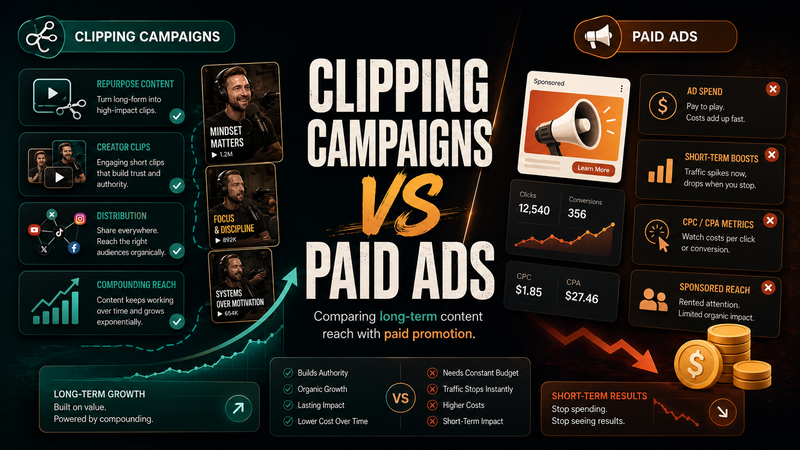

A brand can reach the same person in two very different ways.
The first is direct. An advertisement appears in the feed because the company paid for the placement. The audience sees the message, considers the offer, and either clicks or keeps scrolling.
The second is more gradual. The person watches a short video taken from a podcast, interview, webinar, or founder conversation. The clip may not sell anything immediately. It may explain a problem, share a useful opinion, or introduce the personality behind the brand. A few days later, the same person sees another clip, visits the profile, watches a longer video, and eventually reaches the website.
Both paths can lead to growth, but they create different relationships with the audience.
Paid advertising is designed to accelerate reach and action. Clipping campaigns are designed to extend valuable content and create repeated opportunities for discovery. One relies heavily on media spend. The other relies on useful ideas, strong editing, and consistent distribution.
The right choice depends on more than budget. Brands also need to consider how quickly they need results, whether customers need education before buying, how strong their long-form content is, and whether the goal is immediate traffic or a durable audience.
Start with the job each channel is meant to perform
Clipping campaigns and paid ads are often compared as if they are interchangeable traffic sources. In practice, they usually perform different jobs.
Paid advertising is built around a defined outcome. The advertiser may want purchases, calls, registrations, downloads, leads, or website visits. The campaign is designed backwards from that action.
A clipping campaign begins with existing content.
The source may be:
A podcast episode
A recorded interview
A livestream
A webinar
A founder discussion
A customer conversation
A long-form video
An educational presentation
A panel discussion
A recorded event
The strongest moments are selected and developed into short-form assets. These clips may educate, entertain, challenge an assumption, answer a question, or reveal the brand’s point of view.
A paid ad usually begins with the offer.
A clipping campaign usually begins with the idea.
That difference shapes how the audience responds.
The comparison changes when you look beyond the first click
The debate around Clipping Campaigns vs Paid Ads becomes more useful when the brand looks beyond immediate traffic and considers the full journey.
Paid ads can be excellent at creating a first click. The advertiser chooses the audience, delivers the message, and directs the person toward a landing page or offer.
Clipping campaigns often create several smaller interactions before the click happens.
A viewer may:
Watch a short clip.
Recognise the speaker in a later post.
Follow the account.
Watch another explanation.
Read the comments.
Visit the profile.
Watch the original long-form content.
Join a newsletter.
Visit the service page.
Make contact when the need becomes urgent.
This journey is slower, but it can create greater familiarity.
The audience is not only seeing the brand’s claim. It is seeing the people, ideas, expertise, and personality behind the claim.
Paid ads compress the journey when the offer is ready and the audience already understands the problem. Clipping campaigns can support the earlier stages when people still need education and trust.
What makes a clipping campaign work
A clipping campaign succeeds or fails during the selection process.
The source content may contain dozens of moments, but only a small number may be strong enough to stand alone. A useful clip needs a clear subject, enough context, and a conclusion that feels complete.
The best candidates often include:
A direct answer to a familiar question
A useful disagreement with common advice
A mistake and the lesson that followed
A practical explanation
A memorable story
A surprising result
A clear framework
A strong emotional reaction
A customer insight
A point likely to create discussion
The edit then needs to serve the idea.
A weak clip often starts halfway through the conversation, depends on missing context, or ends before the point is complete. A strong clip feels like a deliberate piece of content, even when it came from a longer recording.
That may require:
Rewriting or tightening the opening
Removing unnecessary setup
Adding a short context line
Improving pacing
Using readable captions
Cropping for vertical viewing
Adding relevant supporting visuals
Ending at the natural conclusion
Adapting the asset for each platform
Clipping campaigns are not simply editing projects. They are distribution systems built around the strongest ideas in the source content.
What makes paid ads work
Paid ads depend on a different set of conditions.
The campaign is more likely to succeed when the brand already has:
A clear audience
A strong offer
A convincing message
A suitable landing page
Reliable conversion tracking
Enough margin to support acquisition costs
A clear call to action
Creative variations for testing
A plan for retargeting
A realistic media budget
Advertising can deliver attention quickly, but it cannot guarantee that the audience will care.
If the offer is weak, the landing page is confusing, or the message does not match the customer’s needs, paying for more traffic will only expose the problem faster.
Paid media works best when the underlying commercial system is already sound.
Speed is where paid ads have the clearest advantage
When time matters, paid ads are difficult to beat.
A campaign can begin generating impressions shortly after approval. This makes it useful for:
Product launches
Event registrations
Seasonal promotions
Limited-time offers
Local service enquiries
Webinar signups
Lead generation
Retargeting
New market tests
Immediate traffic needs
The brand does not need to wait for organic distribution.
Clipping campaigns require a longer runway. Source content needs to exist. The material needs to be reviewed. Clips need to be selected, edited, published, and evaluated.
Some clips may perform quickly, but the campaign is generally built around accumulated momentum rather than immediate certainty.
Paid ads are stronger when the business needs a result now.
Clipping campaigns are stronger when the brand wants to keep creating value after the original publish date.
The cost is not only what appears on the invoice
Paid ads and clipping campaigns spend money differently.
With paid ads, the brand pays for creative production and media delivery. The campaign may also require a landing page, tracking tools, audience research, and ongoing management.
The most visible cost is often the platform spend.
With clipping campaigns, the investment goes into reviewing, editing, packaging, and distributing content. The brand may not pay directly for every organic impression, but it still pays for the system that creates the assets.
The distinction is what remains after the campaign.
When an ad stops running, the advertiser still has the creative and performance data, but the distribution ends.
When a clipping campaign ends, the brand still has a library of short-form assets that can be reused in several ways.
A strong clip may later appear in:
A newsletter
A landing page
A sales presentation
A retargeting campaign
A blog article
A social media compilation
A speaker profile
A customer education sequence
A founder brand campaign
A paid advertisement
This does not make clipping automatically cheaper. It means the investment creates a different kind of asset.
Paid targeting is more precise
Paid advertising gives the brand greater control over audience delivery.
Depending on the platform, the advertiser may be able to target:
Specific locations
Age groups
Interests
Job titles
Previous website visitors
Existing customers
Video viewers
Email lists
Lookalike audiences
People who completed certain actions
This is valuable when the business already knows exactly who it wants to reach.
Clipping campaigns offer less precision.
The topic, caption, speaker, publishing account, platform, and hook can all influence distribution, but the platform ultimately decides how the content travels based on user behaviour.
This makes organic distribution less predictable.
It also creates opportunities for discovery. A clip may reach an unexpected audience or reveal interest from a customer group the brand had not previously considered.
Paid media is better for reaching the audience the business already understands.
Clipping campaigns can help reveal which audiences respond naturally.
Trust is built through different signals
Paid ads can build trust, but the commercial intent is visible.
The viewer sees the sponsored label or recognises the format. This does not make the ad ineffective. A strong advertisement can still use proof, testimonials, demonstrations, guarantees, and useful information to reduce doubt.
Clipping campaigns often create trust indirectly.
The audience sees the brand’s thinking before it sees the sales message.
A founder explains how the industry works. An expert answers a difficult question. A creator shares a mistake. A podcast guest describes a useful process. These moments allow the audience to judge the people behind the business.
Repeated exposure matters.
One clip may create awareness. Another may reinforce expertise. A third may reveal personality. Over time, the audience may begin to recognise the speaker and understand what the brand represents.
Paid ads can create rapid familiarity through repeated delivery.
Clipping campaigns can create familiarity through repeated value.
Clipping campaigns can improve paid ads
The two approaches become more powerful when they are connected.
One of the biggest challenges in paid advertising is creative testing. Brands often need to guess which opening, message, story, or speaker will attract attention.
Organic clips can reduce that uncertainty.
The brand can publish several short videos and measure:
Watch time
Completion rate
Shares
Saves
Comments
Profile visits
Link clicks
Follower growth
Audience questions
Repeat interest in the same topic
The strongest performers can then be adapted into advertisements.
A useful combined process might be:
Produce long-form content around a relevant topic.
Turn the strongest moments into organic clips.
Publish several variations.
Identify the clips with the strongest attention signals.
Adapt those clips for paid campaigns.
Target relevant audiences.
Retarget people who watched or engaged.
Direct them toward a service, product, newsletter, or longer asset.
The clipping campaign becomes a creative testing environment. Paid media becomes the acceleration layer.
Clipping campaigns are not always the right answer
A clipping campaign needs worthwhile source material.
If the long-form content lacks useful ideas, clear explanations, personality, or stories, editing alone will not solve the problem.
The campaign may also be a poor fit when:
The brand needs results within days
There is no long-form content available
The audience is extremely narrow
The offer is highly time-sensitive
The team cannot publish consistently
The speakers are not comfortable on camera
The subject does not lend itself to short-form content
The brand requires precise geographic targeting
There is no capacity to review performance
The goal is a direct conversion rather than audience development
Clipping campaigns should be chosen because the brand has valuable content worth distributing, not simply because short-form video is popular.
Paid ads are not always the right answer
Paid media is also frequently used too early.
A business may launch ads before testing the offer, understanding the customer, or preparing a convincing destination page. This usually produces expensive traffic and weak results.
Paid ads may be the wrong choice when:
The offer is unclear
The audience has not been defined
Conversion tracking is unreliable
The landing page is weak
The business cannot afford a testing period
Customer value is too low
The message changes constantly
The brand needs education before conversion
There is no retargeting plan
The team expects immediate profitability from untested creative
Advertising works best when it amplifies something that already has evidence behind it.
A useful decision framework
Brands can make a more practical choice by answering a few questions.
Do we need reach immediately?
Paid ads are generally the better option when speed is essential.
Do we already have strong long-form content?
A clipping campaign can unlock substantial value from existing podcasts, interviews, videos, and webinars.
Does the audience understand the problem already?
Paid ads work well when the customer is ready for the offer. Clipping campaigns help when education is still required.
Do we know exactly who we need to reach?
Paid media offers more precise targeting.
Are we trying to build a long-term audience?
Clipping campaigns can create repeated touchpoints and a growing content library.
Can we track leads and sales accurately?
Without reliable tracking, it becomes difficult to judge paid performance.
Do we have a strong founder, expert, host, or creator voice?
Clipping campaigns can turn that personality and expertise into a distribution advantage.
Is there enough budget for continued media spend?
Paid reach depends on ongoing investment.
Common clipping campaign mistakes
Clipping campaigns often fail because teams focus on quantity.
Typical problems include:
Selecting moments that need too much context
Publishing weak clips to meet a quota
Reusing the same opening repeatedly
Applying identical editing to every speaker
Posting the same version everywhere
Using distracting captions
Ignoring comments and audience questions
Publishing too many similar ideas at once
Failing to track watch time
Expecting every clip to become viral
A good campaign is selective, varied, and connected to a broader strategy.
Common paid advertising mistakes
Paid campaigns can waste money when execution is rushed.
Common problems include:
Sending traffic to a weak landing page
Using generic creative
Promoting an untested offer
Targeting too broadly
Scaling before the campaign is profitable
Measuring clicks instead of conversions
Ignoring creative fatigue
Changing campaigns too quickly
Failing to retarget engaged users
Treating media spend as a substitute for clear positioning
Paid delivery can accelerate growth, but it can also accelerate waste.
Final thoughts
Clipping campaigns and paid ads are not simply two versions of the same strategy.
Paid ads are built for speed, precision, and controlled delivery. They are strongest when the business has a clear offer, a defined customer, reliable tracking, and a need for immediate traffic.
Clipping campaigns are built around ideas, distribution, and repeated discovery. They are strongest when the brand already has useful long-form content, a recognisable voice, and a reason to build trust over time.
For many companies, the best strategy is not to choose one permanently.
Clipping campaigns can reveal the messages that earn attention. Paid ads can amplify those messages and place them in front of a more precise audience.
The strongest marketing system gives each method a clear purpose. Content builds familiarity and trust. Paid media accelerates the reach of the ideas and offers that have already shown promise.
Comments
No comments yet. Be the first to comment!