
How a Podcast Clipping Agency Scales Show Discovery
A practical three-phase production blueprint for growing your show.
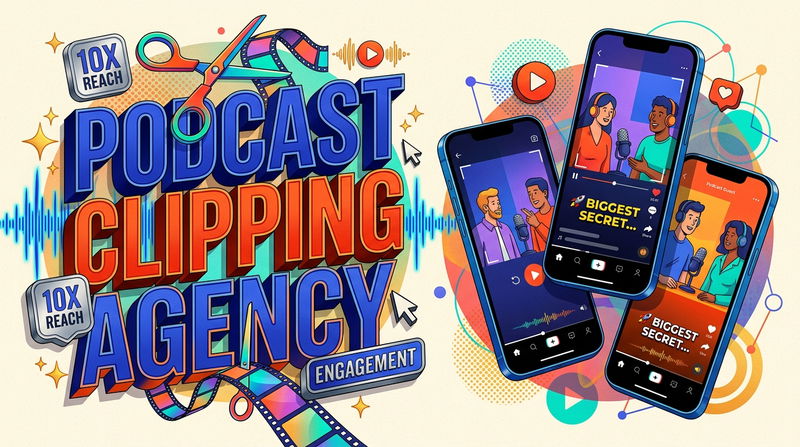

Transforming recorded interview conversations into consistent subscriber growth without exhausting personal time on endless editing timelines is an ongoing operational hurdle for showrunners, executive hosts, and corporate media teams. Publishers dedicate substantial creative effort to coordinating knowledgeable guests, structuring insightful discussion questions, and recording deep conversations. Yet when an episode is published, promotional efforts often collapse into rushed social posts that fail to generate meaningful interest beyond an existing circle of followers. Modern digital audiences discover new shows primarily through mobile vertical video feeds where they evaluate content in rapid, brief decision windows. Expecting casual mobile scrollers to stop browsing, open a separate podcast directory, and listen to a full sixty-minute recording without an immediate hook ignores how people interact with handheld media.
The underlying issue is not a lack of thoughtful conversation or compelling subject matter. Valuable insights simply stay trapped inside long-form recordings that mobile audiences cannot easily sample during quick scrolling breaks.
Deploying the strategic operational model of an editorial-led Podcast Clipping Agency resolves this distribution bottleneck by transforming conversational archives into an organized ecosystem of engaging short-form discovery assets. Rather than treating video excerpts as quick promotional announcements, this production blueprint establishes a repeatable three-stage pipeline that isolates, reframes, and syndicates your strongest conversational moments systematically.
When approached as an editorial storytelling discipline rather than an automated chopping task, strategic show clipping transforms your recorded episodes into an ongoing engine for organic listener discovery.
Below is the complete production blueprint designed to help creators, producers, and marketing teams transform raw interview archives into high-converting video assets that steadily grow a dedicated audience.
The Core Philosophy: Standalone Value Over Generic Teasers
Before setting up timeline markers, production teams must understand why basic interview snippets fail to gain traction on mobile discovery channels. Slicing out a random thirty-second segment where a host laughs or introducing a guest with static title cards treats vertical feeds like passive radio commercial space. In organic mobile feeds, this approach feels like an uninvited interruption, prompting an immediate swipe.
Strategic clipping is an editorial storytelling craft. A well-conducted interview contains multiple distinct revelations, counterintuitive lessons, and relatable human moments that connect deeply with professional and personal experiences. The primary responsibility of an editorial pipeline is to locate those distinct moments, pair them with authentic visual framing, and present the conversation as a self-contained learning moment that delivers complete value in under sixty seconds.
When applied consistently across your release schedule, this framework turns every recorded episode into a suite of versatile discovery assets that expand your reach organically.
Phase 1: Conversational Auditing and Narrative Mapping
The opening stage of the production blueprint focuses entirely on editorial review and narrative story mapping. Handing a completed interview recording directly to a junior video editor without an editorial outline produces fragmented clips that fail to hold viewer interest.
During the curation phase, a content strategist reviews the master recording to identify standalone discussion points. A successful excerpt must present a distinct perspective, establish a clear hook within two seconds, and deliver a practical resolution within forty-five to seventy-five seconds.
Production teams map their source recordings by listening for four specific conversational structures:
The Counterintuitive Lesson: A moment where the speaker explains why standard industry advice leads to unintended problems or inefficient workflows.
The Concrete Number: An observation where the guest shares an exact metric, timeline, or conversion rate that surprises the host and reframes a familiar topic.
The Tactical Method: A concise explanation of a three-step technique that solves an everyday operational bottleneck without complicated tools.
The Personal Vulnerability: An unscripted moment where the guest reflects honestly on a past professional failure and the lesson learned from it.
Each selected moment is documented in a shared production tracker with exact start and end timecodes, a proposed opening hook line, and a brief description of the core takeaway. This documentation ensures that visual editors work exclusively with high-impact material.
Phase 2: Mobile Reframing and Kinetic Typographic Styling
Once candidate moments are approved, the workflow moves into visual adaptation and mobile formatting. Traditional widescreen studio recordings cannot simply be cropped down the center with black letterbox bars, as doing so minimizes facial expressions and reduces emotional connection on smartphone displays.
The editing team reconstructs the visual composition specifically for mobile viewing habits:
Active Speaker Framing: The vertical crop focuses closely on the speaker's eyes and expressions, placing them within the upper forty percent of the vertical frame. In multi-person studio discussions, the edit cuts rhythmically between the speaker talking and the host reacting, maintaining conversational energy.
Visual Context Cutaways: When a guest mentions a specific workflow diagram, published metric, or book passage, cut smoothly to a zoomed, readable graphic of that reference for two to three seconds before returning to the speaker.
Kinetic Subtitle Alignment: Over seventy percent of mobile video consumption occurs on silent mode before audio is activated. Style subtitles in clean, high-contrast lettering centered within the mobile safe zone. Display text in concise clusters of three to five words that match the speaker's vocal cadence, allowing silent scrollers to follow the conversation effortlessly.
Secondary Color Accents: Use secondary brand colors to highlight critical takeaway terms within the subtitles as they are spoken. This subtle visual styling reinforces visual brand recognition throughout the video without requiring an unmoving, intrusive logo watermark.
Phase 3: Discovery Routing and Catalog Attribution
The concluding phase connects top-of-funnel short video impressions back to your primary show directory. Generating high view counts delivers minimal business value if viewers have no clear path to explore your broader catalog.
Traditional calls to action that order viewers to leave the platform, open an external browser window, and click a link in an account biography introduce excessive friction. Mobile users strongly prefer remaining inside their active discovery feeds.
To establish a smooth conversion pathway, each finalized asset implements clean search-driven attribution:
Clear Title Lower Thirds: A clean, non-intrusive lower-third graphic appears for three seconds during the opening hook, displaying the guest's name and the exact episode title before fading away cleanly.
Topic-Focused Captions: In the written description, summarize the practical problem addressed in the video in two concise sentences rather than writing vague promotional copy.
Direct Search Guidance: Conclude your written caption with a clear search directive: "Search our channel for Episode 42 with Sarah Jenkins to hear the full discussion." Telling viewers to search by episode name empowers them to find the recording voluntarily, signaling authentic listener demand to platform algorithms.
Workflow Comparison: Unorganized Slicing vs. The Production Blueprint
Reviewing the practical differences between unorganized video slicing and a structured clipping pipeline illustrates why an editorial approach achieves higher subscriber conversion:
Curation Strategy:
Unorganized Slicing: Relies on generic thirty-second audio volume spikes or automated soundbite detectors.
The Production Blueprint: Deliberate conversational auditing focused on standalone educational and narrative resolution.
Visual Presentation:
Unorganized Slicing: Static widescreen letterboxing with blurred background filler bars.
The Production Blueprint: Dynamic portrait reframing, facial safe-zone alignment, and responsive speaker switching.
Subtitle Design:
Unorganized Slicing: Omitted entirely or using cluttered, unformatted automated transcript blocks.
The Production Blueprint: Centered kinetic typography with selective color emphasis that hooks silent viewers.
Audience Perception:
Unorganized Slicing: Feels like an uninvited commercial advertisement or disconnected noise.
The Production Blueprint: Perceived as an authentic, high-value educational masterclass.
Listener Conversion:
Unorganized Slicing: Pushes clumsy external bio links that convert poorly.
The Production Blueprint: Builds organic search momentum and guided discovery across major streaming networks.
Frequently Asked Questions
Which types of interview discussions produce the best short-form video clips?
Discussions featuring experienced practitioners sharing concrete workplace experiences produce the best results. Founder journeys, operational breakdowns, technical explanations, and unscripted debates all yield high-performing assets when the guest delivers clear, actionable takeaways.
How many vertical video assets should be extracted from a one-hour interview?
A focused sixty-minute recording typically yields between four and eight high-quality standalone clips. Attempting to force fifteen or twenty clips often results in weak, fragmented soundbites that lack clear conclusions. Prioritizing high-density insights ensures that every published asset delivers genuine value to prospective followers.
What is the ideal video duration for an educational podcast clip?
The most reliable running time sits between forty-five and seventy-five seconds. Clips under thirty seconds rarely offer enough time to explain and resolve a nuanced professional topic, while clips stretching beyond ninety seconds experience steep retention drop-offs unless the editing rhythm is exceptionally fast-paced.
Actionable Pre-Flight Production Checklist
Before scheduling your next round of interview discovery assets for distribution, verify your content against these foundational quality standards:
Frame zero opens immediately on an engaging thesis statement or diagnostic observation, free of host greetings, pleasantries, or title graphics.
The selected segment delivers a complete, self-contained lesson that makes sense without requiring context from the earlier conversation.
Visual framing is optimized for vertical mobile displays, keeping the speaker's eyes and expressions positioned in the upper portion of the frame.
Kinetic subtitles are placed safely within the mobile vertical safe zone and styled for effortless reading on silent mode.
Visual cutaways highlight relevant data points, charts, or listener reactions rather than displaying static promotional logos.
Brand identity is expressed through cohesive typography fonts and secondary accent colors rather than an opaque graphic watermark.
Subtle lower-third nameplates introduce the guest name and episode title cleanly during the opening seconds before fading away.
The written description provides a clean, searchable episode title guiding motivated listeners toward the full-length recording on major streaming directories.

Comments
No comments yet. Be the first to comment!