
Podcast Clipping Agency: How to Turn Episodes Into a Content Engine
A practical guide to using podcast clips for reach, trust, audience growth, and sales support without recording more content than you need.
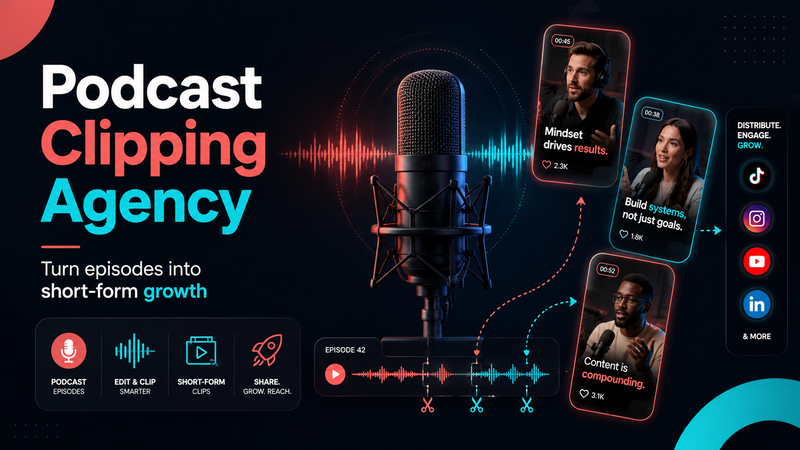

Most podcasts do not fail because the conversations are bad. They fail because the distribution is too weak. A brand records a strong 45-minute episode, publishes it on YouTube or Spotify, shares one post about it, and then expects the audience to find the best parts on their own. That rarely happens. The audience is busy, social feeds move quickly, and even a useful episode can disappear if the strongest moments are not pulled out and placed where people already spend time.
A Podcast Clipping Agency helps brands, creators, founders, agencies, coaches, and media teams turn long podcast episodes into short clips for LinkedIn, TikTok, Instagram Reels, YouTube Shorts, email, landing pages, newsletters, and sales follow-ups.
The definition is straightforward. A podcast clipping agency reviews long podcast recordings, identifies the best standalone moments, edits them into short-form videos, adds captions, formats them for each platform, and helps each episode create more reach than it would get from one full upload alone. A good agency is not just cutting random sections from a recording. It is choosing clips that carry a complete idea, match the audience’s intent, and support a real business goal.
The Straight Answer
A podcast clipping agency helps you turn one long episode into multiple short clips that can attract new viewers, remind existing followers of your expertise, give guests something easy to share, and support the wider marketing funnel.
This matters because most people do not discover a podcast by searching for a full episode. They discover it through a strong clip. They might see a guest explaining a painful industry problem on LinkedIn, a founder sharing a sharp opinion on YouTube Shorts, a useful answer on Instagram Reels, or a debate-style moment on TikTok. If that clip is relevant, they may follow the show, watch the full episode, visit the website, join the newsletter, or remember the brand when they are ready to buy.
For a business podcast, clipping is not just about social media activity. It can support thought leadership, sales education, founder visibility, demand generation, and trust building. For a creator podcast, it can support discovery and audience growth. For a founder-led company, it can turn one thoughtful conversation into weeks of useful content without forcing the team to record every day.
Why Podcast Clipping Works
Podcast episodes are naturally rich source material because they include real conversation. A guest explains something from experience. A founder shares a belief that shows how the company thinks. A customer describes a buying decision in their own words. A host asks a question the audience has probably asked before. These moments are useful because they feel human, specific, and credible.
The problem is attention. A full episode asks the viewer for a large commitment before they know whether the content is worth their time. A short clip lowers that barrier. It gives the audience one useful idea first. If that idea lands, the full episode becomes easier to explore.
A strong podcast clipping system can help with:
Turning one episode into multiple useful assets
Reaching people who do not yet follow the show
Giving guests ready-to-share clips
Supporting LinkedIn, TikTok, Reels, and Shorts from one recording
Creating sales-friendly clips from founder or expert conversations
Building a recognisable point of view over time
Improving the return from every podcast recording
The goal is not to clip every possible moment. The goal is to extract the moments that can travel on their own and still make the brand look clear, useful, and credible.
Clipping Agency’s Angle: Selection Beats Volume
Clipping Agency’s view is that podcast clipping should not be treated as a quantity game. Some teams try to pull 25 clips from every episode because they want more content, but more clips do not automatically create better distribution. Weak clips fill a calendar, but strong clips build attention.
A good podcast clip should make sense to someone who has never heard of the show, the guest, or the brand. It should not require five minutes of missing context. It should deliver one complete idea and give the viewer a reason to care.
The best podcast clips usually have three things:
A clear opening that tells the viewer why the point matters
One focused idea that does not depend heavily on the full episode
A clean ending that feels complete rather than randomly cut off
This is where a podcast clipping agency earns its value. Editing matters, but selection matters more. If the wrong moment is chosen, captions and visuals will not save it. If the right moment is chosen, the edit only needs to make the idea easier to watch, understand, and share.
Step-by-Step Process
Step 1: Review the Full Episode With a Distribution Lens
The process starts by reviewing the full episode carefully. The goal is not to find random funny lines or anything that sounds dramatic. The goal is to find moments that can help the audience understand the brand, the guest, the topic, or the problem being discussed.
A strong episode review looks for:
A guest explaining a common problem clearly
A founder sharing a strong point of view
A customer describing a real result
A host asking a question the audience already has
A story that shows trust, process, or expertise
A practical tip that can stand alone
A useful disagreement or surprising answer
A moment that explains the brand’s category clearly
Not every episode will produce the same number of clips. A strong 60-minute episode may produce 8 to 15 useful clips. A slower episode may only produce 3 to 5. The number matters less than whether each clip has a reason to exist.
Step 2: Choose Clips Around a Clear Goal
Podcast clipping works better when every clip is connected to a goal. Without a goal, the output can feel scattered, even if the editing looks polished.
The goal might be:
Grow the podcast audience
Build founder authority
Drive traffic to the full episode
Create LinkedIn thought leadership
Support a service page
Educate buyers before a demo
Build trust through guest expertise
Keep social channels active between episodes
Create assets the guest can share
A B2B podcast may need clips that answer buyer questions and build trust before a sales conversation. A creator podcast may need clips that create curiosity and pull people into the full episode. A founder-led podcast may need clips that make the founder’s thinking easier to discover. The same episode can serve different goals, but each clip should still be chosen with intent.
Step 3: Select Moments That Work Without the Full Episode
A podcast moment can sound strong inside the full conversation but fail as a standalone clip. This usually happens when the clip depends too much on earlier context. The viewer should not feel like they joined halfway through a private discussion.
A strong podcast clip usually has:
One clear idea
A strong first line
Enough context for a new viewer
Natural pacing
Clean audio
A useful takeaway
A reason to watch, save, share, comment, or click
Sometimes light context can be added through captions, a title card, or a trimmed opening. However, the core idea should still be clear without needing a long explanation.
Step 4: Edit for the Platform
A podcast clip should fit the platform where it will be published. A LinkedIn clip may need a professional angle and a stronger written caption. A TikTok clip may need a quicker opening. An Instagram Reel may need a better visual rhythm. A YouTube Short may need a clearer searchable topic.
Good podcast clip editing includes:
Clean cuts that remove dead space
Readable captions
Proper aspect ratio
Strong opening frame
Balanced audio
Clear speaker focus
Simple branding
Platform-friendly pacing
A call to action when needed
The edit should not make the conversation feel fake. Some brands over-edit podcast clips until the natural delivery disappears. A better approach is to keep the human feel while making the clip easier to consume.
Step 5: Package the Clip Properly
A clip is not only the video file. The title, caption, thumbnail, description, hashtags, guest tag, and post angle all affect performance. A strong clip can underperform if it is posted with a weak caption or unclear title.
A good clip package may include:
A short title
A platform-specific caption
A clear description
Suggested hashtags
Guest mention or tag
A link to the full episode where relevant
A note on where the clip should be used
For example, a clip about a founder’s hiring mistake may work well as a LinkedIn post with a thoughtful caption. A quick guest insight may work better as a YouTube Short with a clear title. A customer story clip may work on a landing page or inside a sales follow-up.
Step 6: Review Performance and Build a Repeatable System
Podcast clipping should improve over time. Once clips are published, the team should review what worked and why.
Useful signals include:
Watch time
Retention
Saves
Shares
Comments
Profile visits
Follows
Clicks to the full episode
Newsletter signups
Demo requests
Sales team usage
A clip with fewer views can still be valuable if it reaches the right audience or helps a sales conversation. A high-view clip can be valuable if it brings new listeners to the show. The point is to learn which topics, guests, hooks, and formats create useful attention.
Specific Examples
A SaaS founder records a podcast with a customer. The best moments become clips about onboarding, decision-making, workflow problems, and measurable outcomes. These clips can support LinkedIn posts, sales follow-ups, and website proof.
A marketing agency hosts a podcast with brand leaders. Strong sections become clips about campaign mistakes, content distribution, budget decisions, and creative process. These clips help the agency show how it thinks before a prospect enquires.
A coach records long interviews with clients and experts. The best moments become short clips that answer common questions, show teaching style, and build trust before someone joins a programme.
A media brand publishes weekly podcast episodes. Clipping helps each episode reach new viewers through Reels, Shorts, TikTok, and LinkedIn instead of relying only on existing listeners.
A B2B consultant records a solo podcast. The strongest insights become LinkedIn clips that explain common mistakes, buyer objections, and frameworks used in client work.
Pros and Cons
Pros
One podcast episode can become several useful clips.
The show can reach people who do not listen to full episodes yet.
Guests get shareable assets, which can expand distribution.
Clips can support social media, email, sales, and website content.
Founder and expert thinking becomes easier to discover.
The brand can publish consistently without recording every day.
Strong clips can bring people back to the full episode.
Cons
Weak episodes may not produce many strong clips.
Random clipping can make the content feel scattered.
Poor captions can reduce watchability.
Over-editing can make a natural conversation feel forced.
Results usually build over time rather than from one clip.
Cheap clipping services may focus on quantity instead of message.
Podcast clips still need a publishing plan to work properly.
The best results come when podcast clipping is connected to the purpose of the show, not treated as an afterthought.
Common Mistakes
Many brands weaken podcast clipping by rushing the process. They choose clips because they are easy to cut, not because they are useful to the audience.
Common mistakes include:
Clipping moments that need too much missing context
Choosing funny moments that do not support the brand
Making every clip a sales pitch
Posting the same version on every platform
Using captions that are too small or crowded
Ignoring the guest’s shareability
Measuring only views
Forgetting to link back to the full episode
Publishing heavily for one week and then stopping
Cutting too many clips from a weak episode
A good podcast clip should give the viewer something useful, even if they never watch the full episode.
Real Business Use Cases
For audience growth, podcast clips create discovery points for people who do not yet know the show. A short clip can introduce the topic, guest, or host in a way that feels easier than asking for a full listen.
For founder visibility, clips can turn thoughtful comments into repeat social content. This is useful for founder-led brands where trust is connected to the person behind the company.
For lead generation, clips can guide viewers toward a full episode, newsletter, demo, or service page. The call to action should feel natural and connected to the topic.
For sales support, clips can answer common objections, explain process, share proof, and make follow-ups more useful. A salesperson can send a short clip instead of asking a prospect to watch a long recording.
For guest distribution, clips give guests something easy to share. This can help the episode reach a wider audience through the guest’s network.
FAQs
What is a podcast clipping agency?
A podcast clipping agency helps brands and creators turn long podcast episodes into short clips for LinkedIn, TikTok, Instagram Reels, YouTube Shorts, email, websites, and sales follow-ups.
What does a podcast clipping agency actually do?
It reviews podcast episodes, selects strong moments, edits clips, adds captions, formats them for platforms, and packages them for distribution. Some agencies also help with titles, captions, posting plans, and performance review.
How many clips can one podcast episode create?
It depends on the quality of the episode. A strong 60-minute episode may create 8 to 15 useful clips. A weaker episode may only create 3 to 5. The goal should be useful clips, not the highest number possible.
Which podcast moments make the best clips?
Strong clips usually include clear answers, useful stories, sharp opinions, common mistakes, customer proof, practical advice, or moments that explain the brand’s point of view.
Can podcast clips help B2B brands?
Yes. B2B brands can use podcast clips to explain complex topics, build founder authority, answer buyer questions, share customer proof, and support sales conversations.
Should every podcast episode be clipped?
Most episodes can produce at least a few clips, but not every episode should be clipped heavily. Some recordings are better used for a small number of strong moments.
Where should podcast clips be posted?
Common channels include LinkedIn, TikTok, Instagram Reels, YouTube Shorts, email newsletters, landing pages, guest social profiles, and sales follow-ups. The right mix depends on the audience and content goal.
Final Thoughts
A podcast clipping agency should not simply make episodes shorter. It should help brands turn the strongest ideas inside each episode into content that can travel further.
A full podcast episode is valuable, but it asks for a lot of attention. Short clips make the best moments easier to discover, easier to share, and easier to reuse across the customer journey.
If your brand is already recording podcasts, interviews, webinars, or long-form conversations, the next step may not be recording more. It may be building a better system for turning those conversations into clips that create repeat visibility.
Clipping Agency can help brands turn long podcast episodes into short-form assets that support reach, trust, audience growth, and business outcomes.

Comments
No comments yet. Be the first to comment!