
YouTube Shorts Clipping Campaign: A Better Way to Reuse Long Videos
How brands turn podcasts, webinars, interviews, and long videos into Shorts that support reach, trust, and consistent publishing.
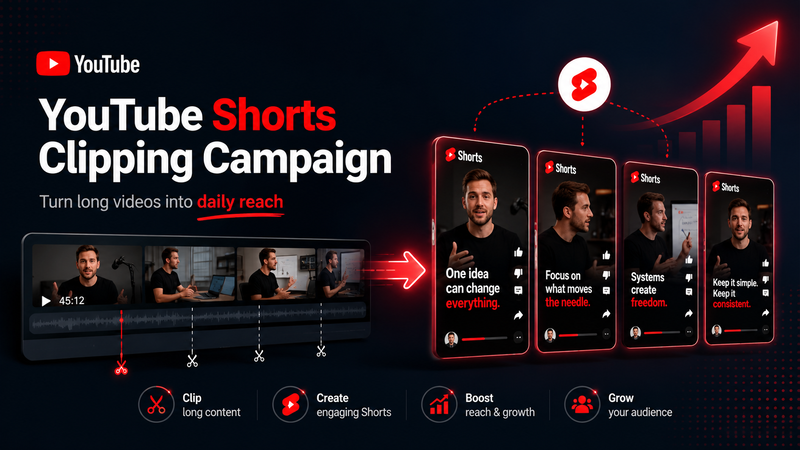

A lot of brands keep asking what they should post next, even though they already have useful video sitting in their own content library. A podcast may have a sharp answer 28 minutes in. A webinar may have one section where the speaker explains a customer problem better than the sales page does. A founder interview may include a story that would work perfectly as a short clip. The content is already there, but the brand does not have a clean system for pulling it out and publishing it properly.
That is the real value of a YouTube Shorts Clipping Campaign. It takes long-form video content and turns the strongest moments into short-form videos built for YouTube Shorts. The goal is not to cut random sections from a long video. The goal is to find the parts that can stand alone, make them easier to watch, and publish them in a way that supports discovery, authority, and repeat visibility.
YouTube Shorts can be especially useful because it sits inside the same ecosystem as long-form YouTube content. A viewer may discover a brand through a 40-second Short, then later explore the full video, channel, service page, podcast, or offer. That makes Shorts more than a content filler. Used properly, they become entry points into the wider brand.
What a YouTube Shorts clipping campaign actually means
A YouTube Shorts clipping campaign is a structured process for turning long-form videos into short-form YouTube clips. It usually includes reviewing source videos, selecting the best moments, editing them vertically, adding context, writing titles, publishing consistently, and tracking what performs.
The source content can include:
Podcasts
Webinars
Founder interviews
Product demos
Long YouTube videos
Livestreams
Customer Q&A sessions
Event recordings
Coaching calls
Educational videos
A proper campaign is not just repurposing for the sake of posting. It is content selection with a purpose. Each Short should have a clear point, a strong enough opening, and enough context for someone who has never seen the full video.
The simple definition is this: a YouTube Shorts clipping campaign turns long-form video into short-form discovery assets.
The practical answer for brands
A YouTube Shorts clipping campaign is useful when a brand already has valuable long-form video but is not getting enough reach from it.
It works especially well for:
Podcasts that need more episode discovery
SaaS brands with webinars and demos
Founders who record interviews or thought leadership
Coaches and consultants with educational sessions
B2B companies with long-form explainers
Creator-led brands with regular video output
Agencies and service businesses with client education content
The campaign makes sense when the brand has strong ideas on video but no repeatable system for turning those ideas into short-form content. A single long recording can often become several Shorts, but only when the right moments are chosen.
Why Shorts need a real campaign, not random clips
Many brands treat Shorts as an afterthought. They upload a long video, cut one quick clip, add captions, and move on. That may create a post, but it does not create a campaign.
A YouTube Short has to work quickly. The viewer may not know the speaker, the topic, the brand, or the full context. If the clip starts too slowly or needs too much background, the viewer will leave before the useful part arrives.
A good campaign asks better questions before editing:
What is the one idea in this clip?
Can the viewer understand it without the full video?
Does the opening create interest quickly?
Is the clip useful, entertaining, or specific enough?
Does it make the brand look credible?
Can this Short lead someone toward more content?
This is where a campaign becomes different from basic clipping. It is not about creating as many Shorts as possible. It is about creating the right Shorts often enough to build momentum.
Step-by-step process for a YouTube Shorts clipping campaign
Step 1: Choose the right source videos
The campaign starts with the long-form content. Not every long video will create strong Shorts. Some videos are too slow, too vague, or too dependent on slides and context. Others are full of useful moments.
Good source content usually includes clear answers, strong opinions, practical examples, customer questions, mistakes, lessons, comparisons, or moments where the speaker explains something in a simple way.
For example, a one-hour founder interview may contain a strong customer story, a practical lesson from a failed campaign, a useful market opinion, and a clear explanation of how the product solves a problem. Each of those can become a separate Short.
Step 2: Find moments that can stand alone
The strongest Shorts usually come from moments that make sense without the full recording. This is where selection matters most.
Good clip moments often include:
A direct answer to a common question
A mistake the audience wants to avoid
A strong opinion that creates interest
A simple explanation of a confusing topic
A practical business example
A short story with a useful lesson
A comparison between two choices
A moment that shows personality or expertise
The goal is not to clip every possible section. The goal is to find the parts that can introduce the brand to someone new.
Step 3: Edit for short-form attention
Once the clips are selected, the edit should make the idea easier to watch. This usually means cutting slow openings, removing filler, tightening pauses, improving audio where possible, framing vertically, and adding readable captions.
The edit should match the brand. A serious B2B company does not need the same editing style as a comedy creator. Too many effects can make useful content feel cheap. Too little editing can make a strong idea feel slow.
Good editing does not try to hide weak content. It helps strong content move faster.
Step 4: Add context without making it feel forced
A viewer watching a Short may not know where the clip came from. A little context can help them understand why the moment matters.
A clip might use an opening like:
“Why most brands waste their long-form videos”
“How one webinar can become ten useful Shorts”
“The mistake founders make with video content”
“Why posting once is not distribution”
“What makes a Short worth watching?”
This kind of context should not feel like clickbait. It should help the viewer understand the value of the clip quickly.
Step 5: Publish consistently and study the response
A YouTube Shorts clipping campaign should not be judged by one upload. The point is to test ideas over time. Some clips will perform because of the topic. Some because of the speaker. Some because the title is clearer. Some because the opening is stronger.
Track patterns like:
Which topics get more views
Which Shorts get comments
Which openings hold attention
Which clips bring viewers back to longer videos
Which speakers or formats perform best
Which ideas deserve a full video later
This is how the campaign becomes smarter. The brand is not just posting clips. It is learning what its audience responds to.
Specific examples
A podcast team can turn each episode into several Shorts. One clip may show the guest’s strongest opinion. Another may answer a common question. Another may tell a short story that makes people want to hear the full conversation.
A SaaS company can clip a webinar into Shorts around use cases, objections, and workflows. One clip might explain a feature. Another might answer a buyer question. Another might show how a customer uses the product.
A founder-led brand can clip interviews into Shorts that show how the founder thinks. This helps build trust because people see repeated examples of the founder’s perspective.
A coaching business can clip training sessions into short lessons. The viewer gets a sample of the coach’s teaching style before booking a call or buying a programme.
A service business can clip client education videos into Shorts that answer buying questions. These clips can support both organic discovery and sales conversations.
Pros and cons of a YouTube Shorts clipping campaign
Pros
Turns long videos into more usable assets
Helps brands publish consistently
Gives older content a second life
Supports discovery inside YouTube
Helps test topics before creating more long videos
Builds trust through repeated useful clips
Can point viewers toward full videos, services, podcasts, or offers
Cons
Weak source content limits the campaign
Poor clip selection can make the output feel random
Shorts need regular publishing to build momentum
Not every clip will perform well
Over-editing can hurt credibility
Results depend on tracking and improvement
A YouTube Shorts clipping campaign works best when it is treated as a distribution system, not a one-time editing job.
Common mistakes brands make
One common mistake is choosing clips that need too much context. A moment may be useful inside the full video, but if the viewer needs ten minutes of background to understand it, it probably will not work as a Short.
Another mistake is starting too slowly. Long videos can build gradually, but Shorts do not have that much room. The viewer needs to understand the value quickly.
Brands also make the mistake of turning every Short into a sales pitch. Shorts can support sales, but if every clip feels promotional, people have little reason to keep watching.
Other common mistakes include:
Choosing clips only because the team likes them
Ignoring titles and descriptions
Using captions that are too small or messy
Posting a few times and stopping
Treating Shorts as leftover content
Not tracking what performs
Failing to connect Shorts to a wider content strategy
Clipping Agency’s angle
From Clipping Agency’s point of view, the biggest opportunity is not just creating more Shorts. It is helping brands get more value from content they already paid to produce.
A webinar takes planning. A podcast takes time. A founder interview takes attention. A product demo takes effort. If that content is published once and then forgotten, the brand is leaving value behind.
The original insight is that a YouTube Shorts clipping campaign can work as both a distribution system and a research system. The Shorts help ideas travel further, but they also show which topics people respond to. If several Shorts around one question perform well, that question may deserve a full video, a landing page section, an email campaign, or a sales script.
That is why clipping should not be seen as basic repurposing. It is a way to extend content lifespan, test ideas, and build a more consistent brand presence.
Real business use cases
A B2B founder can turn weekly interviews into Shorts that build authority without filming new content every day.
A podcast can use Shorts to promote the best moments from each episode and attract people who have never heard of the show.
A SaaS brand can clip demos and webinars into short use-case videos that explain the product more clearly.
A coaching brand can clip workshops and Q&A sessions into short educational videos that show how the coach thinks.
A creator-led business can turn long YouTube videos into Shorts that bring new viewers back to the main channel.
FAQs
What is a YouTube Shorts clipping campaign?
A YouTube Shorts clipping campaign is a structured process of turning long-form videos into short-form clips for YouTube Shorts. It includes selecting strong moments, editing them, packaging them, publishing consistently, and tracking performance.
Is clipping better than filming new Shorts?
It depends on the brand. If the brand already has strong long-form content, clipping is often faster and more efficient. If there is no useful source content, filming new Shorts may be the better first step.
How many Shorts can one long video produce?
It depends on the quality of the recording. A strong podcast, webinar, or interview may produce several usable Shorts. A weaker recording may only produce one or two.
Do YouTube Shorts need captions?
Captions are usually helpful because many viewers watch short-form videos without sound or in noisy environments. Captions should be readable, clean, and timed properly.
Can Shorts help promote long-form videos?
Yes. A strong Short can introduce a viewer to a topic, speaker, or idea, then encourage them to watch the full video or explore the channel.
Final thoughts
A YouTube Shorts clipping campaign is not about cutting long videos into random short pieces. It is about finding the best moments, shaping them clearly, and publishing them in a way that helps more people discover the brand.
For creators, founders, podcasts, coaches, and companies with long-form content, this can turn one recording into several useful assets. The best clips do more than fill a content calendar. They help the right ideas travel further.
Clipping Agency helps brands turn long-form content into short-form clips that are easier to publish, test, and distribute. If your team already creates useful videos but does not get enough reach from them, a structured clipping campaign can help you get more value from every recording.

Comments
No comments yet. Be the first to comment!