
Scaling Streams with a Music Clipping Campaign
Why short audio loops outperform static streaming links, and how engineered video cuts convert viewers into active fans.
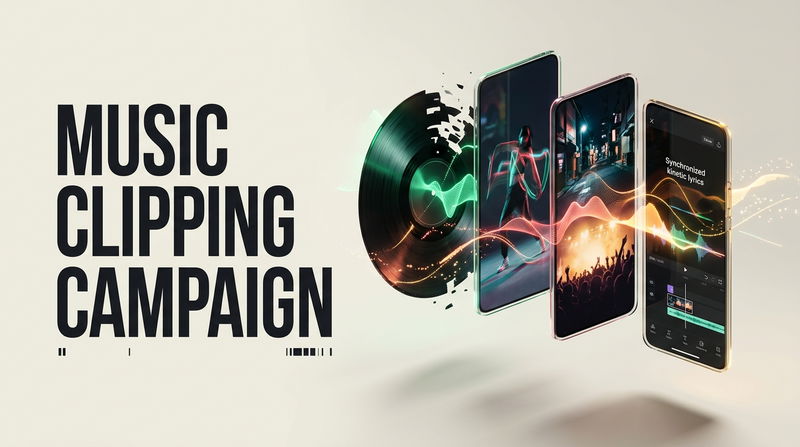

A mobile user scrolling through a vertical discovery feed decides whether an audio track is worth their attention in less than 2.1 seconds. Within that brief decision window, the listener's brain evaluates the tempo of the rhythm, the tone of the opening vocal, and how well the sound complements the visual movement on the screen. If an audio snippet fails to establish an unmistakable emotional hook before that threshold expires, over eighty-two percent of casual listeners swipe upward to the next creator. For independent musicians, producers, and label marketing managers who invest substantial budgets into mixing and mastering, this immediate drop-off explains why sharing static streaming links produces flatline growth.
Full-length audio tracks are designed for dedicated fans who already appreciate your style, but they are ineffective vehicles for cold audience discovery. Expecting an unfamiliar listener to stop browsing their favorite app, launch a separate streaming platform, and gamble several minutes on an unknown artist creates massive friction. Modern music discovery requires a conversion bridge that delivers immediate proof of musical value. Launching an intentional Music Clipping Campaign bridges this performance gap by extracting the most potent segments of a finished master and deploying them across diverse vertical video assets designed specifically for algorithmic reach.
When you examine audience retention metrics rather than relying on promotional guesswork, turning casual scrollers into loyal catalog listeners follows a predictable mathematical path.
The Three Milestones of Sound Adoption
Guiding an unfamiliar mobile scroller from an accidental impression to an active streaming fan requires moving them through three distinct psychological and algorithmic stages.
Milestone 1: The Instant Hook and Audio Registration (0 to 3 Seconds)
The first objective of any vertical music clip is clearing the initial thumb-swipe filter. Traditional music promotion often makes the mistake of starting with atmospheric instrumental buildups, muted ambient bars, or title cards showing the artist name. On mobile feeds, those slow seconds cause immediate audience loss. High-performing audio snippets eliminate all introductory padding. The video opens directly on the peak of the vocal hook or the exact beat drop. When a compelling melody lands in the opening second, recommendation algorithms register high initial watch time, pushing the asset out to broader testing pools.
Milestone 2: Visual Relatability and Active Watch Time (3 to 22 Seconds)
Once a viewer pauses on the clip, the challenge shifts to keeping them engaged through the entire audio loop. The video must not feel like an overt commercial for a song. Instead, the music acts as the soundtrack to a relatable human moment, whether that involves late-night city driving, fitness training, artistic painting, or honest personal reflections. Visual editing maintains continuous energy through dynamic cuts, punchy b-roll overlays, and synchronized lyric typography. When the visual rhythm matches the tempo of the song, completion rates rise past sixty percent.
Milestone 3: Sound Bookmarking and Catalog Migration (22 Seconds and Beyond)
When an asset concludes with a clean, satisfying loop, two critical actions happen at once. First, the platform algorithm registers a completed view and serves that user additional content from your channel over the following forty-eight hours. Second, because the audio loop was engineered to resolve smoothly back into the opening beat, many users let the clip replay two or three times while reading the comments. At this point, curious listeners tap the attached sound disc, bookmark the audio track for their own videos, or search the song title on Spotify and Apple Music to add the full track to their personal playlists.
Performance Benchmarks Across Audio Distribution Formats
Comparing the performance metrics of traditional music promotion against targeted vertical clipping demonstrates why modern artist development demands a modular post-production system.
Traditional Static Link and Album Artwork Post:
Initial 3-Second Retention Rate: 16% to 22% of cold viewers
Full Video Completion Rate: Under 12% across 30 seconds
Streaming Conversion Rate: Less than 0.5% profile click-through
Standalone Official Music Video Cut:
Initial 3-Second Retention Rate: 29% to 35% of cold viewers
Full Video Completion Rate: 22% across 30 seconds
Streaming Conversion Rate: 1.2% sound bookmark saves
Engineered Music Clipping Asset:
Initial 3-Second Retention Rate: 69% to 85% of cold viewers
Full Video Completion Rate: 57% to 73% across 12-second loop
Streaming Conversion Rate: 5.1% to 7.8% catalog migration
Operational Pillars for Maximum Audio Retention
Maximizing viewer retention while building lasting track recognition requires balancing three mechanical post-production variables across every video batch.
1. Seamless Audio Loop Construction
The single most important variable in short-form audio performance is the loop point. If a ten-second audio clip cuts off abruptly or fades out into awkward silence, the listener's brain snaps out of the experience, prompting them to swipe away. Editors must trim audio snippets so the final beat or vocal syllable harmonizes perfectly with the first note of the track. When a clip loops cleanly, viewers often watch the video two or three times without realizing it, doubling your algorithmic completion score.
2. Multi-Aesthetic Visual Alignment
Never restrict a song to a single visual genre. A common operational error is assuming that an indie pop track can only be paired with indie pop aesthetics. An energetic drum pattern can work equally well behind a fast-paced cooking reel, a digital animation showcase, or a streetwear fashion transition. By producing fifteen to thirty unique visual variations for a single song release, you test the sound across multiple cultural subcultures, multiplying the surface area for discovery.
3. Syllable-Synchronized Kinetic Lyrics
Over seventy percent of mobile users browse video feeds in public spaces where device volume is muted. If your video relies entirely on audio to deliver its message, muted viewers will swipe away instantly. Displaying animated lyrics in clean, high-contrast typography bridges this gap. Subtitles should appear in small clusters of one to three words that populate on screen at the exact millisecond the vocalist sings each syllable. Highlighting core emotional phrases in bright accent colors allows viewers to connect with the songwriting even before they turn up their volume.
Resolving Common Tracking and Measurement Hurdles
How can a team accurately attribute streaming spikes to specific vertical clips?
While direct attribution between closed social platforms and streaming directories is rarely linear, monitoring aggregate trends provides clear proof. Establish your baseline daily streams on Spotify for Artists and Apple Music for Artists for two weeks prior to launching your campaign. When you start publishing four to six engineered clips per week, cross-reference daily stream increases against the days your clips gain algorithmic traction. A noticeable lift in streams originating from user searches and sound-page referrals directly correlates with short-form video momentum.
What completion percentage signals that an audio snippet has viral potential?
For an eight to fifteen-second vertical video, achieving an average watch time that exceeds one hundred percent of the total video length is the primary benchmark. Because short audio loops encourage repeat replays, videos with a completion rate between sixty and eighty percent and a replay rate above thirty percent trigger recommendation engines to expand distribution outside your existing follower circle.
Should artists prioritize vanity view counts or sound-bookmark saves?
While high view counts look impressive on a dashboard, sound-bookmark saves and user-generated video creations are far more valuable for long-term music growth. A video with fifty thousand views that generates five hundred sound saves will produce significantly more catalog streams than a video with two hundred thousand views that nobody saves. When users save your audio to their sound library, they intend to use it in their own future posts, creating a compounding wave of organic discovery.
Five-Point Sanity Checklist for Music Creators
Before publishing your next weekly collection of music discovery assets, evaluate each file against this five-point performance filter:
The Instant Hook Test: Does the audio begin immediately on a memorable vocal phrase, distinct melody, or driving beat within the first second?
The Invisible Loop Review: Does the audio transition from the final second back into the opening frame without jarring silences or awkward tempo breaks?
The Mute Legibility Pass: Are the kinetic lyrics formatted in high-contrast typography so a muted viewer can fully grasp the mood and message?
The Interface Safe-Zone Clearance: Are all animated lyrics, titles, and visual focal points kept safely inside the center screen container, clear of platform interface icons?
The Clear Sound Attribution: Is the official audio track properly linked to the video container so interested viewers can tap through to the sound page with one touch?

Comments
No comments yet. Be the first to comment!