
UGC Ads vs Clipping: How Brands Should Choose
A practical guide to picking the right short-form content strategy for paid growth, organic reach, and better content distribution.
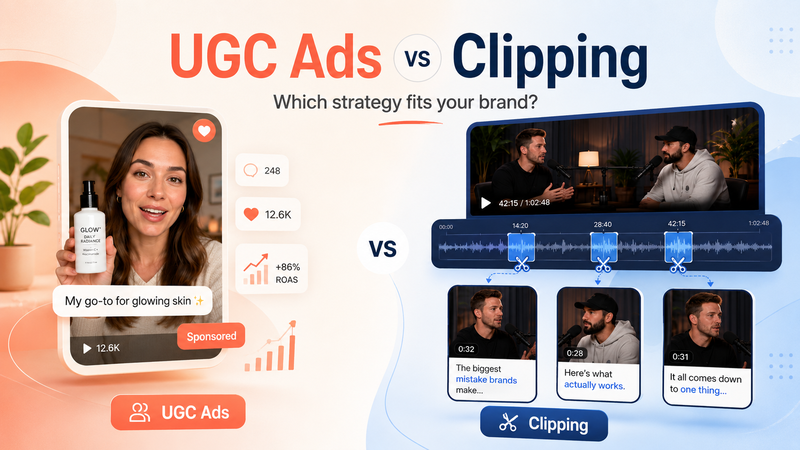

A brand can spend a lot of money creating short-form videos and still end up with content that feels scattered. One video is made for paid ads, another is pulled from a podcast, another is edited for Instagram, and another is posted on TikTok without any clear reason behind it. The problem is not always the video itself. The problem is that the brand has not decided what role each type of content is supposed to play.
That is where the comparison between UGC Ads vs Clipping becomes useful. Both are connected to short-form video, but they are not the same strategy. UGC ads are usually created to sell, test offers, and support paid campaigns. Clipping is usually used to turn existing long-form content into short-form assets that can build reach, trust, and consistency over time.
Clear definition
UGC ads are paid advertising videos designed to look and feel like content made by a real user, customer, creator, or everyday person. They often include product demos, reviews, testimonials, problem-solution scripts, unboxings, or creator-style explanations. The goal is usually to make an ad feel less polished and more natural while still guiding the viewer toward a specific action.
Clipping is the process of taking long-form content and turning the strongest moments into short-form clips. The source content could be a podcast, webinar, YouTube video, founder interview, livestream, coaching call, event recording, product demo, or expert conversation. Instead of filming a new ad from scratch, clipping finds useful moments that already exist and packages them for platforms like TikTok, Instagram Reels, YouTube Shorts, LinkedIn, and Facebook.
The simplest way to understand it is this: UGC ads create new ad-style content around a message. Clipping extracts existing value from longer content and turns it into short-form distribution assets.
Short answer
UGC ads are usually the better choice when your brand needs paid creative, product-focused messaging, direct-response testing, and clear offer promotion.
Clipping is usually the better choice when your brand already has long-form content and wants more reach, stronger authority, more consistent posting, and better content distribution without filming something new every day.
For many brands, the smartest approach is not choosing one forever. A strong brand can use clipping to discover which topics, pain points, hooks, and ideas people care about, then turn those proven ideas into UGC ads for paid campaigns.
Why the difference matters
A UGC ad and a clipped video may both appear as vertical videos, but they come from different thinking.
A UGC ad often begins with a brief. The brand decides the angle, product benefit, offer, creator profile, script, and call to action. The content is made to serve a campaign. It may be tested against other ads, measured by conversion rate, and replaced when performance drops.
A clipped video starts with source material. The editor, strategist, or clipping team looks through a longer recording and identifies moments that can stand alone. A good clip may explain a problem, answer an objection, show expertise, share a strong opinion, or make the viewer want to learn more.
The distinction matters because the wrong choice can waste budget. A brand that needs paid sales creative may not get enough from random podcast clips. A brand with hours of valuable founder content may waste money on UGC ads before using the assets it already owns.
Step-by-step process to choose the right strategy
Step 1: Review what content you already have
Before hiring creators or editing clips, look at your current content library. Many brands already have useful material sitting unused.
Check for:
Podcasts
Webinars
Founder interviews
Customer interviews
Long-form YouTube videos
Livestreams
Training sessions
Sales demos
Event recordings
Product walkthroughs
Behind-the-scenes videos
If your brand already has strong long-form content, clipping is often the natural first step. You are not starting from zero. You are turning existing material into more assets.
If there is no useful source content, UGC ads may be easier to launch because you can brief creators and produce videos around specific angles.
Step 2: Decide the main goal
The goal should decide the format.
Choose UGC ads if you want to:
Test paid ad angles
Promote a product or offer
Drive traffic to a landing page
Create retargeting videos
Handle buying objections
Show a product in use
Generate direct-response creative
Choose clipping if you want to:
Grow organic reach
Repurpose long-form content
Build trust with consistent posting
Increase founder or expert visibility
Turn podcasts into short videos
Create more content from fewer recordings
Learn which ideas your audience responds to
This is one of the biggest mistakes brands make. They choose a format because they saw another company use it, not because it matches the job they need the content to do.
Step 3: Understand your budget
UGC ads can be effective, but the cost is not only the creator fee. You may also need scripts, product shipping, multiple creators, editing, revisions, usage rights, and paid media budget. If one ad does not work, you need more variations.
Clipping has a different cost structure. If you already have long-form content, one recording can produce several clips. A one-hour podcast might create 8 to 15 short-form assets if the conversation is strong enough. A webinar might create clips around objections, examples, product value, and customer questions.
This does not mean clipping is always cheaper. Poor clipping wastes time as well. The point is that clipping can create more output from content that has already been produced.
Step 4: Think about trust and control
UGC ads give more control. You can tell the creator what to say, what product feature to show, what hook to use, and what offer to mention.
Clipping gives a different kind of trust. A founder explaining a real lesson, a guest sharing a sharp insight, or an expert answering a specific question can feel more natural than a scripted ad. The viewer can sense when the content comes from a real conversation instead of a forced sales script.
If your campaign needs a specific offer and a clear call to action, UGC ads are easier to control. If your brand needs depth, authority, and consistent presence, clipping may feel more credible.
Step 5: Build a simple testing loop
The best brands do not treat organic content and paid creative as separate systems. They connect them.
A practical workflow looks like this:
Record long-form content around useful topics.
Clip the strongest moments into short-form videos.
Publish clips across relevant platforms.
Track which hooks, topics, and pain points get engagement.
Turn the best-performing ideas into UGC ad briefs.
Test those UGC ads with paid media.
Use paid results to guide future content topics.
This process helps the brand stop guessing. Instead of writing UGC scripts based only on assumptions, the brand can use real audience behavior to shape paid creative.
Specific examples
A skincare brand with no long-form content may start with UGC ads. A creator can show the product, explain the skin problem, apply the product, and give a quick reason to try it. This works because the product is visual and the buyer can understand the value quickly.
A SaaS brand running weekly webinars should probably look at clipping first. Each webinar may include product explanations, customer questions, use cases, objections, and expert advice. These moments can become short LinkedIn videos, YouTube Shorts, and retargeting content.
A podcast host can use clipping to grow the show. Instead of publishing one full episode and hoping people listen, the host can distribute the best moments as short clips. A strong 45-second clip can introduce the guest, the topic, and the value of the full episode.
A coaching business can clip workshops, Q&A sessions, interviews, and training calls. These clips can answer common questions, show expertise, and help potential clients understand the coach’s approach before booking a call.
A DTC brand can combine both. It can use UGC ads for product campaigns and clipping for founder content, customer education, and behind-the-scenes videos.
Pros and cons of UGC ads
Pros
Strong fit for paid campaigns
Useful for product demos and testimonials
Can be created without long-form content
Easier to brief around a clear offer
Good for testing hooks and objections
Works well for ecommerce, apps, SaaS, courses, and services
Cons
Can become expensive when scaled
Many UGC ads start to look similar
Creator management takes time
Usage rights can add complexity
Weak scripts can make the content feel fake
Performance often depends on paid spend
UGC ads are strongest when the brand has a clear offer, a defined audience, and a proper system for testing creative.
Pros and cons of clipping
Pros
Turns existing content into more assets
Supports organic reach and consistency
Builds authority through real expertise
Helps brands get more from podcasts, webinars, and interviews
Reveals which ideas people respond to
Creates a repeatable short-form content system
Cons
Needs strong source content
Not every long-form video contains useful clips
Requires editorial judgment, not just editing
Poor hooks can weaken good content
Results depend on consistent distribution
Clips need proper context to stand alone
Clipping works best when it is treated as a strategy, not just a basic editing task.
Common mistakes brands make
One common mistake is thinking UGC ads automatically feel authentic. A creator holding a product does not make the content trustworthy by itself. If the script is weak, the hook is generic, or the claim feels forced, the ad will still feel like an ad.
Another mistake is treating clipping as simple trimming. A good clip is not just a shorter version of a long video. It needs a clear opening, a useful point, enough context, clean pacing, readable captions, and a reason for the viewer to keep watching.
Brands also make the mistake of using the same measurement for both formats. UGC ads may be judged by conversion rate, cost per acquisition, click-through rate, and return on ad spend. Clipping may be judged by watch time, saves, comments, shares, profile visits, content output, lead quality, and topic validation.
Other mistakes include:
Posting clips without a clear hook
Making every organic clip feel like a sales pitch
Hiring UGC creators without a strong brief
Ignoring the comments and questions under clips
Using long intros before reaching the useful point
Copying competitor formats without understanding the audience
Creating content once and failing to build a repeatable system
Clipping Agency’s angle
From Clipping Agency’s perspective, the most important difference is that UGC ads are usually campaign assets, while clipping can become a content operating system.
A UGC ad is often made for a specific test. If it works, the brand scales it. If it stops working, the brand replaces it. That can be useful, but it creates a constant need for new creative.
Clipping gives the brand more leverage from content it already owns. A podcast, interview, webinar, or founder recording does not have to be used once and forgotten. It can become a library of short-form videos that support awareness, education, trust, and future paid campaigns.
The original insight here is that clipping can help a brand find its best ideas before it spends heavily on ads. If a clipped video performs well organically, that signal matters. It shows that the topic has pull. That same idea can then be used in UGC ad scripts, landing page copy, email campaigns, sales calls, and future content planning.
In other words, clipping does not only create more content. Done properly, it helps the brand understand what message is worth repeating.
Real business use cases
A B2B agency can use clipping to turn founder interviews, service explainers, podcast appearances, and client conversations into short-form content. These clips can build trust before a prospect ever visits the website.
A SaaS company can clip webinars, demos, onboarding sessions, and customer education videos. The clips can explain use cases in a way that feels more natural than a polished product ad.
A DTC brand can use UGC ads for offers, product launches, seasonal campaigns, and retargeting. It can also use clipping if the founder records product education, brand story content, or customer-focused videos.
A podcast can use clipping to create attention for each episode. Instead of depending only on full-length listeners, the podcast can grow through short clips that highlight the best parts of each conversation.
A personal brand can use clipping as the main content engine. Long interviews, coaching calls, workshops, and livestreams can become a steady stream of short-form posts.
FAQs
Is clipping better than UGC ads?
Clipping is better when the brand already has strong long-form content and wants more organic reach, trust, and consistent publishing. UGC ads are better when the brand needs paid creative around a specific product, offer, or conversion goal.
Can UGC ads and clipping work together?
Yes. In many cases, they work better together. Clipping can show which ideas people respond to, and those ideas can be turned into UGC ad briefs for paid testing.
Do UGC ads only work for ecommerce?
No. Ecommerce brands use UGC ads often because products are easy to demonstrate, but SaaS brands, apps, courses, coaches, and service businesses can also use UGC-style ads if the message is clear.
Does clipping require a podcast?
No. Podcasts are useful, but clipping can also work with webinars, YouTube videos, livestreams, founder videos, interviews, event recordings, product demos, and training sessions.
Which strategy should a small brand start with?
A small brand with no long-form content and a clear offer may start with UGC ads. A small brand with existing webinars, interviews, podcasts, or founder videos should usually start with clipping because it can create more content from assets that already exist.
Final thoughts
UGC ads and clipping both belong in a serious short-form video strategy, but they should not be used blindly. UGC ads are usually better for paid performance, product messaging, and offer testing. Clipping is better for distribution, authority, consistency, and turning long-form content into more short-form assets.
The right starting point depends on what the brand already has. If there is a clear product offer and no useful content library, UGC ads may be the faster move. If the brand has long-form content sitting unused, clipping may be the smarter place to start.
Clipping Agency helps brands turn long-form content into short-form videos that are easier to publish, test, and distribute. If your brand already records valuable content but does not get enough reach from it, a structured clipping system can help you get more value from every recording without turning every post into another ad.

Comments
No comments yet. Be the first to comment!