
UGC Ads vs Clipping: Match the Content to the Goal
A practical way to choose between creator-led advertising and expertise-led short-form distribution.
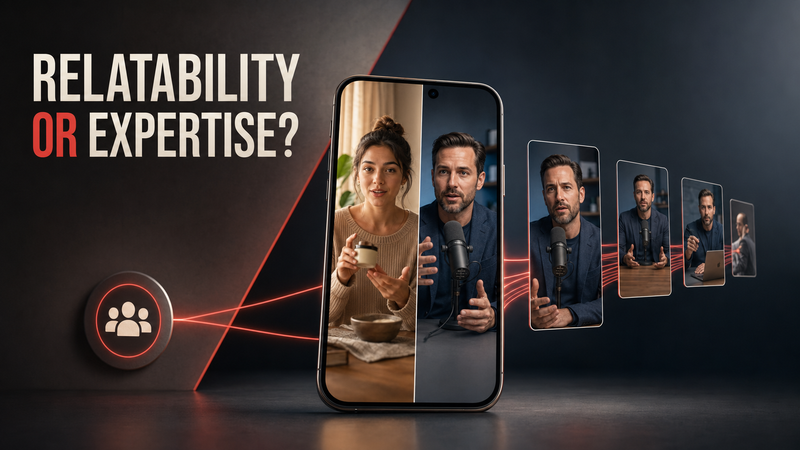

A short-form video can look natural, hold attention, and still be the wrong asset for the business objective. That is why the choice between UGC ads and clipping should happen before creators are briefed, editors begin cutting footage, or a media budget is assigned.
The two formats often appear similar in a feed, but the underlying systems are different.
UGC ads are promotional videos made to resemble content created by an ordinary customer or independent creator. A brand typically commissions the footage around a product, service, problem, or offer, then distributes it through paid advertising. The creator may demonstrate the product, describe a personal experience, compare alternatives, or answer a common purchasing concern.
Clipping is the strategic repurposing of useful moments from long-form video into self-contained short-form content. The source material may be a podcast, interview, webinar, livestream, presentation, or educational YouTube video. The clips are edited and distributed to extend the reach of the original speaker’s ideas.
The central question in UGC Ads vs Clipping is therefore not which format attracts more views in isolation. It is whether the business needs creator-led persuasion for a defined offer or broader distribution of knowledge it already owns.
The Most Useful Decision Rule
Use UGC ads when the audience needs to see a product in a relatable situation and the business wants controlled paid delivery. Use clipping when the audience needs to hear the founder, expert, host, or customer explain a valuable idea and the business wants to build an organic content library from existing recordings.
If the company needs both discovery and conversion, the formats can work together. Clips can introduce the problem and establish the business’s point of view. UGC ads can then demonstrate the offer and give interested prospects a clear reason to act.
What UGC Ads Are Designed to Do
UGC advertising is built around a campaign message. The process usually starts with a target customer, a desired action, and a reason that customer might hesitate. The creator records a video that expresses the message in language and surroundings that feel familiar to the intended audience.
A useful UGC brief normally specifies:
The customer problem or situation to open with
The product benefit that should be demonstrated
The proof that can be shown honestly
The objection the creator should address
The offer and next action
The claims or phrases that must be avoided
The creator still needs enough freedom to sound natural. When every pause, expression, and sentence is prescribed, the result often looks like a conventional commercial wearing casual clothes. Believable UGC depends on a clear message delivered in the creator’s own rhythm.
Paid distribution gives the brand control over targeting and timing. It also creates ongoing requirements. The business needs a media budget, conversion tracking, landing pages that match the creative, and enough variations to manage creative fatigue.
What Clipping Is Designed to Do
Clipping begins with a different asset: a longer conversation or presentation containing ideas worth distributing. The task is not to force an advertisement into the footage. It is to find moments that are useful enough to earn attention on their own.
A strong clip usually contains one clear unit of value, such as:
A direct answer to a recurring customer question
A practical framework viewers can apply
A well-reasoned opinion about an industry problem
A surprising observation supported by experience
A concise story with a relevant conclusion
The editor removes unnecessary context, tightens the sequence, reframes the video for vertical viewing, and adds readable captions. The opening must help the intended viewer recognise the subject quickly, but it should not exaggerate what the speaker actually says.
Clipping also requires distribution discipline. The business needs to decide which accounts and platforms fit the audience, how frequently clips should appear, which captions add context, and what performance signals will guide future recordings. Editing creates the asset; distribution turns it into a campaign.
Step-by-Step: How to Choose the Right Model
Step 1: Name the Business Outcome
Write the primary goal without mentioning a content format. Examples include generating trial sign-ups, building founder recognition, explaining a complex service, supporting a product launch, or reducing dependence on a single social account.
Step 2: Identify What the Audience Must Believe
For a purchase, the viewer may need to believe that the product is easy to use, suitable for someone like them, or worth the price. For an expert service, the viewer may need to believe that the company understands a difficult problem. The required belief points toward the right messenger.
Step 3: Choose the Messenger
UGC works when a relatable creator can demonstrate the experience credibly. Clipping works when the original speaker’s expertise, story, or personality is the asset.
Do not ask an unfamiliar creator to imitate authority they have not earned, and do not turn a knowledgeable founder into a fake customer.
Step 4: Audit the Available Material
Review recent podcasts, webinars, interviews, sales calls, presentations, and founder videos. If the recordings contain specific and useful explanations, clipping can create value without another production cycle.
If no suitable long-form content exists, UGC may provide a faster campaign asset.
Step 5: Decide How Reach Will Be Created
UGC ads buy delivery through a platform. Clipping relies on organic publishing and distribution across relevant accounts.
One offers tighter control; the other can build a growing library of discoverable content. The budget and operating plan should reflect that difference.
Step 6: Define Separate Success Measures
UGC performance may be judged through click-through rate, conversion rate, acquisition cost, and return on ad spend.
Clipping may be judged through retention, relevant engagement, profile visits, inbound enquiries, qualified audience growth, and the performance of recurring topics.
Step 7: Test a Coherent Series
For UGC, test different creators or message angles against the same offer. For clipping, publish a series built around one audience problem or theme.
Random content makes it difficult to understand why one asset worked and another failed.
Step 8: Use the Findings to Improve the Source
If a UGC angle converts, develop additional variations around the same customer concern. If clips about one subject repeatedly attract qualified attention, build future interviews and recordings around that subject.
Specific Example: A Home Fitness Brand
Imagine a company selling a compact strength-training system for people who exercise at home. A UGC ad could feature a creator living in a small apartment. The creator shows where the equipment fits, demonstrates a short routine, and explains why it replaced a gym membership.
The message is persuasive because the viewer can picture the product in a familiar setting.
The same brand might record a long interview with a physiotherapist about exercise consistency, progression, and common mistakes made by beginners. Clips from that interview could answer questions such as how often to train, how to select resistance, or why soreness is not a reliable measure of progress.
The UGC ad presents the offer through an identifiable user. The clipped videos give the brand credible educational material. If the company uses both, the educational clips can create familiarity while the UGC ads provide a controlled route to purchase.
Real Business Use Cases
UGC ads are a strong fit for:
Ecommerce products that need a visible demonstration
Apps with a simple problem-and-solution story
Beauty, fitness, food, and household products used in routines
Local services promoting an introductory offer
Subscription products testing several customer segments
Clipping is a strong fit for:
Founders with interviews, podcasts, or regular commentary
Consultants whose sales depend on demonstrated expertise
B2B companies that must educate prospects before conversion
Educators and coaches with recorded workshops or lessons
Podcasters seeking more distribution from every episode
Pros and Cons of UGC Ads
Pros
The message can be built around a precise audience and offer.
Paid media provides control over delivery, timing, and budget.
Different creators, hooks, and demonstrations can be tested.
Relatable presentation can reduce resistance to a product message.
Cons
Distribution depends on continued media spending.
Creative can lose effectiveness through repeated exposure.
Overwritten scripts make supposedly natural content feel artificial.
Performance depends on the offer, targeting, tracking, and landing page.
Pros and Cons of Clipping
Pros
Existing recordings can support months of short-form publishing.
The original speaker’s knowledge and voice remain central.
Repeated ideas can build recognition around a specialist topic.
Useful clips may continue circulating after their initial publication.
Cons
Vague source material produces vague clips.
Organic distribution is less predictable than paid delivery.
High editing volume does not guarantee relevant reach.
The system requires consistent selection, review, and distribution.
Common Mistakes
The first mistake is choosing the format because it is popular. A company may commission UGC even when customers need specialist explanation, or clip every recording even when the source contains little useful material.
The second mistake is confusing an extract with a complete clip. A short section of a podcast may be technically coherent but still depend on earlier context. A good clip introduces enough information to make sense to someone encountering the speaker for the first time.
Other common problems include:
Giving every UGC creator the same rigid script
Using dramatic captions that distort the original statement
Measuring organic authority content only through immediate sales
Treating broad, irrelevant views as evidence of business value
Publishing identical edits and captions on every platform
Scaling production before establishing a quality standard
Clipping Agency’s Perspective: Match the Messenger to the Proof
The useful dividing line is the kind of proof the audience needs.
UGC is strongest when the proof is experiential. The viewer sees a person demonstrate the product, describe a recognisable situation, or show a credible result.
Clipping is strongest when the proof is intellectual or professional. The viewer hears the original speaker explain a subject with enough clarity to earn trust.
This is why the messenger should be chosen after the proof requirement is understood. A relatable creator cannot manufacture specialist knowledge, and an expert should not be forced into a testimonial that does not reflect their real experience.
The content works when the speaker, message, and distribution model support the same objective.
Frequently Asked Questions
Are UGC Ads and Clipping Competing Strategies?
Not necessarily. They serve different functions. UGC ads are commonly used for paid conversion campaigns, while clipping is used to distribute existing ideas and build organic visibility.
Which Option Is Better for a Company With No Long-Form Video?
UGC may be easier to launch because it can be commissioned around a defined offer.
If the company wants to use clipping later, it should begin recording useful interviews, demonstrations, or educational discussions rather than producing long videos simply for length.
Can Clipped Videos Be Used as Advertisements?
Some clips may be suitable for paid promotion, but they should be reviewed as advertising creative rather than used automatically.
A strong organic explanation may still lack the structure, offer, or action required for a conversion campaign.
How Often Should a Brand Create New UGC?
The answer depends on spending levels and audience exposure. Brands should monitor fatigue and produce variations before one winning concept stops performing, rather than replacing content according to an arbitrary calendar.
What Makes Long-Form Content Suitable for Clipping?
Suitable recordings contain specific ideas, complete explanations, clear stories, or useful disagreements. Good audio and video help, but substance is more important than production polish.
Should a Small Business Use Both?
Only if each format has a defined role and the business can operate both properly. A focused test of one model is more useful than a rushed combination with unclear measurement.
A Practical Next Step
UGC ads turn a campaign message into relatable paid creative. Clipping turns recorded expertise into a structured supply of short-form content.
The right choice depends on what the audience must believe, who can prove it, and how the business intends to create reach.
If your company already records useful conversations but lacks the time or distribution system to turn them into consistent short-form content, Clipping Agency can review the source material, identify the strongest self-contained moments, and build a campaign around the audience those ideas can help.
Begin with one strong recording and a clearly defined business goal.

Comments
No comments yet. Be the first to comment!