
Brand Clipping Campaigns: How to Turn One Recording Into Weeks of Useful Content
A practical guide to planning, producing, and distributing short-form clips that strengthen a brand instead of merely filling its social calendar
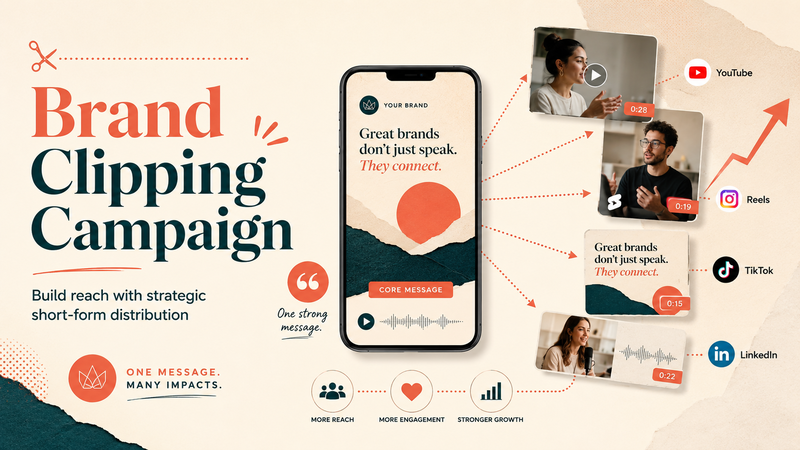

A founder interview can contain several months of useful marketing material. During one conversation, the speaker may explain a customer problem, challenge an industry assumption, describe a product decision, answer a sales objection, and share a story that reveals how the company operates.
Most of that value is lost when the recording is handed to an editor with a simple instruction: “Find as many clips as possible.”
The editor may return twenty polished videos, each with captions and a vertical crop. Yet the content often feels disconnected because the clips were chosen individually rather than planned as parts of a campaign. One discusses company culture, another promotes a feature, and the next offers general advice that could have come from almost any business.
A brand clipping campaign solves this problem by connecting the clips through a shared audience, objective, message, and publishing plan. The recording remains the raw material, but the campaign determines how that material is selected and used.
What is a brand clipping campaign?
A brand clipping campaign is a coordinated process for turning long-form brand content into a planned series of short-form assets that support a specific marketing objective.
The source material may come from:
Founder interviews
Podcasts
Webinars
Product demonstrations
Customer conversations
Conference presentations
Live streams
Educational videos
Internal expert interviews
The finished assets can be published across LinkedIn, Instagram Reels, TikTok, YouTube Shorts, X, newsletters, landing pages, sales emails, and customer education channels.
What makes a Brand Clipping Campaign different from ordinary video repurposing is that every clip has a defined role. The videos are not selected only because they contain an energetic sentence or fit inside sixty seconds. They are chosen because they help the audience understand a problem, recognise the brand’s expertise, evaluate its approach, or take a relevant next step.
What brands should understand before starting
A brand does not need a larger volume of clips simply to appear active. It needs more opportunities to communicate useful ideas consistently.
A clipping campaign can be designed to:
Establish a founder as a credible industry voice
Explain a complicated service or product
Build awareness around a customer problem
Support a launch or event
Answer recurring sales objections
Promote a podcast or webinar
Increase qualified traffic to an owned page
Create supporting material for sales teams
Educate existing customers
The objective should be decided before clip selection begins.
A campaign built to support a product launch will require different moments from one built to strengthen founder authority. The product campaign may focus on customer problems, use cases, demonstrations, and objections. The founder campaign may prioritise opinions, decision-making stories, lessons, and original observations.
Without this distinction, the company may receive professionally edited videos that do not work together or support a meaningful outcome.
How to build a brand clipping campaign step by step
1. Select one primary objective
The campaign needs a clear reason to exist.
Trying to increase awareness, generate leads, recruit employees, promote a podcast, and launch a product through the same batch of clips usually produces an unfocused message.
A primary objective could be:
Introduce a new service category
Increase registrations for a webinar
Build authority around a specialist subject
Support an upcoming product launch
Address a common buyer misunderstanding
Generate interest in a new podcast series
Secondary benefits may follow, but the main objective should guide the campaign.
Consider a software company releasing a new reporting feature. Instead of producing ten clips that repeatedly announce the feature, the company could build a campaign around the reporting problems operations teams experience. The feature then appears as part of the solution rather than the entire message.
2. Define the audience precisely
“Business owners” or “social media users” is not a useful audience definition.
The campaign should be designed for people with a recognisable problem, level of awareness, and decision to make.
Ask:
What is the audience trying to improve?
What does it already understand?
Which assumption is preventing progress?
What questions appear during sales calls?
Which objections delay a purchase?
What language does the audience use?
What evidence would make the brand more credible?
Someone who has only just noticed a problem needs explanation and examples. Someone already comparing providers may need proof, process details, and answers to practical concerns.
The same recording can produce clips for both groups, but those clips should not be presented in the same way.
3. Create source material that produces complete answers
Existing podcasts and webinars can supply strong material. However, an interview recorded specifically for clipping often produces better results because the questions are designed to generate standalone ideas.
Broad questions usually lead to broad answers.
Instead of asking:
What are your thoughts on customer retention?
Ask:
What retention mistake do growing companies make most often?
Can you describe a retention initiative that failed?
Which early warning sign do most teams ignore?
What does the industry misunderstand about churn?
What did your company change after losing an important customer?
Specific questions encourage the speaker to explain the situation, decision, outcome, and lesson. These elements give an editor enough material to create a useful clip without manufacturing context later.
4. Build a message plan before choosing clips
A campaign should cover several connected message types rather than repeating one promotional point.
A useful message plan may include:
Problem clips: Describe what the audience is experiencing.
Perspective clips: Explain how the brand views the problem.
Process clips: Show how the company approaches the work.
Proof clips: Share examples, results, or customer experiences.
Objection clips: Address reasons buyers hesitate.
Founder clips: Reveal values, lessons, and decisions.
Action clips: Help the audience identify a sensible next step.
This mix gives the campaign depth.
If every clip promotes the company, the audience quickly stops paying attention. When the clips educate, demonstrate understanding, and provide evidence, the promotional material feels more credible.
5. Select complete ideas rather than impressive sentences
A strong statement can make an effective opening, but it does not always make a useful clip.
Imagine a founder saying:
“We stopped offering unlimited revisions.”
The sentence creates curiosity, but a new viewer still needs to know:
Why unlimited revisions were introduced
What problem the policy created
What replaced it
Whether the new system worked
What another company can learn from the change
The strongest edit may be longer than the shortest possible version. The goal is to create the shortest clip that still preserves the complete meaning.
This is also where human editorial judgement matters. A tool may identify a confident sentence as a highlight, while an experienced reviewer can recognise that the surrounding explanation is what makes the moment valuable.
6. Give every clip a specific campaign role
Before editing begins, each selected moment should have a purpose.
A clip might be intended to:
Introduce the campaign’s central problem
Challenge a common belief
Provide evidence
Explain part of the company’s process
Answer an objection
Lead viewers to a longer resource
This prevents several clips from covering the same ground.
It also improves written captions and calls to action because the team knows what each asset is expected to accomplish.
7. Adapt the content for each platform
Posting the same export everywhere is convenient, but it ignores how audiences use different platforms.
LinkedIn may support a longer explanation with restrained captions and a written post that develops the idea. Instagram may require a quicker opening and stronger visual pacing. YouTube Shorts can benefit from a clear, searchable topic that remains useful after the campaign ends. A newsletter may use the clip as supporting evidence inside a larger argument.
Platform adaptation may involve changing:
The first sentence
Video length
Headline wording
Caption design
Supporting footage
Thumbnail
Written post copy
Call to action
The central idea stays consistent, but the presentation should suit the channel.
8. Publish clips in a planned sequence
A good campaign develops an argument over time.
A practical publishing sequence could be:
Explain the audience’s problem.
Challenge a common assumption.
Introduce the brand’s perspective.
Share a real example.
Explain the process.
Address a buying objection.
Direct interested viewers to a deeper resource.
Each clip should still work independently because viewers may encounter the campaign at different stages. Regular followers, however, should notice that the videos are connected and building towards something.
9. Connect the campaign to an owned destination
Short-form reach becomes more valuable when viewers have somewhere relevant to continue.
The destination might be:
A full podcast episode
A detailed article
A service page
A case study
A newsletter
A webinar registration page
A downloadable guide
A consultation page
The next step should match the clip.
A detailed educational video may naturally lead to a related guide. A clip addressing a serious buyer objection may lead to a case study or consultation. Sending every viewer directly to a sales page can make the campaign feel forced.
10. Measure signals that reflect the objective
Views can show distribution, but they do not reveal whether the campaign is helping the business.
Useful metrics include:
Average watch time
Completion rate
Saves
Shares
Relevant comments
Profile visits
Website sessions
Newsletter sign-ups
Webinar registrations
Qualified enquiries
Sales conversations influenced by the content
A clip with 10,000 views from the right audience may be more valuable than a clip with 300,000 views from people who have no interest in the company’s offer.
A practical campaign example
Consider a consultancy that helps software companies improve customer onboarding.
The founder records a 60-minute interview covering onboarding delays, internal ownership, implementation mistakes, customer expectations, and communication gaps.
Instead of publishing random highlights, the company organises the clips into a four-week campaign.
Week one: Define the real problem
The first group of clips explains why onboarding delays are often caused by unclear internal responsibilities rather than difficult customers.
Week two: Correct common assumptions
The founder challenges the belief that more meetings automatically create a better onboarding experience.
Week three: Explain the consultancy’s process
The clips show how the company maps responsibilities, milestones, communication points, and implementation risks.
Week four: Reduce hesitation
The final clips address cost, timing, internal workload, and concerns about changing an established process.
The campaign works because each week adds another part of the same argument. A viewer who discovers the brand during week three can still understand the individual clip, while regular followers receive a structured explanation over time.
Advantages of a brand clipping campaign
More value from every recording
One thoughtful conversation can supply several weeks of useful content without requiring the founder to record every day.
Stronger message consistency
The brand can repeat important ideas from different angles rather than switching topics with every post.
Better support for sales and marketing
Clips can be reused in newsletters, sales emails, landing pages, presentations, recruitment campaigns, and customer education.
Easier access to expert knowledge
Many people will not watch a full hour-long interview. Short clips provide easier entry points into the speaker’s thinking.
More efficient production
A clear campaign objective and message plan give editors better selection criteria, reducing random choices and unnecessary revisions.
Disadvantages and limitations
A clipping campaign still requires careful planning and management.
Potential limitations include:
Weak source material may restrict the number of useful clips.
Similar content can create audience fatigue.
Human review is needed to preserve context.
Platform adaptation requires additional production.
Authority campaigns may take time to affect revenue.
Too many calls to action can weaken trust.
A high clip count can encourage quantity over quality.
The campaign should be judged by the strength of its communication, not merely the number of files produced.
Common mistakes brands make
Requesting a fixed number of clips too early
A recording may contain twelve excellent moments or thirty. Deciding the exact number before reviewing the material encourages weak selections.
Choosing only energetic statements
Energy may attract attention, but it cannot replace relevance, context, or evidence.
Cutting away necessary context
An aggressively shortened clip may change the speaker’s meaning or leave the viewer confused.
Publishing identical versions everywhere
Different platforms have different viewing habits, audiences, and creative expectations.
Releasing the entire batch too quickly
Publishing similar clips close together causes them to compete with one another and shortens the life of the campaign.
Turning every clip into a sales pitch
Most clips should educate, explain, or demonstrate expertise. Promotion should be used where it fits naturally.
Ignoring what happens after the view
A campaign loses commercial value when interested viewers have no relevant next step.
Clipping Agency’s Message Momentum Model
Clipping Agency evaluates a brand campaign through four stages that move the audience from recognition to action.
Recognition
The audience sees a problem, experience, or question it already recognises.
Reframing
The brand introduces a clearer or more useful way to understand the issue.
Reinforcement
Examples, proof, processes, and repeated insights strengthen the brand’s position.
Response
The viewer receives a relevant next step, such as reading a guide, watching the full discussion, joining a webinar, or exploring a service.
The stages do not need to appear inside every clip. They should appear across the campaign.
A campaign that stops at recognition may attract views without building authority. A campaign that jumps directly to response may feel overly promotional. Momentum develops when the audience is first understood, then given a perspective, shown supporting evidence, and finally offered a sensible path forward.
Frequently asked questions
How many clips should a campaign include?
There is no fixed number. A focused campaign may use eight to twelve strong clips, while a larger launch may require several dozen. Message quality and coverage matter more than volume.
How long should the campaign run?
Many campaigns work well over four to eight weeks. The right duration depends on the amount of source material, posting frequency, platforms, and objective.
Does every campaign require new recordings?
No. Existing podcasts, webinars, interviews, and event footage can be used when the information remains accurate and relevant.
Should every clip contain a call to action?
No. Some clips should educate, build credibility, or encourage discussion. Calls to action should appear only when the next step fits the content.
Can AI produce a complete brand clipping campaign?
AI can assist with transcription, content discovery, draft captions, and rough edits. Human direction remains important for positioning, context, sequencing, brand fit, and approval.
Which platforms should the campaign use?
The brand should prioritise the platforms where its intended audience already spends time. Strong execution on two relevant channels is often better than weak distribution across six.
How should a company test a clipping agency?
Start with one representative recording and a small campaign. Evaluate selection quality, message consistency, platform adaptation, communication, revision handling, and performance reporting.
Turning a recording into a lasting brand asset
A brand clipping campaign should do more than keep a social calendar active. It should help the company explain what it understands, how it approaches a problem, and why its perspective matters.
The strongest campaigns combine purposeful source material, careful selection, platform-aware production, coordinated publishing, and a clear route towards deeper engagement.
Clipping Agency helps brands turn podcasts, interviews, webinars, and founder content into structured campaigns instead of disconnected posts. A practical first step is to choose one objective, identify one audience problem, and build a focused group of clips around a consistent message.
When the clips work together, a single recording can continue supporting the brand long after the original conversation ends.

Comments
No comments yet. Be the first to comment!