
Clipping Services: How Long Videos Become Social Content That People Actually Watch
A practical guide to turning podcasts, webinars, and long videos into short-form clips that are easier to discover, share, and remember.
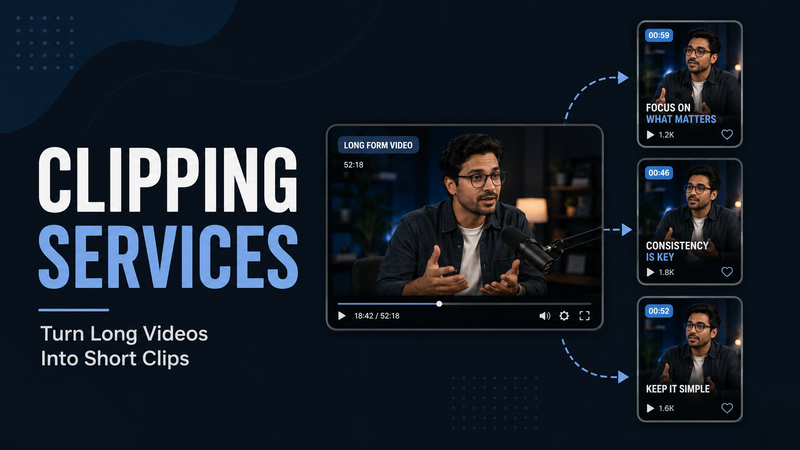

Long videos are useful, but they ask a lot from people.
A full podcast episode needs time. A webinar needs focus. A founder interview needs patience. A long YouTube video needs someone to care enough to sit through the intro, the setup, the middle section, and all the small details before they reach the best part.
That is fine for warm audiences.
It is much harder for new ones.
Most people do not discover a brand by watching its longest content first. They discover one moment. A sharp answer. A clear explanation. A short story. A useful opinion. A clip that makes them stop scrolling for a few seconds and think, “That was actually worth hearing.”
That is where clipping services help.
Clipping services turn long-form videos into short-form clips that are easier to watch, easier to share, and easier to distribute across social platforms. The goal is not just to cut a long video into smaller pieces. Any editor can do that. The real value is finding the moments that deserve attention and shaping them so they work on their own.
A good clip should not feel like a random chunk pulled from a longer conversation.
It should feel like a complete moment.
What Are Clipping Services?
Clipping services are professional video repurposing services that turn long-form content into short-form clips.
The source content can be a podcast, webinar, founder interview, livestream, event recording, customer conversation, online lesson, or long YouTube video.
A clipping service reviews the full recording, finds the strongest moments, edits them into short clips, adds captions or formatting, and prepares them for platforms like TikTok, Instagram Reels, YouTube Shorts, LinkedIn, Facebook, and other channels.
A good clip might explain one idea.
It might answer one common question.
It might tell one story.
It might show one result.
It might create curiosity about the full video.
That sounds simple, but good clipping takes more judgment than people expect. The editor has to know where the clip should begin, where it should end, what context the viewer needs, and whether the moment can stand alone.
Because not every short section of a long video deserves to become a clip.
Some parts are useful inside the full video but weak by themselves. Some need too much setup. Some start too slowly. Some look fine after editing but do not say anything people will remember.
Good clipping is not just cutting.
It is choosing.
Why Clipping Services Matter
The internet is not short on content.
It is short on content people actually stop for.
That is the real challenge.
Long-form content still has value. Podcasts can build trust. Webinars can explain complex ideas. Founder interviews can show personality and expertise. Long YouTube videos can teach properly.
But long-form content often needs help being discovered.
A new viewer may not know the speaker. They may not trust the brand. They may not have time for the full video. They may not even understand why the topic matters yet.
Short clips reduce that friction.
They give people one useful moment before asking for more attention.
That moment can introduce the speaker, explain a problem, show expertise, share proof, or make the full video feel worth watching later.
The long video gives depth.
The short clip creates the first touch.
Clipping services connect both.
Basic Editing Is Not the Same as Good Clipping
There is a clear difference between trimming a video and creating a useful clip.
Basic editing is mechanical.
Pick a section. Cut the start. Cut the end. Add captions. Export it.
Good clipping is more thoughtful.
It asks whether that moment deserves to exist as its own piece of content.
That one question changes everything.
A weak moment with clean subtitles is still weak. A flat answer with nice framing is still flat. A slow section does not become useful just because it has jump cuts and a trendy sound behind it.
This is where many brands waste time.
They think the goal is to create more clips.
The real goal is to create better short-form moments from the content they already have.
Good clipping services do not just ask, “Can this be clipped?”
They ask, “Will someone care if this appears in their feed?”
That is the better question.
The Best Clips Are Often Hidden
The best clip in a video is not always at the beginning.
Actually, it usually is not.
The intro may be slow. The guest may still be warming up. The host may still be setting context. The strongest answer may come after a follow-up question. The most useful story may appear near the end. The clearest explanation may happen halfway through the recording.
That is why proper review matters.
A weak clipping process grabs the easiest sections.
A strong clipping process looks for moments with weight.
These moments usually do at least one of these things:
Explain a useful idea clearly
Answer a question the audience already has
Share a real story
Show proof or experience
Make the speaker feel credible
Create curiosity about the full video
Give the viewer something worth saving or sharing
The right moment is not always the loudest one.
Sometimes it is the cleanest sentence.
Sometimes it is the most practical line.
Sometimes it is the small detail that makes the whole conversation feel real.
That is why human judgment matters.
The software can help.
The eye still matters more.
What Makes a Clip Worth Publishing?
A clip is worth publishing when it gives the viewer something clear.
It does not need to explain the entire topic. It does not need to carry every detail from the original video. It just needs to do one job well.
That job might be education, proof, story, opinion, or curiosity.
A strong clip usually has three things.
A Clear Point
The clip should focus on one idea.
One lesson. One answer. One mistake. One story. One opinion. One practical takeaway.
Trying to fit too much into one short clip usually makes it weaker. The viewer should not have to work hard to understand the point.
A clear clip is easier to watch.
It is also easier to remember.
Enough Context
Short-form content still needs context.
The viewer does not need the full backstory, but they need enough information to understand why the moment matters.
If the clip only makes sense to someone who already watched the full video, it is not ready.
It needs reshaping.
A good clip should work for someone seeing the speaker or brand for the first time.
That is what makes it useful for discovery.
A Strong Opening
The first few seconds matter because people scroll quickly.
That does not mean every clip needs fake drama. Not every useful business idea needs to arrive like someone just leaked a secret file.
A strong opening simply reaches the useful part faster.
A slow opening might sound like this:
“Yeah, when we were talking about content, there were a few things that came up…”
A stronger opening would be:
“One long video can create several useful clips if you know what to pull from it.”
The second version gives the viewer a reason to stay.
That is what a good opening needs to do.
Types of Clips a Good Service Can Create
A good clipping service should not make every clip feel the same.
Different clips should have different roles.
Educational Clips
Educational clips explain one useful idea.
These work well for creators, founders, agencies, consultants, coaches, and B2B brands that want to build authority.
The best educational clips stay focused.
One clear idea usually works better than five rushed points.
Story Clips
Story clips share a real moment.
This could be a founder lesson, customer situation, personal mistake, behind-the-scenes detail, or lived experience.
Stories make content feel more human.
They also make ideas easier to remember.
Opinion Clips
Opinion clips give the speaker a clear point of view.
They do not need to be controversial. They just need to be specific.
Generic advice disappears quickly because it sounds like everything else.
A clear opinion gives people something to react to.
Proof Clips
Proof clips show evidence.
That might be a result, client example, case study, comparison, or lesson from real work.
These clips help turn attention into trust.
Proof matters because audiences have seen enough empty claims.
Teaser Clips
Teaser clips create curiosity about the full video.
They should give value, but not everything. The aim is to make the full version feel worth watching.
A balanced clipping strategy uses a mix of these clip types.
Some clips teach.
Some clips prove.
Some clips tell stories.
Some clips create curiosity.
That variety keeps the content from feeling repetitive.
Why Platform Fit Matters
The same clip can often work across several platforms, but it should not always be posted in the exact same way.
LinkedIn may need a thoughtful caption.
TikTok may need the useful part to arrive faster.
Instagram Reels may need a stronger first frame.
YouTube Shorts may need tighter pacing.
Facebook may need a clearer setup.
Small changes can make a big difference.
Good clipping services understand this.
They do not treat every platform like the same room with different wallpaper. Each platform has its own habits, and the clip should respect that.
This does not always mean rebuilding the whole clip from scratch.
Sometimes it means changing the caption.
Sometimes it means tightening the opening.
Sometimes it means choosing a better frame.
Sometimes it means cropping the video differently.
Small edits.
Better fit.
Why Clipping Services Help With Consistency
Consistency is hard when every post starts from zero.
New ideas take time. New recordings take energy. New captions need writing. New edits need review. Eventually, the content process starts to feel heavier than it should.
Clipping services make consistency easier because they turn existing videos into several useful posts.
One podcast can become a week of clips.
One webinar can become several educational posts.
One founder interview can become story clips, proof clips, opinion clips, and teasers.
That gives a brand more chances to show up without constantly creating from scratch.
And consistency matters because trust rarely happens in one post.
People need repeated exposure. They need to hear useful ideas more than once. They need to recognize the speaker. They need to understand the message from different angles.
Clipping services help create that rhythm.
Common Mistakes Brands Make With Clipping
The first mistake is clipping too much.
More clips do not always mean more reach. If a video has five strong moments, make five strong clips. Do not force fifteen weak ones because the calendar looks empty.
The second mistake is starting clips too slowly.
A clip can feel natural, but it still needs to reach the value quickly.
The third mistake is overediting.
Too many zooms, flashing captions, emojis, and sound effects can make a useful idea feel cheap. Editing should support the message, not compete with it.
The fourth mistake is posting the same version everywhere.
The same core clip may work across platforms, but the caption, crop, title, or first frame may need to change.
The fifth mistake is only judging by views.
Views matter, of course.
But saves, shares, comments, profile visits, clicks, and lead quality can also show whether a clip is doing its job.
A clip with fewer views but stronger audience intent can be more useful than a viral clip watched by people who will never care about the brand.
Less flashy.
More valuable.
When Should a Brand Use Clipping Services?
Clipping services make sense when a brand already creates long-form content but does not fully use it.
That could mean podcasts, webinars, founder interviews, YouTube videos, livestreams, internal talks, training sessions, or customer conversations.
They are especially useful when:
The team has long videos but no time to repurpose them
The brand wants more short-form content without recording constantly
The audience is active on Reels, Shorts, TikTok, LinkedIn, or Facebook
Useful ideas are buried inside longer recordings
The team wants a more consistent publishing rhythm
The brand wants to build trust through repeated exposure
Clipping services are not magic.
They cannot turn weak ideas into strong ones.
But they can help strong content travel further.
That is often the difference.
Final Thoughts
Clipping services help good videos become social content people actually watch.
They take podcasts, webinars, interviews, livestreams, and long YouTube videos and turn the strongest moments into short-form clips that can educate, prove, build trust, create curiosity, and keep the brand visible across platforms.
The simple version is this.
Record strong content. Find the best moments. Shape them clearly. Adapt them for each platform. Publish with rhythm. Learn from performance.
That is how one long video becomes more than one upload.
It becomes a steady source of short-form content.
And in crowded feeds, that kind of system matters.

Comments
No comments yet. Be the first to comment!