
White Label Clipping Service Canada: Helping Agencies Deliver More Video Without More Hiring
A practical way for Canadian agencies to offer short-form video, serve more clients, and keep production running without building a full editing team in-house.

Many Canadian agencies are running into the same problem.
Their clients want more short-form video. They want clips for TikTok, Instagram Reels, YouTube Shorts, LinkedIn, Facebook Reels, newsletters, landing pages, paid ads, and sales follow-ups. They may already be recording podcasts, webinars, founder interviews, livestreams, product demos, customer stories, and long YouTube videos, but they do not want those recordings to sit unused.
They want those videos turned into clips.
For an agency, this is a good opportunity. Short-form content is useful, easy to explain, and often fits naturally into existing services. A social media agency can add clips to its monthly content calendar. A podcast agency can offer episode highlights. A paid ads agency can turn long-form content into creative variations. A B2B marketing agency can turn founder interviews into LinkedIn videos.
The demand is there.
The harder question is how to deliver it without overloading the team.
Hiring editors, training them, managing revisions, building production systems, handling file storage, creating caption styles, checking quality, and keeping turnaround times consistent can become a lot of work very quickly. One client may be easy. Five clients may start to stretch the team. Ten clients can become a real production bottleneck.
That is where a White Label Clipping Service Canada solution makes sense.
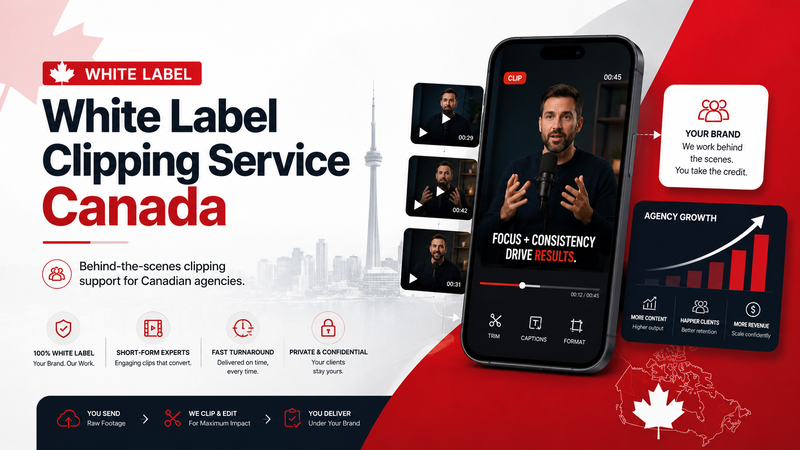
It allows agencies to sell clipping services under their own brand while a production partner handles the backend work. The agency owns the client relationship, manages the strategy, sets the offer, and presents the final clips. The white label team supports the editing, clipping, formatting, and delivery behind the scenes.
For Canadian agencies that want to grow their video offer without hiring a full internal editing team right away, this can be a smart and practical model.
Why Clipping Has Become an Easy Service to Sell
Clients are starting to understand the value of short clips.
They know that a one-hour podcast should not only live as one long episode. They know a webinar can become more than a replay link. They know a founder interview may contain several strong moments that could work as social posts. They know long videos often hold useful ideas, but those ideas need to be pulled out and shared in a format people will actually watch.
This is why agencies are being asked for clipping more often.
A client may ask:
Can we turn this podcast into Reels?
Can this webinar become short clips?
Can we make Shorts from our YouTube videos?
Can we cut founder videos for LinkedIn?
Can we use these clips for ads?
Can we create social posts from our interviews?
These are reasonable requests, and agencies are in a strong position to answer them. The agency already understands the client’s brand, audience, and goals. Adding clipping can make the agency feel like a more complete partner.
The challenge is not whether the service is useful.
The challenge is whether the agency can deliver it consistently.
Why Building an In-House Team Is Not Always the First Move
Some agencies eventually build their own editing teams, and that can work well once demand is stable.
But hiring too early can create pressure.
Editors need training. Workloads can change from month to month. Some clients may need many clips. Others may pause. Some source videos may be simple. Others may need more review and cleanup. If the agency hires before the service is proven, it may carry costs before the revenue is predictable.
There is also the management side.
Video clipping is not only about editing. Someone has to review source material, choose strong moments, organize client notes, apply brand guidelines, prepare captions, export the files, manage revisions, and make sure everything is delivered on time.
That takes process.
White label clipping gives agencies a way to offer the service before building the full internal machine. It lets them test demand, create packages, serve clients, and increase retainers without taking on all the production weight at once.
What White Label Clipping Actually Covers
White label clipping means the agency sells the service under its own name while another team handles production in the background.
The client does not work directly with the production partner. The agency stays in control of the relationship. The agency manages communication, pricing, strategy, reporting, and expectations. The white label team helps turn source videos into finished clips.
A strong white label clipping setup may include:
Reviewing long-form videos
Finding strong clip moments
Cutting clips for short-form platforms
Editing for pacing and clarity
Formatting videos vertically
Adding readable captions
Preparing clips for TikTok, Reels, Shorts, and LinkedIn
Organizing exports for delivery
Supporting recurring monthly output
Handling revisions based on agency feedback
This setup helps the agency add a high-demand service without sending clients elsewhere.
The client gets more content. The agency keeps the relationship. The white label partner handles the production work quietly.
Good Clipping Needs More Than Editing
A common mistake is thinking clipping is only about cutting a video into smaller pieces.
It is not.
A random section from a podcast may not make a good clip. A webinar answer may be useful, but it may need a stronger opening. A founder may say something valuable, but the clip may need trimming so the point lands faster. A product demo may need visual callouts. A customer story may need the right pacing so it feels believable.
The real work starts with selection.
Someone needs to watch the source content and choose moments that can stand alone. A strong clip should make sense to someone who has not watched the full recording. It should give enough context, reach the useful part quickly, and focus on one idea.
A good clip might:
Explain one customer problem
Answer one common question
Share one practical lesson
Show one proof point
Highlight one mistake
Share one strong opinion
Create curiosity about the full video
Make a complex idea easier to understand
This is why a white label clipping partner should understand content, not just editing software.
If clip selection is weak, the final clips will feel weak even if the captions and graphics look polished.
How Agencies Can Package the Service
White label clipping works best when the agency creates a clear package.
Clients should know what they are getting, how many clips are included, what source content is accepted, what platforms the clips are formatted for, how revisions work, and how often clips are delivered.
For example, an agency might offer:
8 clips per month from podcast episodes
12 clips per month from webinars or founder interviews
20 clips per month for multi-platform short-form distribution
Weekly LinkedIn clips for B2B founders
YouTube Shorts from long-form videos
TikTok and Reels packages for creators
Product demo cutdowns for SaaS companies
Short-form ad creative from long videos
Monthly clip libraries from existing recordings
The package can be simple, but it should not be vague.
If the agency promises unlimited clips, unlimited revisions, or viral growth, the service can become hard to manage. A better offer is built around consistent output, strong clip selection, clean editing, and a clear delivery rhythm.
Why Workflow Matters So Much
A white label service should make the agency’s life easier, not harder.
If the agency has to chase files, repeat instructions, fix every clip, or manage a messy revision process, the setup is not doing enough. The agency needs a workflow that feels predictable.
A good workflow should include:
Clear intake for source videos
Client brand notes
Editing preferences
Clip selection standards
Delivery timelines
Revision process
File naming rules
Organized folders
Simple communication
Room for feedback and improvement
This matters because agencies are often managing several clients at once.
If the workflow is clean, the agency can confidently sell the service. If the workflow is messy, the agency may spend more time managing the production than growing the account.
White Label Delivery Protects the Client Relationship
One reason agencies like white label services is that the client relationship stays with the agency.
If an agency sends a client directly to another video provider, the client may start building a separate relationship with that provider. Over time, the agency can become less central to the work.
White label delivery avoids that.
The agency remains the visible partner. The client receives the clips through the agency. The white label team stays behind the scenes.
This is useful for agencies that already handle strategy, social media, content, ads, SEO, branding, or growth. Clipping can become another service under the same umbrella, which makes the agency more valuable to the client.
Instead of saying, “We do not offer that,” the agency can say, “Yes, we can handle that.”
Common Mistakes Agencies Should Avoid
Adding clipping can create new revenue, but only if the offer is set up properly.
Some agencies rush into it without clear rules. They accept any source content, promise too much, price too low, or treat revisions casually. That can create problems later.
Common mistakes include:
Selling unlimited clips without boundaries
Promising viral results
Ignoring poor source video quality
Pricing too low for the amount of work involved
Offering too many revisions without limits
Using the same editing style for every client
Not defining turnaround times
Treating clip selection as less important than editing
Forgetting to connect clips to the client’s wider strategy
A good clipping offer should be clear and practical.
The client should understand that clipping helps them get more value from content they already create. It supports visibility, consistency, and brand recall. It is not a magic button, and it should not be sold as one.
What to Look for in a White Label Clipping Partner
Not every video editor is the right fit for white label work.
A white label partner needs to understand agency delivery. They need to follow instructions, protect confidentiality, work behind the agency brand, handle recurring output, and make the agency look good.
Before choosing a partner, agencies should ask:
Can they work quietly behind the agency brand?
Do they understand short-form pacing?
Can they select strong moments from long videos?
Do they follow client-specific brand notes?
Can they handle recurring monthly production?
Are revisions easy to manage?
Do they deliver files in an organized way?
Can they support different client styles?
Do they understand strategy, not only editing?
Can they scale if client volume grows?
The right partner should reduce pressure.
If the agency has to constantly fix clips, chase deadlines, or explain the same instructions every week, the white label setup is not working.
Why This Can Become Recurring Revenue
Clipping fits well into monthly retainers because clients need ongoing content.
They do not need one clip one time. They need a steady flow of short-form assets that keep them visible. They need clips from new podcast episodes, new webinars, new interviews, new demos, and new long-form videos.
This gives agencies a natural recurring offer.
The client sends source videos. The agency turns those videos into clips. The clips support social content, newsletters, landing pages, ad testing, founder visibility, and sales follow-ups.
This can increase the value of an existing client account without requiring the agency to create every idea from scratch.
It also helps the client stay consistent, which is one of the hardest parts of content marketing.
Final Thoughts
Canadian agencies have a strong opportunity with short-form video.
Clients want clips. They want their long-form content turned into assets they can post across different platforms. They want more visibility without managing the editing process themselves.
A White Label Clipping Service Canada partner helps agencies meet that demand without building a full editing team immediately.
The agency keeps the client relationship. The white label team handles production. The client gets more useful short-form content. The agency gets a scalable service it can sell under its own brand.
For agencies that want to grow content, social media, podcast, or video marketing services, white label clipping can be a practical way to add value without adding too much internal pressure.

Comments
No comments yet. Be the first to comment!