
A Practical Breakdown of TikTok Clipping Services (And When They're Worth It)
What the process actually involves, what it costs you in control, and who it makes sense for
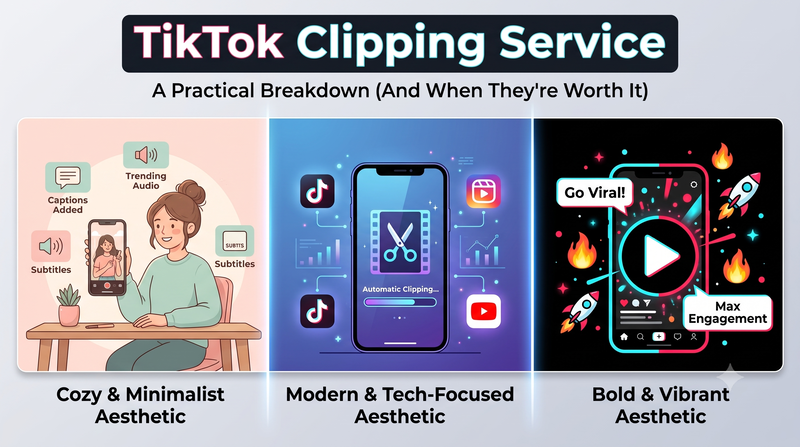

A TikTok clipping service takes long-form footage, podcasts, streams, webinars, sales calls, and turns it into a batch of short, vertical clips built for TikTok's feed. Rather than a creator or brand manually reviewing hours of raw video every week, an editor (often supported by AI for transcription and timestamp flagging) does that review and hands back a set of edited, captioned clips on a recurring schedule.
It's most useful for anyone who's already producing long-form content but doesn't have the bandwidth to also mine it for short-form. A TikTok clipping service exists specifically to close that gap, turning content that's already been paid for into something that keeps working on a second platform.
In Plain Terms
If long-form content already exists but isn't being repurposed into short clips, a clipping service fills that gap: raw footage goes in, edited vertical clips come out on a set schedule. Better services also track which clips actually perform and adjust future picks based on that data, rather than cutting on a fixed formula every time.
The Process, Step by Step
Raw footage gets sent over. Usually a full podcast episode, a livestream recording, a webinar, or a recorded call.
An editor reviews it looking for self-contained moments, ones that make sense without any surrounding context. This step is the actual skill involved; cutting and captioning is comparatively mechanical.
Selected moments get reframed into vertical format, captioned, and paced specifically for TikTok, which moves differently than Reels or Shorts despite the shared aspect ratio.
Clips are delivered in a batch, typically weekly, often 10 to 20 at a time.
The client posts them (or the service does, for full-service plans) and reviews performance.
Performance data feeds back into the next batch, so clip selection sharpens over several cycles rather than staying static.
Examples
A podcaster sending one weekly episode and receiving a dozen clips built around distinct exchanges or stories, not just the most obviously quotable line.
A consultant running recurring webinars, with individual insights extracted as standalone advice clips that don't require the full session for context.
A gym or coaching business turning client session footage into clips built around one specific correction or tip per video, instead of a long unedited session.
Pros and Cons
What works in favor of using one: it removes the actual bottleneck (footage review, not editing), keeps a consistent posting cadence without adding to anyone's workload, and lets a business test far more formats and hooks than manual editing would allow.
What works against it: control over tone and pacing is reduced unless expectations are made explicit upfront, quality is capped by the source footage regardless of how well it's cut, and there's a real ramp-up period, usually a few weeks, before clip selection starts to reflect what the specific audience responds to.
Common Mistakes
Sending footage without any direction and expecting the editor to infer brand voice on the first pass. Evaluating the service after a single batch instead of a few cycles. Releasing an entire week's clips at once instead of spacing them out. Never closing the feedback loop by telling the editor which clips actually performed.
FAQs
Does footage need to be recorded differently for clipping to work?
Not substantially, but audio clarity and specific, self-contained statements clip far better than unstructured rambling.
How many clips come from an hour of footage?
Typically 8 to 15, depending on how content-dense the source material is.
Does this extend to other platforms?
Usually yes. Reels and Shorts share the vertical format, though pacing and hooks often need small adjustments per platform.
Is it worth it for occasional posting?
Not really. It's built for businesses already producing long-form content regularly; without ongoing raw footage, there's nothing to clip.
Where This Take Differs
Most clipping services apply one process to every clip: find something quotable, cut it, move to the next. But a clip meant to be discovered by someone with zero prior context needs different pacing than a clip meant to deepen trust with an existing follower. Treating both the same way is a common reason clipped content plateaus after the first month or two, even when the source footage is genuinely strong.
Business Use Cases
Podcasters relying on clips as their primary discovery channel rather than the full episode. Coaches and consultants using client sessions or webinars as an ongoing, low-effort lead generation source. Brands stretching a single founder interview into a week of native-feeling content instead of producing new short-form from scratch. Streamers pulling from VODs to maintain a TikTok presence without extending recording time.

Comments
No comments yet. Be the first to comment!