
What a YouTube Shorts Clipping Agency Actually Does
How creators and businesses can turn existing videos into focused Shorts that attract relevant viewers and support wider channel growth.
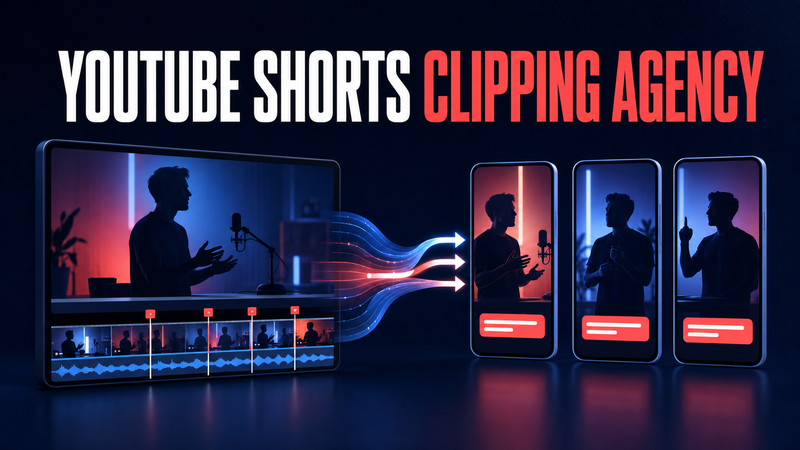

A long YouTube video may contain excellent stories, explanations, demonstrations, and opinions, but those moments rarely become effective Shorts without deliberate editing. The strongest section may depend on an earlier question, take too long to reach its conclusion, or lose important visual information when the footage is cropped vertically.
A YouTube Shorts clipping agency is a specialist content partner that identifies useful moments inside long-form recordings and turns them into self-contained vertical videos for YouTube Shorts. The service generally includes source review, clip selection, narrative editing, vertical reframing, captioning, quality control, and performance analysis.
This is different from asking an editor to divide a video into smaller pieces. A clipping agency must decide why a moment deserves to become a Short, how much context an unfamiliar viewer needs, and whether the finished clip supports the creator’s wider channel or business.
The Practical Answer
A YouTube Shorts clipping agency helps creators, podcasters, educators, and businesses publish a consistent supply of short-form videos without requiring them to record new vertical content every day.
The agency reviews existing podcasts, interviews, webinars, livestreams, tutorials, and YouTube videos. It looks for moments that offer a complete idea, removes unnecessary repetition, and edits each selection so that it can be understood without watching the original recording.
A structured clipping service can help a channel:
Recover valuable ideas hidden inside older videos
Maintain a consistent publishing schedule
Reach people who prefer short-form content
Test subjects before investing in longer videos
Direct interested viewers towards related content
Reduce the time spent searching through footage
Create a recognisable visual and editorial style
Learn which topics attract subscribers, enquiries, or customers
The important word is relevant. A Short that receives a large number of views but attracts people who have no interest in the channel’s usual content may provide less value than a smaller clip that produces qualified subscribers or customer enquiries.
Why Basic Video Editing Is Not Enough
Basic editing usually begins after someone has selected a timestamp. Professional clipping begins before that decision.
Suppose a founder says, “That mistake cost us six months.” The sentence may sound like a strong opening, but it does not explain which mistake occurred or why it mattered. Starting the Short at that exact sentence could create curiosity, but the rest of the clip may fail to give viewers enough information.
A clipping specialist examines the surrounding discussion and finds the smallest amount of context needed to make the story clear. The final Short might begin with the original decision, move into the unexpected consequence, and finish with the lesson that changed the company’s approach.
The same principle applies to visual demonstrations. If a fitness creator explains a squat error, viewers need to see the relevant movement as well as hear the correction. A vertical crop focused only on the creator’s face would remove the evidence that makes the explanation useful.
Effective clipping combines several types of judgement:
Editorial judgement about which moments deserve attention
Narrative judgement about where the clip should begin and end
Visual judgement about what needs to remain visible
Brand judgement about whether the moment represents the speaker fairly
Strategic judgement about how the Short fits the wider channel
Working with a YouTube Shorts Clipping Agency should provide this complete process, rather than a collection of disconnected excerpts cut to a standard length.
How the YouTube Shorts Clipping Process Works
1. Establish the Purpose of the Campaign
The process should begin with a clear reason for publishing Shorts.
A podcast may use them to introduce new guests. A software company may want to answer common product questions. A consultant might need clips that demonstrate expertise, while an established creator may use Shorts to remain visible between longer uploads.
A useful campaign brief should identify:
The intended audience
The subjects the channel wants to be associated with
The preferred balance of education, entertainment, and promotion
Brand, caption, and editing guidelines
Relevant products, services, playlists, or longer videos
Claims or topics that require additional approval
The expected publishing frequency
The metrics that will define a useful result
Without this direction, clip selection can become a search for the loudest reaction or most dramatic statement. Those moments may attract attention without helping the channel build the right audience.
2. Review and Organise the Source Material
The next step is creating a usable source library. Videos can be grouped by subject, guest, format, campaign, product, or recording date. Transcripts make the archive searchable, while timestamps provided by hosts or production teams can offer useful starting points.
However, automated suggestions and transcripts should not replace watching the footage. A transcript cannot always reveal a facial reaction, visual demonstration, pause, shift in tone, or piece of information shown on screen.
Older recordings should also be considered. A useful explanation recorded two years ago may still work if the information remains accurate and the creator has permission to reuse the footage.
3. Identify Moments With Standalone Value
A suitable source moment needs more than an interesting sentence. It should give an unfamiliar viewer a clear subject, a reason to continue watching, and a worthwhile conclusion.
Promising moments often include:
A direct answer to a specific question
A mistake followed by a practical correction
A surprising result supported by evidence
A concise personal or business story
A product demonstration that solves a problem
A strong opinion supported by reasoning
A before-and-after comparison
A disagreement that reveals an important distinction
A process that can be explained in several clear stages
A reaction whose cause is visible or understandable
Some moments should remain long-form. If shortening an explanation removes necessary qualifications or makes the advice misleading, producing a Short would be the wrong editorial decision.
4. Build a Complete Narrative
The selected footage must then be shaped into a compact but complete idea.
Consider a business webinar in which a marketing director explains why a campaign failed. The original answer lasts six minutes and contains repeated background information. A focused Short could begin with the assumption behind the campaign, show the result that disproved it, and end with the change that improved performance.
A cooking channel offers another example. Showing only a failed dish creates a reaction clip. Showing the preparation error, the failed result, and the correction creates a practical lesson.
Good clipping does not simply shorten footage. It shortens the route to understanding while preserving the reasoning that gives the moment value.
5. Adapt the Clip for Vertical Viewing
Once the editorial structure works, the footage can be prepared for a vertical screen. Depending on the source material, this may involve 9:16 reframing, speaker tracking, split-screen layouts, accurate subtitles, audio repair, supporting footage, and restrained visual effects.
During editing, the team should check whether:
The speaker or main subject remains visible
Products and demonstrations can be understood on a phone
Screen recordings are large enough to read
Captions avoid covering faces or essential details
Names, statistics, and specialist terms are accurate
Music and sound effects support the material
Cuts preserve the speaker’s intended meaning
The opening makes an honest promise
The ending delivers a complete result
The editing style should follow the content. A software walkthrough cannot be treated like a gaming reaction, and a serious founder story should not be edited like a comedy compilation.
6. Complete Editorial and Brand Review
Before publication, the finished Short should be compared with the original source.
This review confirms that the edit has not changed the speaker’s position, removed an important condition, or used a dramatic opening that the remaining footage does not support. It should also identify private information, sponsor conflicts, outdated claims, and visual elements that fail to meet brand guidelines.
This stage is especially important for medical, legal, financial, technical, and product-related subjects. Removing one qualification can change the meaning of an otherwise responsible explanation.
7. Publish, Measure, and Refine
A Shorts campaign should be evaluated across a consistent batch rather than judged by one upload.
Useful performance indicators include:
Viewed versus swiped away
Average view duration
Average percentage viewed
Rewatches
Comments and shares
Subscribers gained
Visits to related long-form videos
Relevant enquiries, sign-ups, or sales
Results should also be compared by topic and clip purpose. A broad personal story may produce strong reach, while a specific tutorial receives fewer views but generates more qualified subscribers. Both can be valuable when each clip has a defined role.
The Clipping Agency Discovery, Proof, and Path Framework
From Clipping Agency’s perspective, a strong Shorts library should perform three different jobs: Discovery, Proof, and Path.
Discovery Clips
Discovery clips introduce the channel to people who may not know the creator or business. They usually begin with an accessible problem, surprising observation, useful story, or recognisable experience.
Their purpose is to attract relevant attention, not the widest possible audience at any cost.
Proof Clips
Proof clips demonstrate why the viewer should trust the speaker. They may contain a detailed explanation, case example, product demonstration, before-and-after result, or carefully reasoned opinion.
These clips sometimes receive less reach than broader discovery content, but they can be more valuable for consultants, educators, software companies, and specialist brands.
Path Clips
Path clips create a natural reason for the viewer to continue. They may connect with a longer interview, tutorial, playlist, product demonstration, recurring series, or service.
A Path clip does not need to end with an aggressive sales message. The relationship between the Short and the next step should already make sense.
The framework can guide monthly production:
Review the source library for moments suitable for each role.
Avoid filling the entire schedule with broad Discovery clips.
Include enough Proof clips to establish expertise and credibility.
Connect selected clips with a relevant video or business asset.
Compare performance within each category instead of ranking everything by views.
Adjust the next batch according to the audience and actions each category produces.
This approach treats the Shorts library as a content portfolio. One clip earns attention, another builds confidence, and another helps an interested viewer continue.
Specific YouTube Shorts Clipping Examples
A founder interview could produce a Discovery clip about an unexpected early failure, a Proof clip explaining how the team identified the problem, and a Path clip connected to a longer discussion about building the company.
A fitness educator could create separate Shorts covering a common technique error, the physical reason it occurs, and a progression viewers can practise. The edit must keep any safety information required to use the advice responsibly.
A software company could turn a recorded webinar into a series of focused answers. One Short might demonstrate an automation feature, while another explains when that feature is not appropriate. The second clip may reach fewer people, but its honesty can build trust among serious buyers.
An ecommerce brand could repurpose a livestream into a material comparison, sizing explanation, care guide, and response to a common objection. These clips help customers make decisions without making every upload feel like an advertisement.
A podcast could use one episode to create a personal story, expert explanation, useful disagreement, and practical answer. This provides a more balanced representation of the conversation than publishing only its most controversial statement.
Real Business Uses for Shorts Clipping
Creators and YouTubers can remain active between major uploads while learning which subjects deserve longer follow-up videos.
Podcast teams can give every episode several discovery points. Different clips may appeal to viewers interested in the guest’s experience, industry, advice, or personal story.
Consultants and coaches can turn detailed conversations into clear examples of how they analyse problems. Those clips can support newsletters, courses, communities, or services when the connection is relevant.
Software companies can repurpose webinars, customer interviews, demonstrations, and founder content into useful answers for prospective buyers.
Ecommerce brands can create Shorts from product demonstrations, comparisons, customer questions, manufacturing footage, and educational content.
Agencies and production companies can use a managed or white-label clipping workflow to expand client deliverables without hiring and supervising a large internal editing team.
Across these cases, the main advantage is not simply producing more content. It is making better use of knowledge and footage that the business has already paid to create.
Advantages and Limitations
The main advantages of using a clipping agency include:
More value from existing recordings
Less internal time spent reviewing footage
More consistent editing and quality control
A repeatable method for testing topics and openings
More discovery points across a YouTube channel
Better use of webinars, podcasts, interviews, and livestreams
Performance insights that can guide future content
The possible limitations include:
Weak source material restricts the quality of the finished clips
No clipping agency can guarantee viral distribution
Vertical framing may reduce the clarity of some demonstrations
Poor clip selection can attract an irrelevant audience
High view counts may not produce customers or subscribers
Frequent production requires an efficient approval system
An ongoing campaign needs a reliable supply of suitable recordings
Clipping works best when the source material contains genuine value and the Shorts support a defined channel or business objective.
Common Mistakes to Avoid
One of the most common mistakes is choosing a clip because its opening sounds dramatic. If the rest of the Short does not explain or support that opening, the viewer is left with an incomplete promise.
Other common mistakes include:
Beginning every Short with the same generic question
Using one editing pace for every topic
Removing context that protects the accuracy of a statement
Publishing only emotional or controversial moments
Covering products, faces, or screen details with subtitles
Forcing every recording to produce the same number of clips
Adding a sales message to every ending
Ignoring older footage with evergreen value
Repeating the same idea across several Shorts
Measuring the campaign through total views alone
The strongest clipping system is not the one that exports the greatest number of files. It is the one that repeatedly selects worthwhile moments and gives every Short a clear purpose.
Frequently Asked Questions
What does a YouTube Shorts clipping agency need from a client?
The agency usually needs access to the original recordings, permission to repurpose them, information about the intended audience, brand guidelines, editing preferences, and a clear approval process. Complete recordings provide more editorial flexibility than isolated timestamps.
How many Shorts can one long video produce?
The number depends on the density of useful material. A focused 30-minute interview may contain more viable Shorts than a repetitive two-hour conversation. Clip quality should determine the output rather than a fixed quota.
Can older YouTube videos be turned into Shorts?
Yes, provided the creator or business owns the footage or has permission to reuse it. Older recordings can contain evergreen explanations, stories, and demonstrations that have never been presented vertically.
Is professional clipping the same as YouTube’s Clips feature?
No. YouTube’s built-in Clips feature shares a section from an existing upload. A professionally produced Short is a separate vertical video that may include reframing, subtitles, narrative restructuring, supporting visuals, and its own publishing details.
Should every Short direct viewers to a longer video?
No. Some Shorts work best as complete standalone answers. A connection to a longer video, playlist, series, product, or service should only be included when it is genuinely relevant.
Can AI handle the entire clipping process?
AI can assist with transcription, archive searches, captioning, reframing, and preliminary timestamp suggestions. Human judgement remains important for evaluating context, accuracy, audience fit, brand risk, visual clarity, and the role of each Short within the wider channel.
How should a business evaluate a clipping agency?
The business should examine the consistency and accuracy of the output, the relevance of the audience, subscriber growth, visits to related content, and any trackable enquiries or conversions. Total views are useful, but they should not be the only measure.
Build a More Useful Shorts Library
Most active creators and businesses already have more usable short-form material than they realise. The difficult part is finding moments that remain clear outside the original recording, editing them without changing their meaning, and giving each clip a useful role.
Clipping Agency helps turn existing recordings into a structured YouTube Shorts pipeline covering source review, clip selection, vertical editing, quality control, and performance refinement. A practical first step is to review several recent recordings through the Discovery, Proof, and Path Framework and identify which valuable ideas are currently buried inside longer videos.

Comments
No comments yet. Be the first to comment!