
What Is Content Clipping and Why Does It Matter
A practical guide to turning podcasts, webinars, interviews, and long videos into valuable short-form content.
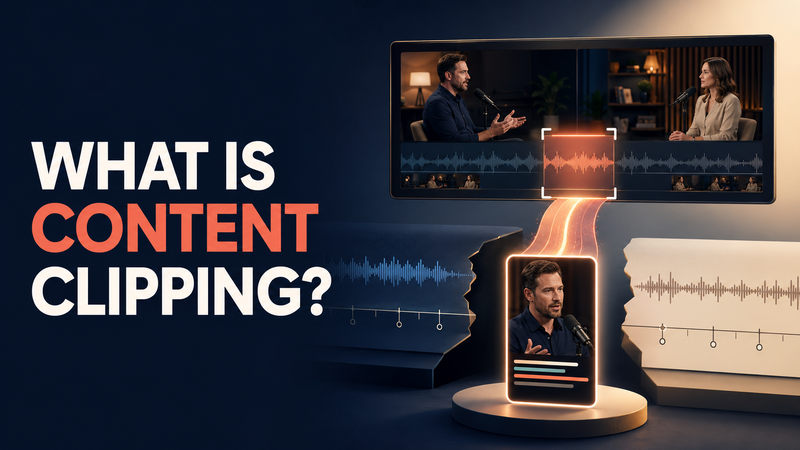

A valuable answer can disappear inside a 90-minute podcast. A useful product explanation may be buried halfway through a webinar, while the strongest story from a livestream can become almost impossible to find once the broadcast ends.
Content clipping gives these moments another opportunity to reach an audience. It turns selected sections of long-form recordings into focused pieces that can be published on YouTube Shorts, Instagram Reels, TikTok, LinkedIn, and other relevant channels.
The process is sometimes described as simply cutting long videos into smaller ones. That definition misses the editorial work involved. Effective clipping requires someone to find the right moment, rebuild its context, protect its meaning, adapt it to the platform, and measure whether it reached the intended audience.
What Is Content Clipping?
Content clipping is the process of identifying valuable moments within long-form video or audio and transforming them into standalone short-form content.
Source material can include:
Podcasts
Interviews
Webinars
YouTube videos
Livestreams
Virtual events
Training sessions
Product demonstrations
Customer conversations
Conference presentations
Recorded workshops
A successful clip communicates one complete idea, story, answer, opinion, demonstration, or outcome. Someone discovering it independently should be able to understand its subject without watching the original recording first.
Content clipping usually involves source review, moment selection, editorial restructuring, video editing, captioning, visual reframing, quality control, publishing, and performance analysis.
The Answer in Simple Terms
Content clipping helps creators and businesses get more value from recordings they have already produced.
Instead of filming a new video for every social post, a clipping team reviews existing content and identifies individual moments that deserve their own format and distribution plan. One podcast episode might contain a personal story for attracting new viewers, an expert explanation for building trust, and an answer to a customer objection for people already considering the service.
The objective is not to extract as many clips as technically possible. It is to find moments with enough value and context to succeed on their own.
How Content Clipping Works
1. Decide What the Clips Should Achieve
A clipping project should begin with a defined objective. A clip intended to reach new viewers will often differ from one created to answer a detailed customer question.
Possible goals include:
Increasing awareness among relevant viewers
Building recognition around a founder or expert
Supporting a podcast or YouTube channel
Answering common customer questions
Demonstrating specialist knowledge
Reviving useful archive material
Directing viewers towards longer content
Testing topics for future videos
Generating relevant profile visits or enquiries
This objective becomes the standard used to select clips and evaluate results.
2. Review the Available Recordings
The team then reviews recent recordings and older archives. Useful candidates may appear in podcasts, webinars, interviews, tutorials, presentations, product demonstrations, or livestreams.
During this review, the selector looks for complete answers, interesting comparisons, practical lessons, strong opinions, customer objections, personal experiences, mistakes, demonstrations, and stories with clear outcomes.
Excitement alone is not enough. A loud reaction may attract attention but provide little lasting value. A calm explanation of a genuine customer problem may be far more useful to the business.
3. Select Moments That Can Stand Alone
A memorable section within a full conversation does not always become a strong short-form video. Some moments depend heavily on information shared several minutes earlier.
Before sending a moment into production, the team should ask:
Is the subject clear?
Can the viewer identify the speaker or situation?
Does the section contain a complete idea?
Is there a satisfying conclusion?
Can unnecessary context be removed safely?
Does the topic matter to the intended audience?
Does the moment support the campaign objective?
If the section needs a lengthy introduction before it becomes understandable, it may be better left within the original video.
4. Reconstruct the Moment
Natural conversation is rarely structured for short-form viewing. Speakers pause, repeat themselves, refer to earlier comments, and take time to reach the main point.
The editor must remove unnecessary material without changing the original meaning. A well-constructed clip normally includes:
An opening that identifies the subject or tension
Enough context for an unfamiliar viewer
A focused explanation, story, opinion, or demonstration
A conclusion that resolves the opening
This may require shortening a question, removing side comments, changing the order of closely connected sentences, or adding a brief on-screen introduction. The result should feel complete rather than extracted at random.
5. Adapt the Video for Its Platform
Most long-form recordings use a horizontal frame, while popular short-form platforms favour vertical video. Reframing therefore requires more than changing the dimensions of the file.
The editor may need to follow the active speaker, enlarge a product, reorganise a screen recording, show two participants together, or change the crop during a demonstration. Important visual details must remain visible without making the edit feel restless.
Captions should be accurate, readable, and positioned away from usernames, descriptions, and platform controls. Names, figures, technical terms, and specialist language need manual review because automated transcripts frequently misunderstand them.
6. Strengthen the Opening Without Distorting It
Long-form content can take several minutes to establish its subject. A short clip needs to clarify its value much sooner.
The editor might begin with the strongest relevant statement, remove a slow introduction, open at the point of conflict, or add a concise question that frames the discussion.
However, the opening must accurately represent what follows. A dramatic hook may earn an initial view, but the viewer will leave if the promised explanation never arrives. Repeated use of misleading hooks can also weaken trust in the creator or brand.
7. Review the Final Meaning and Quality
Before publication, each clip should be checked for caption accuracy, audio quality, framing, pacing, brand terminology, factual meaning, and platform-safe positioning.
Context review is particularly important for technical, medical, legal, financial, and business subjects. Removing a qualifying statement can make a careful explanation sound like an absolute claim.
Responsible editing makes the original point easier to understand. It should never make the speaker appear to say something they did not mean.
8. Publish, Measure, and Improve
A structured approach to What is Content Clipping connects moment selection and editing with distribution, quality control, reporting, and future planning.
Useful performance signals include:
Viewer retention
Completion rate
Rewatches
Shares and saves
Relevant comments
Profile or channel visits
Subscriber growth
Views of related long-form content
Enquiries influenced by the clips
Views matter, but they need context. A specialist clip reaching 4,000 relevant viewers may produce more business value than a general clip watched by 100,000 people with no lasting interest in the subject.
Clipping Agency’s Context Gap Principle
Clipping Agency evaluates content through what we call the Context Gap. This is the distance between how understandable a moment is inside the original recording and how understandable it will be when encountered alone.
A statement such as “That decision nearly ended the company” may feel powerful during a full founder interview. As an isolated opening, however, it leaves several unanswered questions. What decision was made? Which company is being discussed? Why was the situation serious? What happened afterwards?
A clipping team closes the Context Gap by ensuring that four elements remain present:
Subject: The viewer understands what is being discussed.
Significance: The viewer knows why the moment matters.
Substance: The clip provides the explanation, evidence, or story promised.
Resolution: The idea reaches a useful conclusion.
This principle separates extraction from reconstruction. Extraction removes a section from a timeline. Reconstruction gives that section enough structure to work independently.
It also explains why more clips do not automatically create a better campaign. A weak moment with a large Context Gap requires more editing and still may not become genuinely useful. Selecting fewer moments with strong standalone value often produces clearer audience signals and more consistent quality.
Specific Content Clipping Examples
Consider a 70-minute interview with a software founder. The conversation could produce separate clips about a failed launch, an important customer complaint, the company’s pricing decision, the first hiring mistake, and a common industry misconception.
The failed-launch story may attract broad attention because it contains tension and a recognisable lesson. The pricing explanation may receive fewer views but reach people who are actively comparing solutions.
A fitness educator could divide a recorded seminar into focused clips about exercise technique, recovery, programming errors, injury prevention, and realistic progress. Each clip answers one question, while the original seminar remains available for viewers seeking the complete lesson.
A consultant could turn a workshop into short explanations about positioning, customer research, budgeting, team management, and campaign measurement. These clips demonstrate expertise through useful information rather than making every post an advertisement.
Real Business Use Cases
Podcasters
Podcast episodes often contain guest insights, disagreements, stories, and practical lessons. Clips make those moments easier to discover, while guest-focused content may also be shared by the featured speaker.
YouTube Creators
Creators with large archives can reintroduce evergreen ideas that newer subscribers have never encountered. This supports consistent publishing without requiring another full recording.
Coaches and Consultants
Workshops, interviews, presentations, and question-and-answer sessions can become direct responses to common client problems. Prospective customers can assess the expert’s knowledge and communication style before arranging a call.
SaaS Companies
Software businesses can clip product demonstrations, webinars, founder interviews, and customer conversations. One webinar may provide separate clips about a feature, a workflow, an objection, and a customer outcome.
Livestreamers
Long livestreams are difficult to search after the broadcast. Clipping can recover complete stories, skilful moments, useful explanations, and memorable reactions from the archive.
Marketing Agencies
Agencies can work with a specialist clipping partner to serve several client accounts without maintaining a large internal editing team. Clear production rules and approval systems allow the agency to retain strategic control.
Advantages and Limitations
Advantages
Existing recordings produce more usable content.
Creators can publish regularly without filming every day.
Older content receives new discovery opportunities.
Specialist review improves moment selection.
One recording can address several audience needs.
Internal teams spend less time searching through footage.
Consistent standards make quality easier to maintain.
Performance data can improve future content planning.
Limitations
Weak source material will limit the quality of the clips.
Careless editing can remove important context.
Clear brand guidelines and timely approvals are required.
One small batch rarely provides enough evidence to judge a strategy.
Excessive output can weaken selection standards.
High view counts do not guarantee a relevant audience.
Meaningful improvement requires testing across several production cycles.
Content clipping can extend the usefulness of strong material, but it cannot manufacture expertise, clarity, or an interesting idea that was absent from the source.
Common Content Clipping Mistakes
Selecting incomplete moments: The viewer should not need to understand the previous ten minutes before the clip makes sense.
Starting too early: Greetings and background details can consume the opening before the useful point appears.
Using misleading hooks: The opening should create interest in what the clip genuinely delivers.
Prioritising quantity over value: Producing every possible clip adds editing and approval work without guaranteeing better results.
Applying one style to every idea: Stories, demonstrations, opinions, and educational explanations may require different pacing.
Overloading the screen: Captions, zooms, stock footage, transitions, and sound effects should support the message rather than compete with it.
Ignoring older recordings: The newest video is not automatically the best source. Archive material may contain stronger evergreen moments.
Measuring views alone: Retention, relevant comments, profile visits, subscribers, and long-form viewing provide important context.
Frequently Asked Questions
Is content clipping the same as video editing?
No. Editing is one part of the process. Content clipping also includes source review, moment selection, context reconstruction, platform adaptation, distribution planning, and performance analysis.
How many clips can one long video produce?
The answer depends on the density of useful material. A structured webinar may contain several complete explanations, while an informal conversation may offer fewer standalone moments. Quality should determine the final number.
Can older videos be clipped?
Yes, provided the information remains accurate and relevant. Older interviews, tutorials, webinars, and livestreams often contain valuable material that has never been distributed in a short-form format.
Does content clipping work for audio podcasts?
Yes. Audio can be adapted using speaker footage, branded layouts, relevant supporting visuals, or an audiogram format. The central idea must still be suitable for independent viewing.
Should every clip include a call to action?
No. Some clips should simply provide a complete and useful idea. A call to action works best when the next step is genuinely relevant, such as watching the full interview or exploring a detailed guide.
Can one clip be posted on every platform?
The same moment can often be adapted for several platforms, but each version should account for different safe zones, lengths, captions, features, and viewing behaviour.
Recover More Value From Every Recording
Valuable ideas should not disappear because they were published inside a long podcast, webinar, interview, or livestream. Content clipping makes those ideas easier to discover, understand, share, and learn from.
Clipping Agency approaches the work as a connected system of selection, reconstruction, editing, quality control, distribution, and analysis. If your content archive contains useful moments that are not receiving enough attention, Clipping Agency can help identify the strongest opportunities and build a clipping process around your audience and objectives.

Comments
No comments yet. Be the first to comment!