
AI Clipping vs Human Clipping: What Actually Drives Real Short-Form Growth
A practical breakdown of automation vs editorial judgment in modern content clipping workflows
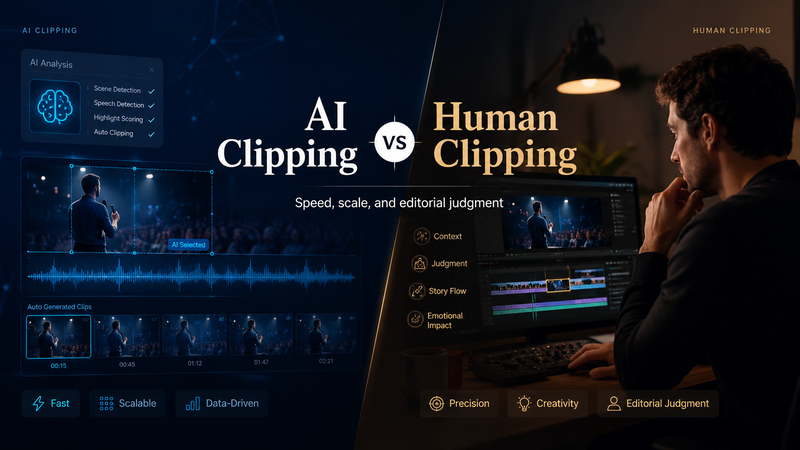

The way content gets cut, repurposed, and distributed has changed faster in the last two years than in the previous decade. Short-form platforms have pushed every creator, brand, and agency into the same question: should we rely on AI to handle clipping, or is human editing still the standard that actually performs?
On the surface, AI clipping looks like the obvious answer. It is faster, cheaper, and available at scale. But when you start looking at retention, storytelling quality, platform fit, and how audiences actually respond, the gap between AI clipping and human clipping becomes more visible.
This article breaks down both approaches in a grounded way, without overcomplicating it. The goal is not to pick a winner blindly, but to understand where each one works, where it fails, and how modern distribution systems are actually combining the two.
The context of this discussion also fits the way modern publishing tools are structured. Most platforms today, like the editor shown in the screenshot, are designed for structured publishing with a title, subtitle, header image, and a clean writing space for long-form content. That structure matters because clipping is not just about cutting video anymore. It is about packaging content for platforms that reward clarity, pacing, and relevance.
What AI Clipping Actually Does
AI clipping tools are built to process long-form content and automatically extract short segments that “look” engaging. They rely on pattern recognition, speech detection, keyword spikes, and sometimes basic engagement prediction models.
In simple terms, AI watches your video or audio and tries to guess which parts might perform well as short-form clips.
Most AI clipping systems focus on:
Detecting high-energy moments in speech or visuals
Cutting segments based on silence, volume shifts, or keywords
Auto-generating captions and subtitles
Formatting videos into vertical ratios for platforms like TikTok, Instagram Reels, and YouTube Shorts
Producing multiple variations quickly for testing
The strength of AI clipping is scale. A single long video can be turned into dozens of clips within minutes. For creators or agencies dealing with large content libraries, this speed is useful.
However, AI does not understand intent. It does not understand why something is funny, why a pause matters, or why a specific story builds emotional weight. It only recognizes signals, not meaning.
That limitation becomes visible in the final output. Many AI-generated clips feel technically correct but emotionally flat. They may include the right words, but not the right moment.
What Human Clipping Brings to the Process
Human clipping is slower, but it is fundamentally different in how decisions are made.
A human editor does not just look for highlights. They look for context. They understand setup, payoff, tone, pacing, and audience psychology.
Where AI looks for signals, humans look for stories.
Human clipping typically involves:
Understanding the full narrative before cutting anything
Identifying emotional arcs instead of isolated moments
Adjusting pacing based on platform behavior, not just raw footage
Reframing clips to improve clarity or impact
Adding timing decisions that match audience attention patterns
Removing technically correct but strategically weak segments
A strong human editor will often skip “viral moments” if they do not serve retention. At the same time, they will enhance quieter sections if they improve storytelling.
This is where human clipping consistently outperforms AI. Short-form content is not just about grabbing attention. It is about holding it long enough for the platform algorithm to distribute it further. That requires judgment, not just detection.
Key Differences Between AI Clipping and Human Clipping
The difference is not just speed versus quality. It is about how decisions are made at every stage of the editing process.
1. Understanding Context
AI clipping:
Works on isolated segments
Misses setup and payoff structure
Treats clips as independent pieces
Human clipping:
Understands full narrative flow
Preserves meaning across segments
Selects moments based on story, not isolation
2. Emotional Timing
AI clipping:
Detects loud or high-energy moments
Often cuts too early or too late
Misses emotional build-up
Human clipping:
Recognizes tension before payoff
Knows when silence is important
Times cuts based on audience reaction patterns
3. Platform Optimization
AI clipping:
Uses generic formatting rules
Applies uniform templates across platforms
Lacks platform-specific storytelling nuance
Human clipping:
Adjusts style based on platform behavior
Understands TikTok vs YouTube Shorts differences
Edits for retention curves, not just appearance
4. Consistency of Output
AI clipping:
Produces large volume quickly
Quality varies significantly across clips
Requires manual filtering afterward
Human clipping:
Produces fewer but more refined clips
Maintains consistent quality
Reduces need for post-review adjustments
5. Strategic Editing
AI clipping:
Focuses on extraction
Does not think in terms of campaign goals
Human clipping:
Aligns clips with marketing objectives
Builds content sequences, not just standalone videos
Understands brand tone and positioning
Where AI Clipping Works Well
Despite its limitations, AI clipping is not useless. In fact, it plays an important role in modern workflows when used correctly.
AI works best when:
You need fast content repurposing at scale
You are testing large volumes of ideas
The source content is repetitive or structured (podcasts, interviews, webinars)
You are building a raw clip library before refinement
Speed matters more than precision
In these cases, AI acts as a first layer filter. It reduces workload and helps surface potential moments that humans can later refine.
Where Human Clipping Becomes Essential
Human clipping becomes critical when content has strategic value.
This includes:
Brand campaigns where messaging must be precise
Influencer content where tone matters
Educational content where clarity is essential
Story-driven videos that rely on pacing
High-stakes marketing content
In these cases, a poorly cut clip does not just underperform. It can distort meaning or weaken the entire campaign.
Human clipping ensures that what is said is not just captured, but preserved correctly.
The Real Industry Shift: Hybrid Clipping
The most effective systems today are not choosing between AI and human clipping. They are combining both.
A common workflow looks like this:
AI generates a large pool of potential clips
Human editors filter and refine selections
Final clips are adjusted for platform-specific performance
Distribution strategies are aligned with campaign goals
This hybrid approach solves the biggest problem in content distribution today, which is not production speed, but decision quality at scale.
AI handles volume. Humans handle judgment.
Together, they create a system that is both fast and accurate.
Why This Matters for Modern Content Distribution
Short-form content is no longer just a social media tactic. It is a primary distribution channel for brands, creators, and agencies.
The difference between a clip that gets 500 views and one that gets 500,000 views often comes down to small editorial decisions:
When the clip starts
When attention is hooked
What context is included or removed
How the message is framed in the first few seconds
These decisions are still heavily human-driven in high-performing content systems.
This is also where professional clipping services like Clipping Agency position themselves, combining structured editorial review with scalable production workflows to ensure content is not just produced, but actually distributed effectively.
Conclusion
AI clipping and human clipping are not competing systems in the long term. They are different layers of the same workflow.
AI brings speed and scalability. Human editing brings context, emotion, and strategic clarity. The real advantage comes from knowing where each one belongs.
If the goal is pure volume, AI is enough. If the goal is performance, retention, and brand impact, human clipping still leads. And in most serious content systems, the future is not one or the other. It is both working together in a structured pipeline.
Modern content distribution is not about cutting videos faster. It is about cutting them correctly.

Comments
No comments yet. Be the first to comment!