
Brand Clipping Campaigns Help Content Work Harder
How brands turn podcasts, interviews, webinars, and long videos into short-form assets that build reach, trust, and recall.

Why brands need more than one good piece of content
Many brands already have strong content sitting inside long videos, founder interviews, podcasts, webinars, product demos, customer calls, and event recordings. The problem is not always content quality. In many cases, the real issue is that the content is only used once, posted in one place, and then forgotten.
A long-form video can take hours to plan, record, edit, and publish. It may contain useful ideas, strong opinions, customer insights, and moments that explain the brand better than any static post could. Still, if that video only goes live as one upload, most of its value remains hidden. The people who would benefit from the message may never see it because they are not ready to watch a 40-minute video or listen to a full podcast episode.
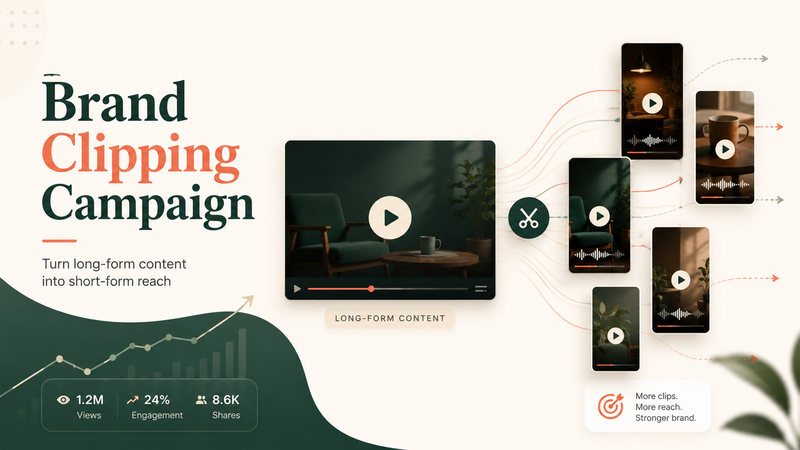
That is where a Brand Clipping Campaign becomes valuable. It gives brands a way to turn long-form content into multiple short-form clips that can be shared across platforms in a planned and consistent way. Instead of hoping one big piece of content reaches everyone, the brand creates several smaller entry points for different audiences, different platforms, and different stages of awareness.
What a brand clipping campaign actually does
A brand clipping campaign is a structured process for finding the strongest moments inside long-form content and turning them into short videos that can perform on social platforms. These clips are not random cuts. They are selected, edited, captioned, and distributed with a clear purpose.
The source content can come from many places, including:
Podcast episodes
Founder-led videos
YouTube interviews
Webinars and live sessions
Customer conversations
Educational videos
Product explainers
Event recordings
Behind-the-scenes footage
Long-form social videos
The aim is to create short clips that can stand on their own. Someone should be able to watch the clip without knowing the full context and still understand the point. This is what separates proper clipping from basic repurposing. A weak clip feels like a piece taken out of something bigger. A strong clip feels complete, useful, and worth watching by itself.
For a brand, this matters because short clips can introduce people to its thinking, personality, expertise, and offer without asking for too much time upfront.
Why clipping campaigns fit modern attention habits
Most people do not discover brands by watching full-length videos from the start. They often come across a short clip first. A useful 45-second clip can introduce a viewer to a founder, a topic, a product angle, or a customer problem faster than a full webinar ever could.
This does not mean long-form content is no longer useful. Long-form content still builds depth, authority, and trust. The issue is that many viewers need a smaller reason to care before they commit to longer content. Short clips do that job well because they give people a quick sample of the brand’s perspective.
A clipping campaign helps brands meet people where they already spend time. A viewer may see one clip on LinkedIn, another on Instagram, and another on YouTube Shorts. Over time, the brand becomes more familiar. That repeated exposure can matter more than a single post with strong numbers because trust usually grows through multiple touchpoints.
The difference between random clips and a proper campaign
Many brands make the mistake of clipping content without a strategy. They choose a few moments, add captions, post them, and hope something works. Sometimes this brings views, but it rarely builds a consistent content engine.
A proper campaign is more intentional. It looks at the brand’s goals, the audience, the platform, the message, and the format before clips are created. It also tracks what happens after the clips go live, so the brand can learn which topics and hooks are actually connecting.
The difference is simple:
Random clipping creates more content.
A clipping campaign creates more useful distribution.
Random clipping focuses on output.
A clipping campaign focuses on reach, learning, and recall.
Random clipping may chase trends.
A clipping campaign supports the brand’s bigger message.
This is why the planning matters. The editing is important, but the clip selection and distribution strategy often decide whether the content does anything meaningful.
What makes a clip worth publishing
Not every moment from a long video deserves to become a short-form post. Some sections only make sense in the full conversation. Others may be useful but too slow for social platforms. The best clips usually have a clear idea, a natural hook, and enough context to make sense quickly.
A strong clip often includes one of these elements:
A clear answer to a common question
A sharp opinion that starts conversation
A practical tip the audience can use
A relatable problem the viewer recognises
A customer insight or proof point
A simple explanation of a complex topic
A human moment that shows personality
A strong statement that makes people stop scrolling
The clip does not need to be loud or over-edited. In fact, many brand clips work better when they feel natural. Viewers can usually tell when a clip has been forced to sound dramatic. A calm, useful, honest explanation can often do more for brand trust than an overproduced video trying too hard to go viral.
How brands can use clipping across platforms
One of the strengths of a clipping campaign is that one long-form recording can support several different platforms. The same source video can become short clips for Instagram Reels, TikTok, YouTube Shorts, LinkedIn, X, Facebook, newsletters, landing pages, and even sales follow-up material.
However, brands should avoid posting the exact same version everywhere without thinking about platform fit. A clip that works on TikTok may need a different caption for LinkedIn. A clip designed for YouTube Shorts may need a stronger title or search-friendly angle. A founder opinion clip may work well on LinkedIn if it connects to a business challenge, while a behind-the-scenes clip may feel more natural on Instagram.
A simple platform approach can look like this:
Use LinkedIn for founder opinions, industry lessons, and trust-building clips.
Use Instagram Reels for brand personality, culture, and easy-to-consume moments.
Use YouTube Shorts for search-friendly educational clips and topic-based discovery.
Use TikTok for fast hooks, relatable problems, and direct explanations.
Use newsletters to resurface the best clips with added context.
Use landing pages to support proof, process, or product education.
This kind of distribution helps the brand avoid relying on one platform only. It also gives each clip a better chance of reaching the right audience in the right format.
Why clipping supports brand recall
Brand recall is built through repetition, but repetition does not mean posting the same message in the same way every day. A clipping campaign allows the brand to repeat its core ideas through different moments, speakers, stories, and formats.
For example, a brand may want to be known for helping companies turn long-form content into short-form growth assets. That message can appear in many ways. A founder can explain the strategy. A customer can describe the result. A clip can show the editing process. Another clip can break down a distribution mistake. A webinar snippet can explain why brands waste content. Each clip supports the same larger idea, but it does not feel like the same post repeated again and again.
This is useful because most people need to see a brand several times before they remember it. They may not click after the first clip. They may not follow after the second. But after seeing useful content repeatedly, they may start to associate the brand with a specific problem or solution.
How clipping campaigns help teams use content more efficiently
Many marketing teams struggle to keep up with content demand. They need posts for several platforms, but they may not have the time or budget to produce new creative assets every day. Clipping makes the process more efficient because it turns one content effort into many smaller assets.
This does not mean the brand should record anything and expect clips to perform. The source content still matters. Strong long-form conversations, useful interviews, and clear educational videos make better clips. But once the source material is strong, clipping helps the team extend its life.
A single recording can support:
A series of short social videos
Multiple captions and post angles
Newsletter sections
Blog ideas
Sales enablement snippets
Website proof points
Retargeting assets
Founder content
This is why clipping can work well for brands that already invest in podcasts, webinars, interviews, or video-based thought leadership. They are not starting from zero. They are making better use of what already exists.
What a good clipping workflow looks like
A useful clipping workflow is simple enough to repeat, but structured enough to avoid wasted effort. The exact process can vary, but most strong campaigns follow a similar path.
First, the team reviews the long-form content and identifies moments with standalone value. Then those moments are grouped by theme, audience need, or campaign goal. After that, clips are edited with captions, framing, pacing, and context. Finally, the clips are scheduled, published, and reviewed for performance.
A practical workflow may include:
Reviewing the source video for strong ideas and clean moments
Selecting clips based on audience value, not internal preference only
Creating hooks that match the opening seconds of the clip
Editing for mobile viewing with clear captions
Writing captions that add context to the video
Adjusting the post slightly for each platform
Publishing consistently over several weeks
Tracking watch time, saves, shares, comments, and profile visits
Using the results to guide future recording topics
The last step is important. A clipping campaign should improve over time. If certain topics keep getting saved or shared, that tells the brand something. If certain hooks lose viewers early, that tells the brand something too. The campaign becomes a feedback loop, not just a content machine.
Common mistakes to avoid
A clipping campaign can fail when brands focus only on volume. More clips are not always better. If the clips feel repetitive, unclear, or disconnected from the brand’s message, they can create noise instead of momentum.
Some common mistakes include:
Choosing clips that need too much missing context
Making every clip sound like a sales pitch
Using captions that are hard to read on mobile
Posting the same caption across every platform
Ignoring the first three seconds of the clip
Over-editing until the video feels unnatural
Publishing without a schedule
Measuring only views and ignoring deeper engagement
Failing to connect clips back to the brand’s main positioning
A good campaign avoids these mistakes by treating each clip as a small brand asset. The clip should have a reason to exist. It should help the viewer understand something, feel something, or remember something about the brand.
Final thoughts
A brand clipping campaign is one of the most practical ways to get more value from video content. It helps brands stop treating long-form content as a one-time asset and start using it as a source of ongoing reach. When the clips are chosen carefully and distributed consistently, they can support awareness, trust, education, and brand recall at the same time.
The brands that benefit most are usually the ones that think beyond editing. They use clipping as part of a wider distribution strategy. They choose moments with purpose, adapt clips for different platforms, publish regularly, and learn from the data. Over time, this creates a stronger content presence without forcing the team to produce brand-new ideas every day.
For brands with podcasts, interviews, webinars, founder videos, or educational content already available, clipping can turn existing material into a steady stream of useful short-form content. It gives the brand more chances to be seen, more chances to be remembered, and more chances to turn attention into trust.

Comments
No comments yet. Be the first to comment!