
Clipping Campaigns: The Smarter Way to Stretch One Video Across Every Platform
How a structured clipping campaign turns long-form content into short-form moments that keep showing up where your audience already spends time.
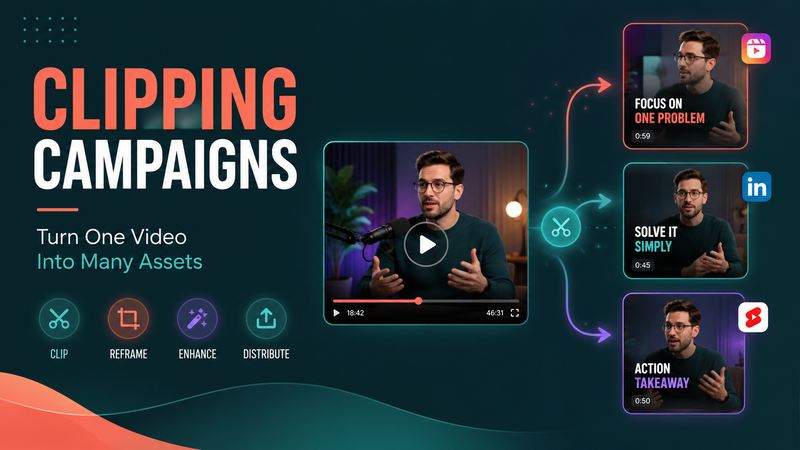

One strong video should not be treated like a one-time upload.
A podcast episode, webinar, founder interview, livestream, or long YouTube video often contains more than one useful idea. There may be a sharp answer in the middle. A good story near the end. A simple explanation that makes the whole topic easier to understand. A short moment that would work perfectly as a Reel, Short, TikTok, or LinkedIn clip.
The problem is that these moments rarely get used properly.
The full video goes live. Someone posts a link. A few people watch. Then the team moves on to the next piece of content.
That is where a clipping campaign becomes useful.
A clipping campaign takes long-form content and turns the strongest moments into short-form clips with a clear plan behind them. It is not just video chopping. It is not “let’s make five clips because we need five posts.”
It is a more intentional system.
The goal is to make one good video show up in more places, in more formats, and in front of more people.
What a Clipping Campaign Really Is
A clipping campaign is a planned distribution system built from long-form video.
The source content could be a podcast, interview, webinar, YouTube video, event recording, online lesson, customer conversation, or expert discussion. Instead of treating that content as one asset, a clipping campaign breaks it into useful moments that can stand on their own.
That last part matters.
A campaign clip should not feel like a random piece from the middle of a conversation. A viewer should understand the point without needing to watch the full video first.
A good clip might explain one idea. It might answer one question. It might tell one short story. It might show one result. It might challenge a belief. It might create curiosity about the full video.
A campaign gives each clip a job.
Some clips build awareness. Some build trust. Some show personality. Some prove expertise. Some drive people back to the original content.
That is the difference between posting clips and running a clipping campaign.
Why One Long Video Can Do More Than One Job
A long video usually contains several different angles.
A founder interview may include a personal story, a customer problem, an industry opinion, and a proof point from real work. A podcast may include a useful lesson, a funny moment, a strong quote, and a practical tip. A webinar may explain several smaller problems inside one larger topic.
That gives the content more value than one post can capture.
For example, one long video can create:
A short educational clip for people who want quick value
A story clip that makes the brand feel more human
A proof clip that builds trust
An opinion clip that starts conversation
A teaser clip that sends people toward the full video
Same source.
Different purpose.
Different audience response.
That is what makes clipping campaigns powerful. They let one piece of content work in several directions instead of forcing one post to carry everything.
Why Random Clips Usually Fall Short
There is nothing wrong with clipping content casually, but random clips rarely create a real system.
Someone watches the video, grabs a few sections, adds captions, and posts them. Maybe one clip does well. Maybe none of them do. Either way, there is no real structure behind the process.
A clipping campaign works differently.
It asks better questions before the edit starts.
Which moments are actually useful?
Which clips can stand alone?
Which platform is each clip best suited for?
Should this clip educate, entertain, build trust, or drive attention back to the full video?
What should the opening line be?
How should the caption frame the clip?
That planning matters.
A polished clip with a weak idea is still weak. It may look clean, but it will not do much. Strong clipping campaigns begin with good selection, not flashy editing.
The Best Moments Are Often Hidden
The strongest part of a video is not always where people expect it to be.
Sometimes it is not in the intro. Sometimes it is not in the planned talking points. Sometimes it appears after the guest has relaxed or after the host asks a follow-up question.
That is why proper review matters.
A good campaign does not skim the video and grab the easiest sections. It looks for moments that carry weight. A clear answer. A useful sentence. A story that feels real. A point that the audience will understand quickly.
These moments are often buried.
A clipping campaign brings them forward.
That does not just help the original video get more reach. It also helps the audience find the best parts faster.
What Makes a Clip Worth Using?
A clip is worth using when it gives the viewer something clear.
It should not need too much background. It should not wander for too long. It should not feel like the middle of a private conversation.
A strong clip usually has three things.
A clear idea
The clip should focus on one message.
One lesson. One story. One mistake. One opinion. One proof point.
Trying to say too much in a short clip usually makes it weaker.
Enough context
Short-form content still needs context.
The viewer does not need the entire backstory, but they need enough to understand why the moment matters.
A strong opening
The first few seconds matter because people scroll quickly.
That does not mean the opening needs to be fake or dramatic. It just needs to reach the value fast.
A slow opening might be:
“Yeah, when we were discussing the content plan, a few things came up…”
A stronger opening would be:
“One long video can feed several platforms if you know which moments to pull.”
The second one gives the viewer a reason to stay.
A Better Way to Structure a Clipping Campaign
A clipping campaign should feel organized without becoming complicated.
Here is a simple structure that works.
Campaign StepWhat It MeansWhy It MattersReview the source videoWatch the full content properlyStrong moments are often hiddenSelect key momentsChoose clips that stand aloneAvoids weak fillerGroup by purposeSort clips by education, story, proof, opinion, or teaserKeeps the campaign variedShape the openingStart closer to the valueHelps people keep watchingEdit for clarityUse clean captions and natural pacingMakes the message easier to followAdapt by platformAdjust crop, caption, title, or first frameEach platform behaves differentlyPublish with rhythmSpread clips over days or weeksBuilds repeated visibilityReview performanceStudy saves, shares, comments, clicks, and watch timeImproves the next campaign
That last step matters more than people think.
A campaign should teach the team something. If story clips get profile visits, that is useful. If educational clips get saves, that is useful. If opinion clips get comments, that is useful.
The next campaign should be smarter because of what the last one showed.
Why Platform Fit Matters
The same clip can work across more than one platform, but it should not always be posted the exact same way.
LinkedIn may need a stronger written setup.
TikTok may need the useful part to appear faster.
Instagram Reels may need a better first frame.
YouTube Shorts may need tighter pacing.
Facebook may need a clearer caption.
The core clip might stay the same, but the packaging can change.
That is where many campaigns improve. Not by making everything harder, but by making small adjustments that fit the platform better.
A clipping campaign should not treat every platform like the same room with different wallpaper.
The audience behaves differently in each place.
Common Mistakes That Weaken Clipping Campaigns
The first mistake is forcing too many clips from one video.
If a video has five strong moments, make five strong clips. Do not force fifteen weak ones just because the calendar looks empty.
The second mistake is keeping slow openings.
A clip can feel natural, but it still needs to get to the point quickly.
The third mistake is overediting.
Too many zooms, flashing captions, sound effects, and random movements can make a useful idea feel cheap. Editing should support the message, not compete with it.
The fourth mistake is judging everything by views.
Views matter, but they are not the only signal. Saves, shares, comments, profile visits, clicks, and lead quality can also show whether a clip is doing its job.
A clip with fewer views but stronger audience intent can be more useful than a viral clip watched by people who will never care about the brand.
Less exciting, maybe.
But much more useful.
Why Clipping Campaigns Help Content Teams Stay Consistent
Consistency is hard when every post starts from scratch.
New ideas take time. New recordings take effort. New captions need writing. New edits need review. Eventually, the content process starts feeling heavier than it should.
Clipping campaigns make consistency easier because they create multiple useful posts from content that already exists.
One podcast can become a week of clips.
One webinar can become several educational posts.
One founder interview can become story clips, proof clips, opinion clips, and teasers.
That gives the brand more chances to show up without constantly starting from zero.
And repeated visibility matters.
People rarely trust a brand after one post. They need to see useful ideas more than once. They need to recognize the speaker. They need to understand the message from different angles.
A clipping campaign helps create that rhythm.
Final Thoughts
Clipping campaigns help good content travel further.
They turn long-form videos into short-form moments that can educate, prove, build trust, create curiosity, and keep the brand visible across platforms.
The simple version is this.
Record strong content. Find the best moments. Group them by purpose. Edit them clearly. Adapt them for each platform. Publish with rhythm. Learn from performance.
That is how one video becomes more than one upload.
It becomes a campaign.
And in crowded feeds, that makes all the difference.

Comments
No comments yet. Be the first to comment!