
Content Clipping: The 1.9-Second Playbook
How audience retention curves transform raw video archives into measurable subscriber growth.
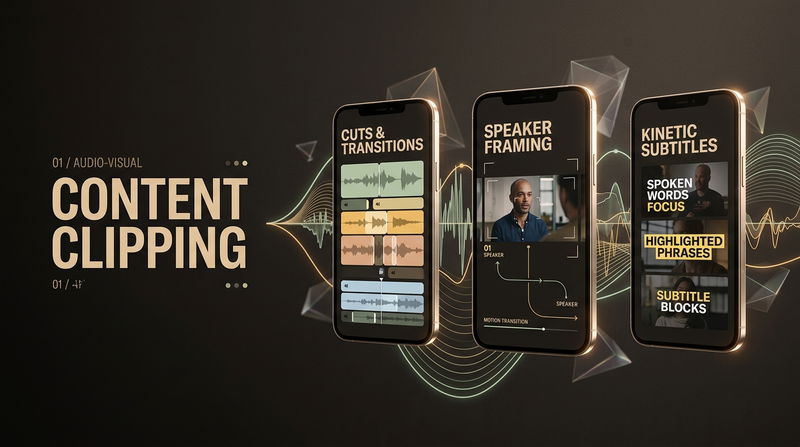

Auditing mobile video interactions reveals that a casual smartphone user decides whether to stay on an unfamiliar video within 1.9 seconds. During that narrow window of time, the viewer subconscious brain evaluates visual movement, vocal energy, and subject relevance. If an unmanaged conversational excerpt opens with ten seconds of casual small talk, room acoustics testing, or slow atmospheric buildup, roughly eighty-one percent of mobile browsers swipe away before the speaker reaches their primary conclusion.
Founders, educators, and creative media teams dedicate extensive hours to researching specialist subjects, interviewing industry experts, and polishing high-definition recordings. Yet once those complete discussions are uploaded to standard long-form hosting libraries, viewership metrics almost always flatten within seventy-two hours of the initial announcement. Traditional video channels and podcast feeds function as static storage libraries rather than active discovery engines. Expecting an unfamiliar person to stop what they are doing, open a separate application, and sit through an unvetted forty-five-minute recording without context is an unrealistic hurdle. Overcoming this visibility barrier requires understanding the data mechanics of Content Clipping to systematically extract high-retention moments from master recordings, transforming full-length footage into an active fleet of vertical cutdowns that meet prospective fans directly on mobile feeds.
The Conversion Mechanics of Handheld Discovery
Building a sustainable audience in modern digital networks is an exercise in conversion funnel mathematics. The objective of short-form media is never to persuade an unfamiliar viewer to consume an entire sixty-minute archive during their lunch break. The primary goal is capturing three to five seconds of focused attention so the viewer absorbs a single, high-impact insight.
When a media team exports an unedited recording that opens with pleasantries, background setup, or thirty seconds of introductory disclaimers, the conversion funnel collapses immediately. In a live presentation, a gradual introduction sets the mood for the room. On a fast-moving algorithmic video feed, that identical introductory delay represents sheer friction that drives potential subscribers away.
Eliminating this drop-off requires aligning sound and framing with actual mobile browsing behavior. Examining where viewers abandon conversational videos highlights how visual rhythm, dynamic spatial reframing, and typographic styling recover lost reach.
The Three Drop-Off Friction Points in Handheld Media
Reviewing viewer curves across thousands of short-form educational and interview assets reveals three distinct friction points where publishers consistently lose audience attention.
Friction Point 1: The Context Confirmation Window (Seconds 0 to 2)
The opening two seconds represent the steepest drop-off point in handheld media. Unmanaged conversational cutdowns routinely lose seventy to seventy-eight percent of total viewers before the subject matter is even introduced.
The underlying cause is conversational delay. Creators often upload clips that preserve the chronological beginning of an answer, complete with throat-clearing, polite affirmations, or references to points made earlier in the episode. The mobile scroller senses a lack of immediate relevance and triggers an automatic swipe upward.
The quantitative fix requires cutting straight to the core thesis of the statement. The video must launch on the exact frame where the speaker delivers a bold declaration, an unexpected statistical finding, or a compelling question. Pairing this opening statement with a bold on-screen headline gives the viewer an instant mental framework to interpret the clip, arresting scroll speed before their thumb can move.
Friction Point 2: The Engagement Runway (Seconds 3 to 22)
The second friction point tests whether an asset can maintain the attention of the twenty to twenty-five percent of viewers who stayed past the initial hook. During this intermediate segment, poorly structured cutdowns lose another thirty-five to forty percent of their remaining audience.
The primary failure trigger during this phase is visual stagnation. Even when a viewer finds the topic interesting, staring at an unmoving camera shot leads to visual boredom. If two speakers sit inside an unmoving wide shot without dynamic camera changes or visual rhythm, user attention drifts.
To maintain engagement across this runway, production teams synchronize visual edits directly with natural speech cadence. Introducing dynamic speaker cutaways, gentle reframing punches on emphatic words, and high-contrast kinetic subtitles keeps both the visual and auditory senses engaged simultaneously. As the viewer stays absorbed in the story, the underlying conversational point plays through completely.
Friction Point 3: The Audience Conversion Milestone (Seconds 23 to 55)
The final friction point involves the dedicated five to ten percent of viewers who watch through to the end of the highlight. This focused group represents prospective fans ready to convert into regular subscribers, yet unguided releases routinely lose ninety percent of them without gaining a single follower.
The drop-off trigger is the classic conversion wall. Demanding that viewers click external bio links, navigate multiple redirect pages, and download third-party applications introduces immense friction. The vast majority of mobile users will not abandon their active social feed to chase down an external link.
The solution is frictionless attribution. Rather than begging for link clicks, anchor the video with a bold, legible lower-third displaying the exact show title, guest name, and episode number alongside a clear concluding summary. When the takeaway lands cleanly, interested viewers remember the topic name and seek out the full catalog naturally when they open their podcast app later in the day.
Audience Progression and Behavioral Drop-Off Benchmarks
Tracking mobile video decay by exact playback intervals highlights the concrete adjustments needed to maintain high audience retention:
The Opening Hook (0 to 2 Seconds):
Retained Audience Share: Roughly 21% to 25% of viewers remain on screen.
Primary Drop-Off Factor: Conversational filler, polite greetings, slow atmospheric build-ups, and missing on-screen topic headlines trigger an automatic skip.
Production Solution: Open directly on the core revelation, display a high-contrast topic headline, and eliminate introductory lag so the audience understands the premise immediately.
The Engagement Runway (3 to 22 Seconds):
Retained Audience Share: Between 8% to 13% maintain active viewing attention.
Primary Drop-Off Factor: Stationary wide camera angles, lack of physical movement, visual stagnation, and uncaptioned speech cause viewers to drift away.
Production Solution: Introduce rhythmic speaker cuts, subtle camera punches on key phrases, and high-contrast kinetic subtitles to keep both eyes and ears engaged simultaneously.
The Conversion Milestone (23 to 55 Seconds):
Retained Audience Share: Approximately 3% to 6% reach the final frame.
Primary Drop-Off Factor: Aggressive link-in-bio demands, sudden jarring cuts, or missing show credits cause viewers to exit without remembering the brand.
Production Solution: Maintain clear lower-third show branding throughout the segment, finish on a natural takeaway, and loop the ending smoothly back to the opening hook.
The Compound Economics of Spoken Asset Multiplication
Evaluating the true return on an educational recording requires measuring distribution reach against initial preparation time. Researching source material, organizing guest logistics, and conducting a sixty-minute interview requires significant creative focus.
If that completed recording is uploaded to digital archives accompanied only by an episodic title card and a standard social post, the entire investment depends on a single event. If online directories do not feature the recording during launch week, the material gathers dust, yielding a poor return on the host preparation time.
Adopting an asset multiplication model changes the economics of show promotion completely:
A single one-hour interview yields six to ten distinct conversational highlights: an unexpected industry finding, a contrarian perspective, a practical step-by-step framework, and an answer to a common question.
Each individual highlight is reframed into native vertical video, optimized for silent scrollers, and formatted within platform safe zones.
This multiplication converts one recording into a collection of independent discovery assets that can be scheduled across multiple algorithmic video networks throughout the month.
Even under modest performance estimates, sharing eight to twelve targeted video highlights consistently generates ten to twenty times more discovery impressions than an isolated full-length upload. Because each video presents an independent idea to different community niches, these touchpoints compound over time, building steady authority and recognition for the show.
Resolving Measurement Hurdles: Frequently Asked Questions
How can an organization tell if short video views are turning into real long-form listeners?
Because mobile video platforms discourage outbound links, measuring direct click attribution is rarely straightforward. The most dependable method is tracking the correlation between weekly video publication consistency and organic search increases on major podcast apps. Successful clipping efforts reliably drive measurable increases in direct title searches, episode downloads, and subscriber retention within three to five weeks of steady publishing.
Will publishing multiple short highlights spoil the interview for regular listeners?
No. Modern discovery platforms share content based on individual engagement history rather than chronological timelines. An average follower only sees a small portion of what an account posts. Distributing different conversational angles allows you to reach new niches without crowding the feeds of existing subscribers.
What audio adjustments are needed when preparing studio recordings for mobile feeds?
Mobile video platforms apply strong compression that can cause dynamic studio dialogue to sound quiet or muffled. Extracted audio should be compressed for even speech volume and equalized to boost mid-range clarity. Rolling off low-end rumble ensures that spoken dialogue remains crisp and easy to understand even on small phone speakers.
The 5-Point Channel Sanity Checklist
Immediate Hook Delivery: Does the video cut begin on a strong observation, clear insight, or compelling realization within the first 1.9 seconds?
Interface Safe-Zone Padding: Are all subtitles, speaker names, and show titles placed safely away from platform buttons, bottom captions, and account handles?
Visual Pacing Transitions: Does the visual framing switch between speakers or punch in slightly on important phrases every three to four seconds to keep the eye engaged?
Silent Browsing Legibility: Can a mobile user understand the entire point through clean, high-contrast subtitles with device volume turned off?
Clear Attribution Anchors: Are the show title and episode number visible on screen so interested viewers know exactly what to look up on podcast directories?
Building a dependable media presence does not require chasing short-lived social trends or spending fifteen hours every week wrestling with timeline editing software. It comes down to getting the full value out of the conversations you already produce. When every recorded interview feeds a reliable system of targeted, high-retention discovery assets, your audience grows steadily in the background.

Comments
No comments yet. Be the first to comment!