
Hire a Clipping Agency to Turn Long-Form Content Into Real Growth
What brands should look for, what to avoid, and why the right clipping partner can make existing content work much harder.
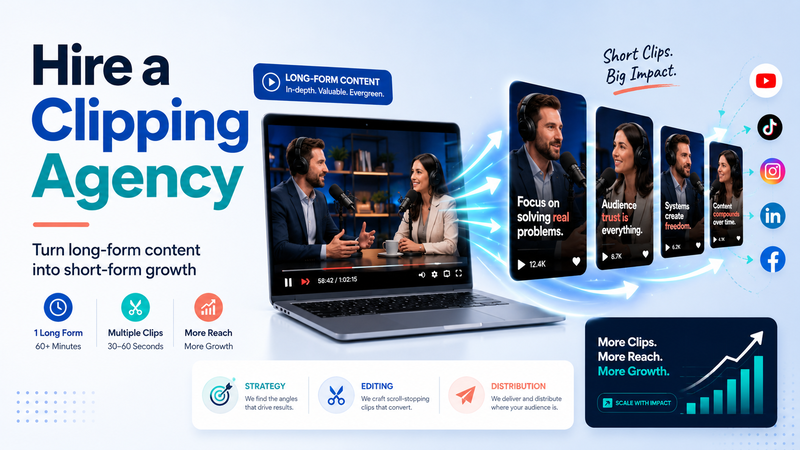

A lot of brands are already creating more content than they realize. A founder goes on a podcast. A team hosts a webinar. A company records product demos, internal interviews, client conversations, YouTube videos, livestreams, and educational sessions. There is usually no shortage of raw material. The real problem is that most of this content is used once, posted once, and then forgotten.
That is where clipping becomes valuable.
When a business decides to Hire Clipping Agency support, it is not just outsourcing editing. It is investing in a better way to distribute ideas that already exist inside its content. Instead of relying on one long video to do all the work, the business can turn that material into multiple short clips that fit the way people actually consume content today.
People do not always discover a brand by visiting its website first. They may come across a short clip on LinkedIn, YouTube Shorts, Instagram Reels, TikTok, or X. They may hear a founder explain one smart idea in 30 seconds and remember the brand because of that. They may never watch the full podcast episode, but they might watch a short highlight and then decide the company is worth paying attention to.
That is why clipping is no longer just a content extra. For many brands, it has become part of a practical growth system.
What a clipping agency actually helps with
The phrase “clipping agency” sounds simple, and in one sense it is. The agency takes long-form content and turns it into short-form assets. But the useful agencies do a lot more than trim videos into smaller pieces.
A good clipping partner usually helps with:
Reviewing long-form content for strong moments
Identifying the sections that can stand alone
Editing for clarity, pacing, and watchability
Adding captions that are clean and readable
Formatting content for different platforms
Helping with hooks, titles, and post structure
Keeping the output aligned with brand voice
Supporting a repeatable workflow for content distribution
That last point matters more than most people think. If the brand only gets a folder of clips back with no system behind them, the process becomes messy again. The strongest agencies help make the content machine easier to run.
Why more brands are hiring clipping agencies
Short-form content has become one of the easiest ways to stay visible without constantly creating brand-new material from scratch. That is the appeal. A company can get more from work it has already done.
Imagine recording one 45-minute founder interview. On its own, that is one useful asset. But with clipping, that same interview could become:
A short insight on an industry trend
A clip answering a common customer question
A strong founder opinion for LinkedIn
A teaser for the full video or podcast
A practical lesson pulled from experience
A short clip promoting a service angle
A story-driven moment people are likely to share
This is why brands are moving in this direction. They want more reach from the content they already have, and they want a more efficient way to stay visible.
The benefits are fairly clear:
More output from the same source material
Better consistency across platforms
More opportunities to be discovered
More content for founders and leadership teams
Better support for webinars, podcasts, and YouTube videos
A stronger content distribution system
For lean teams, that can make a big difference.
Editing is not enough on its own
One mistake many businesses make is assuming clipping is just a cheaper version of editing. It is related, of course, but it is not the same thing.
An editor may do exactly what they are told. Cut this section. Add captions. Trim the pause. Export the file. That can be useful if the internal team already knows which moments matter and how the clips should be used.
A clipping agency should ideally bring more judgment into the process.
It should be able to look at a longer conversation and ask:
What part of this will make sense instantly?
Which section contains a clear takeaway?
Where does the real idea begin?
What would work better on LinkedIn than on Reels?
Which clips are worth publishing and which should be ignored?
That strategic layer is what separates random cutting from useful clipping.
A weak agency gives you files.
A strong agency gives you content assets with a purpose behind them.
What to look for before you hire a clipping agency
Not all agencies are worth hiring, and the polished sales pitch can be misleading if you do not know what to check. The best approach is to look for signals that the agency understands both content and communication.
Here are a few things worth paying attention to.
1. They understand your kind of content
Clipping a founder interview is not the same as clipping a gaming stream. A B2B podcast is not the same as a lifestyle vlog. The tone, pacing, captions, and hooks need to fit the content.
If the agency has examples that feel close to your format or audience, that is a good sign.
2. They know how to pick strong hooks
This is huge. Most clips fail in the opening. If the agency starts the clip too late or too early, the viewer loses interest.
A strong opening does not need to be dramatic. It just needs to get to the point in a way that makes sense.
3. They can explain their process clearly
If an agency cannot explain how it reviews content, how it chooses moments, or how it adapts clips for different platforms, that should raise a question.
Clear process usually means cleaner work.
4. They respect brand voice
Some brands want a polished, thoughtful style. Others want something more direct and energetic. A good clipping agency adjusts to the client instead of forcing the same editing style everywhere.
5. They think beyond volume
A big package of clips sounds impressive, but volume means very little if the clips are weak. Ten strong clips are more useful than fifty forgettable ones.
Questions worth asking before you commit
You do not need to grill the agency like you are running a courtroom, but a few smart questions can save time and money later.
Consider asking:
How do you decide which moments should become clips?
Do you adapt content for different platforms?
How do you handle brand voice and tone?
Do you write the on-screen hooks or only edit footage?
How many clips do you usually create from one long-form asset?
Do you help with caption ideas or post copy?
What does your revision process look like?
How do you measure whether the clips are working?
The answers matter. The better agencies tend to speak in practical terms. They will talk about audience, clip structure, clarity, retention, and fit. The weaker ones often lean too heavily on buzzwords and generic promises.
Why source content still matters
Even the best clipping agency cannot perform miracles with weak source material. If the original content is dull, vague, or filled with filler, the clips will have limitations.
That does not mean the source material needs to be perfect. It just needs real substance.
The best long-form content for clipping often includes:
Clear opinions
Strong explanations
Useful stories
Common mistakes
Real examples
Direct answers
Founder insights
Industry commentary
This is one reason smart brands start thinking about clipping before they even record. If the host asks sharper questions, the final clips will be stronger. If the founder speaks more clearly about a real problem, the clips become easier to shape.
Good clipping starts with good raw material.
Common mistakes businesses make
There are a few mistakes that come up again and again when brands first enter this space.
Hiring only on price
Cheap clipping can end up being expensive if the output is weak and unusable. The content may look acceptable on the surface but do very little for visibility or engagement.
Chasing volume over quality
More clips do not automatically mean better results. If the clips are repetitive, unclear, or poorly chosen, the volume just creates more noise.
Expecting instant magic
Short-form content helps with visibility, but it still works best over time. It supports consistent exposure. It is not a switch that suddenly transforms the brand overnight.
Giving no context
Even a strong agency needs direction. It helps to tell them what the brand wants to be known for, who the audience is, which platforms matter most, and what kind of tone feels right.
What a good first month should look like
The first month should feel like a real test, not a blind leap. A business should be able to learn a lot from the first batch of clips.
A healthy first month may include:
Reviewing a few strong long-form assets
Testing different kinds of clip openings
Refining the editing style
Clarifying tone and brand fit
Identifying which topics feel strongest
Learning which platforms suit the content best
Building a simple workflow for future batches
You are not looking for perfection in week one. You are looking for signs that the agency understands the material and can improve over time.
Why clipping supports long-term growth
The reason so many businesses are now choosing to hire a clipping agency is simple. It helps content work harder.
Long-form content has depth. It can explain things properly. It can build trust. But short-form clips help that depth travel. They give the brand more touchpoints, more visibility, and more chances to be discovered.
That matters because modern attention is scattered. People are not waiting patiently for your one big piece of content to show up in front of them. Brands have to meet people in the places where attention already lives. Clips help do that.
Over time, that can lead to:
More brand visibility
Better founder recognition
More support for existing content
Better social consistency
More content efficiency
Stronger top-of-funnel awareness
It is not just a production choice. It is a distribution choice.
Final thoughts
If a brand already creates useful long-form content, hiring a clipping agency can be one of the most practical ways to get more from that work. The right agency helps identify the best moments, shape them into stronger short-form pieces, and make them easier to distribute across the channels that matter.
The key is not to hire based on flashy editing alone. It is better to hire for judgment, structure, platform understanding, and reliability. Those qualities are what turn content clipping into something genuinely useful.
A strong clipping agency does not just shorten content. It helps extend the life of it. It helps good ideas travel further. And for brands trying to stay visible without constantly starting from zero, that is a very worthwhile investment.
Comments
No comments yet. Be the first to comment!