
How a Streamer Clipping Service Turns Broadcasts Into Growth
A practical guide to converting Twitch, YouTube Live, and Kick streams into short-form content that attracts new viewers
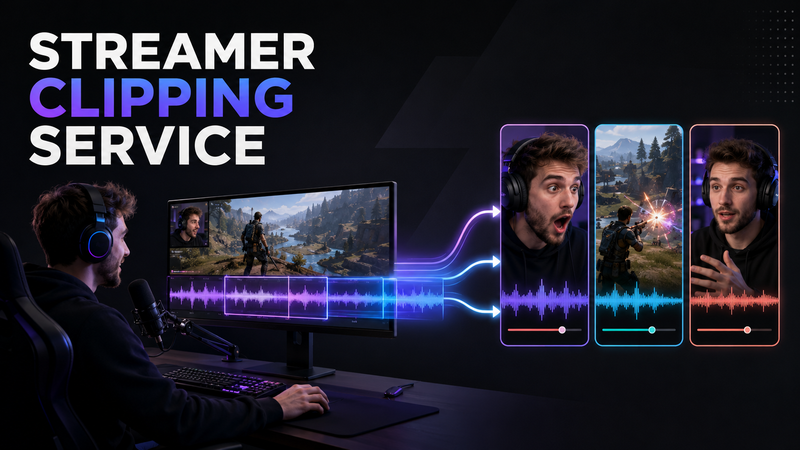

A live broadcast may contain hours of entertaining, useful, or memorable content, yet most of that value disappears once the stream ends. The best plays, honest reactions, audience exchanges, useful explanations, and unexpected moments remain buried inside a VOD that few new viewers will watch from beginning to end.
A streamer clipping service reviews recorded broadcasts, selects moments with genuine standalone value, edits them into platform-ready short videos, and prepares or distributes those clips across TikTok, Instagram Reels, YouTube Shorts, and other relevant channels.
The purpose is not simply to create a collection of highlights. It is to turn each stream into a reliable source of discovery content that can introduce the creator to people who were not present during the original broadcast.
When a clipping service makes sense
A streamer should consider a clipping service when the live content is strong but the channel lacks the time, team, or system needed to distribute that content consistently.
It is especially useful when:
Streams regularly last two hours or longer.
Good moments are being missed because nobody reviews the full VOD.
Clips are posted inconsistently or only when the streamer remembers.
Existing uploads depend too heavily on community jokes or previous context.
The creator wants to reach viewers beyond the main streaming platform.
One editor cannot produce enough platform-specific variations.
The channel needs content between live sessions.
Professional clipping is not necessary for every creator. A new streamer who broadcasts occasionally and produces little usable footage may be better served by improving the stream itself first. However, a creator who already generates several hours of engaging material each week often has more potential content than they can realistically process alone.
Why raw stream highlights rarely perform at their best
Live platforms and short-form platforms reward different viewing behaviours. Someone who opens Twitch, Kick, or YouTube Live may be prepared to spend an hour with a familiar creator. Someone scrolling through TikTok, Reels, or Shorts may decide within seconds whether a video is worth watching.
This difference changes how a stream moment must be presented.
A section that worked live may begin with thirty seconds of setup, refer to an earlier conversation, or depend on knowledge shared by regular viewers. When uploaded without editing, the same moment can feel slow or confusing to a new audience.
A professional Streamer Clipping Service treats clipping as both an editorial and distribution task. The team must decide whether a moment can interest an unfamiliar viewer, how much context it needs, which opening will make the situation clear, and which platform is most suitable for it.
This is why publishing more clips does not automatically produce more growth. The real objective is to create clips that can attract attention while still representing the streamer accurately.
How the streamer clipping process works
1. Define the creator’s content and growth objective
The process begins with an understanding of the channel. A clipping team should know the creator’s audience, tone, humour, recurring themes, restricted topics, preferred platforms, and wider business goals.
Different creators require different selection criteria. A competitive gaming streamer may want to emphasise skill, tension, and decisive reactions. An educational creator may benefit from clear explanations and corrections of common misconceptions. An IRL streamer may produce stronger clips through conversations, observations, and unpredictable encounters.
This information becomes an editorial brief that helps every clip feel consistent with the creator’s identity.
2. Organise and review the source footage
VODs should be labelled by date, topic, game, guest, or stream format. Timestamps supplied by the streamer, moderators, or viewers can speed up the process, but they should not be treated as the only source of usable moments.
A viewer may mark the instant when something funny happens, while the stronger clip begins twenty seconds earlier with the comment that caused it. Reviewing the surrounding footage helps the editor find a complete setup and payoff.
The team should also note recurring topics. If the streamer answers similar questions during several broadcasts, those answers may support a short educational series rather than a group of unrelated uploads.
3. Select moments that can stand on their own
A busy or emotional section is not automatically a strong clip. The moment needs a clear reason for someone outside the existing community to care.
Useful candidates often include:
A surprising result or sudden reversal
A recognisable problem followed by a practical answer
A genuine emotional reaction
A disagreement with an understandable point
An unusual exchange with chat, a guest, or another player
A concise story with a clear payoff
A mistake that becomes funny or instructive
A strong opinion that invites discussion
A display of skill that remains impressive without lengthy explanation
Editors also need to reject weak material. If a section requires several paragraphs of added context, it may belong in a longer YouTube video rather than a short clip.
4. Shape the opening and edit
The opening should establish the situation quickly without misleading the viewer. This may involve beginning with the strongest spoken line, adding a brief text prompt, or removing a delay before the important action.
Consider a gaming clip in which a streamer spends a minute preparing before winning an apparently impossible fight. The edited version could begin just before the decisive move and use a short caption to explain the challenge. The clip remains truthful, but the viewer reaches the meaningful part sooner.
The rest of the edit should preserve the creator’s natural rhythm. Removing every pause can make a conversation feel artificial, while leaving too much empty space can lose attention. Good editing finds the balance between clarity and personality.
5. Adapt the clip to each platform
Cropping a video into a vertical frame is only one part of platform adaptation. The editor must keep faces, gameplay, guests, or important visual details readable on a mobile screen. Captions should support the clip without covering the action.
Different platforms may also justify different versions. A fast, reaction-led opening may suit TikTok, while YouTube Shorts may support a slightly more explanatory introduction. Instagram may benefit from a cleaner presentation that works alongside the creator’s existing profile.
The point is not to make every version completely different. It is to adjust the parts that influence how viewers understand and respond to the clip.
6. Review, publish, and learn
Before publication, each clip should be checked for caption accuracy, audio balance, framing, factual meaning, brand suitability, and sponsor requirements. This is particularly important when a short edit could change the meaning of a joke, opinion, or conversation.
Clips should then be distributed through a consistent schedule rather than released in one large batch after every broadcast.
Performance should be assessed through a combination of:
Average watch time
Completion rate
Rewatches
Shares and saves
Comments
Profile visits
New followers or subscribers
Visits to the main streaming channel
Views show reach, but the other signals reveal whether the clip held attention and attracted people who may care about the creator’s wider content.
The Clipping Agency Moment-to-Viewer Fit framework
Clipping Agency evaluates potential clips through what can be called Moment-to-Viewer Fit. The idea is simple: a good stream moment only becomes effective discovery content when the moment, presentation, and intended viewer align.
The framework uses three questions:
What makes the moment worth watching?
The answer might be humour, skill, tension, emotion, insight, or a surprising opinion. If the value cannot be described clearly, the moment may not be strong enough.What does a new viewer need to understand it?
Some clips need only a tighter opening. Others require a short caption or an earlier line of dialogue. If too much explanation is necessary, the clip is probably unsuitable for short-form distribution.What should the viewer want next?
A tutorial may encourage a save. A strong opinion may invite comments. A personality-led clip may lead to a profile visit, while a dramatic highlight may make the viewer curious about the full stream.
This approach prevents teams from selecting content only because something happened on screen. It connects every editing decision to the viewer the clip is expected to reach.
Examples of one stream becoming several clips
Imagine a Twitch creator attempting a difficult gaming challenge during a four-hour stream. The creator fails several times, explains a strategy to chat, disputes a viewer’s suggestion, nearly completes the challenge, and eventually succeeds because of an unexpected opponent mistake.
That one broadcast could produce:
An educational clip explaining the strategy
A humorous edit featuring the most relatable failures
A tension-led clip showing the final attempt
A reaction clip centred on the successful finish
A response clip based on the disagreement with chat
These are not duplicate versions of the same highlight. Each has a different reason to be watched. One may earn saves from players who want to improve, while another introduces the streamer’s personality to people who do not know the game well.
The same method applies outside gaming. A music streamer could produce a live performance, a production tip, an audience request, and a before-and-after arrangement. A business creator could extract a direct answer, a case study, a misconception, and a useful audience question from one discussion.
Real business use cases
An emerging streamer can use clipping to build discovery outside the live platform. The priority at this stage is usually to show the creator’s personality and give new viewers a reason to visit the main channel.
An established creator may use clips to remain visible between broadcasts, promote recurring formats, and generate additional sponsor inventory. If a sponsor agreement permits reuse, a natural live integration can sometimes become a separate short-form asset with the correct disclosure.
Esports organisations can create clips from player perspectives, team communication, interviews, match reactions, and behind-the-scenes broadcasts. This gives each event value beyond the tournament itself.
Podcast and interview streamers can publish individual arguments, answers, and stories instead of relying on a generic episode trailer. Each clip gives the audience a specific reason to explore the longer conversation.
Talent managers and creator agencies can use a shared clipping system to organise approvals, maintain brand standards, and compare results across several creators without making every channel look identical.
Advantages and limitations
A managed clipping service offers several practical advantages:
It recovers useful content from footage that might otherwise remain unused.
It reduces the streamer’s editing and administrative workload.
It supports regular posting between live broadcasts.
It makes testing different topics, hooks, and formats easier.
It helps creators reach audiences outside their primary platform.
It creates performance data that can improve future streams and clips.
There are also limitations:
Weak or repetitive source material restricts the quality of the output.
Short-form results remain unpredictable, even with good editing.
Poor clipping can remove context or distort the creator’s tone.
High output requires clear brand and approval guidelines.
Large view counts do not always convert into loyal live viewers.
An ongoing service needs enough suitable footage to justify the workflow.
Clipping can amplify strong content, but it cannot replace an interesting stream, a recognisable creator identity, or a clear reason for viewers to return.
Common mistakes that weaken performance
One of the most common mistakes is choosing moments only because existing fans enjoyed them. Community references can be useful, but they often confuse new viewers when the clip provides no explanation.
Another mistake is forcing every clip into the same template. A tutorial, gaming highlight, personal story, and emotional reaction should not all have identical pacing, captions, and music.
Other problems include:
Starting too far before the important moment
Using exaggerated hooks that the footage does not fulfil
Covering gameplay or facial expressions with oversized captions
Publishing inaccurate subtitles
Removing context that changes the speaker’s meaning
Uploading the same version everywhere without testing
Measuring success through views alone
Prioritising volume until the creator’s personality disappears
Failing to guide interested viewers towards the main channel
The best edits make the streamer more accessible without making the content feel manufactured.
Frequently asked questions
How many clips can one stream produce?
The number depends on the length and density of the broadcast. A focused two-hour interview may contain more usable material than a six-hour gaming session with long quiet periods. The final number should be based on quality, not an arbitrary quota.
Does clipping work only for gaming streamers?
No. Clipping can support music, education, commentary, interviews, art, sports analysis, business discussions, and IRL content. The source needs moments that provide clear value, emotion, entertainment, or insight.
Is a clipping service the same as hiring a video editor?
Not necessarily. A traditional editor may work from timestamps and deliver finished files. A clipping service can also handle VOD review, moment selection, platform adaptation, quality control, distribution planning, and performance analysis. The exact scope should always be confirmed before hiring.
Should every clip include a call to action?
No. Repeating “follow for more” in every video can make the content feel mechanical. A call to action works best when it naturally connects the clip to a full stream, recurring series, upcoming event, or relevant channel.
Can old VODs still be clipped?
Yes, provided the content remains relevant and the creator has permission to reuse it. Older broadcasts often contain strong moments that received little attention when the channel had a smaller audience.
How quickly should results be judged?
A clipping strategy should not be judged from a handful of uploads. Individual videos can perform unpredictably. A more useful review looks at a consistent body of content and compares patterns across topics, openings, formats, platforms, and viewer actions.
What should a streamer provide to the clipping team?
Useful materials include VOD access, brand guidelines, examples of preferred editing, pronunciation notes, restricted topics, sponsor requirements, platform priorities, and the main objective of the campaign.
Making every broadcast work harder
A live stream should not stop creating value when the broadcast ends. With careful selection, accurate editing, and consistent distribution, one session can continue attracting viewers for days or weeks.
For streamers already producing regular broadcasts, the biggest challenge is often not a lack of content. It is the absence of a dependable system for finding the right moments and presenting them to the right viewers.
Clipping Agency helps creators build that system around their actual content, audience, and growth priorities. The sensible first step is to review the channel and its available footage before deciding how many clips to produce or where they should be distributed.

Comments
No comments yet. Be the first to comment!