
How US Brands Can Turn Podcasts Into a Content Engine
A practical guide to selecting, editing and distributing podcast clips that build reach, trust and business value.
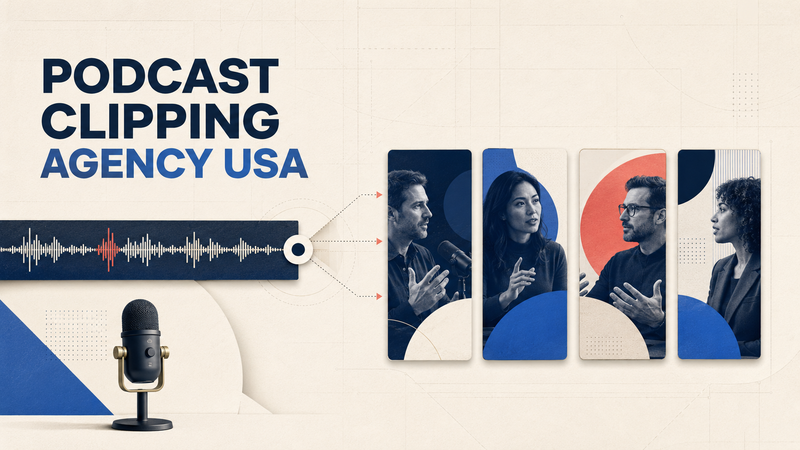

Recording a podcast gives a business something most marketing teams struggle to produce consistently: a long, natural conversation filled with opinions, explanations, stories and practical experience. The problem is that much of this value remains buried inside a 40-minute or 60-minute episode.
Existing followers may listen to the full discussion, but new viewers are unlikely to make that commitment before they understand why the host or guest is worth their attention. Short-form clips solve this discovery problem by presenting one useful moment at a time.
A podcast clipping agency reviews long podcast recordings and turns selected moments into short videos for YouTube Shorts, Instagram Reels, TikTok, LinkedIn and other content channels. The service can include clip selection, video editing, captions, branding, platform adaptation and performance review.
For American founders, podcasters and marketing teams, the aim is not simply to extract more files from each episode. It is to create a repeatable content system that helps good ideas reach the people most likely to value them.
Is a podcast clipping agency worth hiring?
A podcast clipping agency is worth considering when a business records useful conversations regularly but lacks the time, editorial judgement or production capacity to turn those episodes into consistent short-form content.
The strongest agencies do more than identify energetic quotes. They look for moments that can stand on their own, give the viewer a meaningful payoff and contribute to a wider marketing objective. One clip may introduce a new viewer to a problem, while another demonstrates expertise or helps a prospective customer evaluate the company.
When comparing a Podcast Clipping Agency USA, businesses should examine how the provider selects moments as carefully as they examine its editing quality. Clean captions and attractive graphics cannot rescue a weak section that lacks context or reaches no useful conclusion.
Strategic podcast clipping combines editorial judgement, video production and distribution planning. All three are needed if the campaign is expected to produce more than a folder of finished files.
What does a podcast clipping agency handle?
The exact scope varies, but a complete service may include:
Reviewing full video or audio episodes
Searching transcripts for promising sections
Selecting complete stories, lessons and explanations
Removing repetition, false starts and unrelated discussion
Creating a stronger opening for each clip
Reframing horizontal footage for vertical viewing
Adding manually checked captions
Applying fonts, colours and other brand elements
Creating cover headlines and supporting graphics
Preparing different versions for selected platforms
Managing feedback, revisions and final files
Studying results to improve future clip selection
Some providers also write post captions, schedule uploads or manage distribution. These responsibilities should be confirmed before the campaign begins.
A business receiving ten edited clips is buying a production service. A business receiving researched clips, platform-specific versions and recommendations based on audience behaviour is investing in a broader content system. Either arrangement can be useful, but the distinction should be clear.
How the podcast clipping process works
Strong podcast clipping begins with the purpose of the campaign. Editing style matters, but it comes after the decisions about audience, subject and value.
1. Establish the campaign objective
The agency first determines what the podcast should help the business accomplish.
Common objectives include building the founder’s profile, reaching new listeners, supporting a product launch, answering sales questions or creating educational content for an existing audience.
The objective changes what counts as a valuable clip. A broad industry opinion might support discovery, while a detailed customer example may be better for building trust with potential buyers.
2. Define the intended viewer
Each clip should be created with a recognisable audience in mind.
A first-time viewer may respond to a familiar problem explained in plain language. An experienced professional may prefer a detailed opinion that challenges an accepted practice. A potential customer may need evidence, a practical example or an answer to a common concern.
This decision also determines how much context the clip requires. If the viewer needs two minutes of background before understanding the point, the selected section may not be suitable for short-form content.
3. Review the complete episode
The recording should be reviewed as a complete conversation. AI transcription can make this process faster, but a transcript alone does not capture delivery, tone or the importance of a pause.
Useful moments often contain:
A clear answer to a recurring question
A lesson drawn from direct experience
A specific example with an identifiable result
A well-supported opinion
A mistake and what changed afterwards
A practical process the audience can follow
A story that reveals the speaker’s personality
The most animated section is not necessarily the strongest. A calm explanation of a difficult subject may generate fewer casual views while attracting more saves, thoughtful comments and qualified enquiries.
4. Confirm that the moment works independently
A person finding the clip through TikTok or YouTube may not recognise the speaker or know what was discussed earlier in the episode. The clip must still be understandable.
For example, opening with “That was when we changed the entire plan” creates an information gap. The editor may need to begin earlier, reposition a sentence or add a short line of on-screen context.
The ending matters just as much. Withholding every conclusion to force viewers towards the full episode can weaken trust. Most clips should deliver a complete insight before presenting an optional next step.
5. Strengthen the opening
Podcast discussions often take time to reach their central point. Short-form videos need to establish relevance more quickly.
A clip might begin with a clear conclusion, recognisable problem, specific result or useful question. The opening can sometimes be taken from later in the selected section and moved forward, provided the change does not distort the speaker’s meaning.
This does not require manufactured controversy. “Most company podcasts underperform because the episode is treated as the final product” creates interest through a clear argument rather than an exaggerated claim.
6. Edit while preserving natural delivery
Editors can remove long pauses, repeated phrases and irrelevant tangents, but they should not eliminate every breath or moment of reflection. Excessive cutting can make a knowledgeable speaker sound nervous and unnatural.
Captions also need manual review. Automatic transcription regularly mishandles names, statistics, product terminology and industry abbreviations. A visible error can undermine an otherwise credible clip.
Graphics, zooms and supporting footage should make the idea easier to follow. They should not compete with the speaker for attention.
7. Adapt the clip for each platform
The same underlying moment can be used on several platforms, but each version may need small changes.
YouTube Shorts can work well for searchable questions and evergreen explanations. TikTok often favours a quick opening and conversational presentation. Instagram Reels can support concise stories and visually clear ideas. LinkedIn is usually appropriate for founder perspectives, professional lessons and B2B discussions.
The agency may adjust the duration, opening line, caption design, cover headline, supporting footage or call to action. These changes help the content feel appropriate for each channel without requiring an entirely new edit.
8. Measure results and refine the campaign
Useful performance indicators can include:
Retention during the opening
Average watch time
Completion rate
Saves and shares
Relevant comments
Profile and podcast visits
Newsletter subscriptions
Qualified enquiries
Full-episode views
View count should be considered alongside audience relevance. A specialised clip watched by 6,000 suitable decision-makers may create more business value than a general video watched by 150,000 unrelated people.
Performance can also improve the podcast itself. If clips about implementation repeatedly earn strong retention and detailed questions, the host has evidence that the subject deserves more attention in future episodes.
Clipping Agency’s Useful Distance Principle
At Clipping Agency, we assess podcast moments according to what we call the Useful Distance Principle. It considers how far a clip can travel from its original episode without losing its meaning or value.
A moment with a short useful distance depends heavily on the conversation around it. The viewer may need to know who was mentioned, what happened earlier or why the speaker reached a particular conclusion.
A moment with a long useful distance can reach someone unfamiliar with the podcast and still provide a complete, credible idea.
We evaluate this distance through three questions:
Can a new viewer identify the subject quickly?
The clip should not require knowledge of the earlier conversation.Does the viewer receive a complete payoff?
The moment should provide an answer, lesson, explanation or useful conclusion.Does the clip remain accurate after editing?
Removing context must not change the speaker’s meaning or make a cautious statement appear absolute.
This principle helps explain why some polished clips fail. They may look suitable for social media, but they cannot travel beyond the original audience because too much context has been removed.
It also gives marketing teams a practical standard for reviewing content. Rather than asking whether a clip feels exciting, they can ask whether it remains useful at a distance from the full conversation.
A practical example
Imagine a Chicago financial technology company records a 50-minute conversation between its founder and a small-business advisor. The episode covers cash-flow planning, lending mistakes, customer qualification and several early product decisions.
A basic editing service might select the five moments with the most animated delivery. A strategic clipping agency could instead produce:
A discovery clip explaining why revenue growth can conceal cash-flow problems
An educational clip covering three warning signs before seeking financing
A trust-building clip about an early product decision the founder reversed
A proof clip describing how a customer improved its forecasting process
A progression clip introducing the full conversation
The clips could be published over three or four weeks. The educational videos might be adapted for YouTube Shorts and LinkedIn, while the founder story could use a faster opening for Instagram Reels and TikTok.
All five clips come from one recording, but each has a defined audience and role.
Real business use cases in the USA
Founder-led technology companies
A California software startup can use podcast clips to explain product decisions, discuss customer problems and establish its founder’s point of view. This creates a regular stream of founder content without requiring separate daily recordings.
Professional services firms
Accountants, consultants and attorneys can turn podcast discussions into focused explanations of common client problems. Because these topics may involve legal, financial or regulatory details, preserving context is more important than adding dramatic editing.
Real estate businesses
A Texas real estate company can clip conversations about financing, inspections, local buying conditions and frequent buyer mistakes. Each video can answer a specific question prospective clients may search for before contacting an agent.
Business interview podcasts
A New York podcast featuring executives can create clips about hiring decisions, leadership problems, market changes and lessons from unsuccessful projects. Guests also receive useful videos they are more likely to share with their own audiences.
Health and wellness brands
A Florida wellness company can repurpose interviews with qualified practitioners into educational content. Editors must retain careful wording, verify captions and avoid turning a balanced explanation into an exaggerated health claim.
Advantages and limitations
The main advantages of hiring a podcast clipping agency include:
Episodes continue creating value after publication.
Hosts need fewer separate social media recording sessions.
Individual subjects become easier to discover and share.
Consistent editing supports stronger brand recognition.
Guests receive content they can distribute.
Internal teams spend less time reviewing recordings.
Campaign data can improve future podcast planning.
There are also limitations:
Weak or repetitive episodes may provide few strong clips.
Greater output does not guarantee relevant attention.
Removing too much context can change the speaker’s meaning.
Excessive visual effects may weaken credibility.
Technical and regulated topics require careful review.
Clipping cannot repair an unclear offer or lack of expertise.
Consistent distribution is still necessary.
Clipping is most effective when it multiplies the value of strong source material. It cannot manufacture useful insight that was absent from the original recording.
Common podcast clipping mistakes
One common mistake is demanding the same number of clips from every episode. Some conversations contain ten useful moments, while others contain only three. Forcing a fixed quota often produces repetitive or incomplete videos.
Other mistakes include:
Selecting sections only because they sound controversial
Starting with references that require missing context
Ending before the speaker completes the answer
Covering the screen with unnecessary graphics
Failing to verify names, figures and technical terms
Publishing an identical version on every platform
Adding a promotional message to every clip
Removing the speaker’s natural delivery
Measuring the campaign entirely through views
The process should improve as the team learns which subjects, openings and formats attract the right viewers. Repeating the same approach despite clear performance data wastes one of the main advantages of an ongoing campaign.
Frequently asked questions
What is a podcast clipping agency?
A podcast clipping agency turns long podcast episodes into short, platform-ready videos. Its work may include episode review, moment selection, editing, captions, branding, platform adaptation and performance analysis.
How many clips can one podcast episode produce?
The number depends on the episode’s length, structure and quality. A focused 45-minute interview may produce several strong clips, while a longer but repetitive conversation may produce fewer. Quality should take priority over a fixed quota.
Can audio-only podcasts be clipped?
Yes. Editors can use speaker photographs, branded graphics, waveforms, animated captions and relevant supporting visuals. Video podcasts provide more creative options, but audio-only recordings can still become effective short-form content.
How long should a podcast clip be?
There is no universal ideal length. A direct answer may work in 20 seconds, while a detailed story may require 90 seconds or longer. The clip should be long enough to deliver its full point without unnecessary background.
Can the same clip be published on every platform?
Yes, although small adaptations can improve performance. The opening, duration, cover headline, caption and call to action may be adjusted for YouTube Shorts, TikTok, Instagram Reels and LinkedIn.
Can AI create podcast clips automatically?
AI can assist with transcription, moment suggestions and repetitive editing. Human review remains important for interpreting context, checking factual details, preserving the speaker’s meaning and deciding whether a moment supports the campaign.
How should a business measure results?
The appropriate metrics depend on the objective. Watch time, completion rate, saves, relevant comments, profile visits, full-episode views, newsletter subscriptions and qualified enquiries may all be useful. Views should always be evaluated alongside audience relevance.
Give every episode a longer useful life
A podcast should not stop creating value when the complete episode is published. One thoughtful conversation may contain weeks of useful material, provided the right moments are selected and given enough context to succeed independently.
Clipping Agency helps US podcasters, founders and businesses turn long recordings into structured short-form campaigns. If valuable conversations are disappearing into your archive, a strategic clipping process can bring the strongest ideas back into circulation without creating another demanding recording schedule.

Comments
No comments yet. Be the first to comment!