
How Brand Clipping Campaigns Turn Content Into Market Memory
A practical look at how brands can turn interviews, webinars, podcasts, and founder videos into short clips that build reach, trust, and recognition.
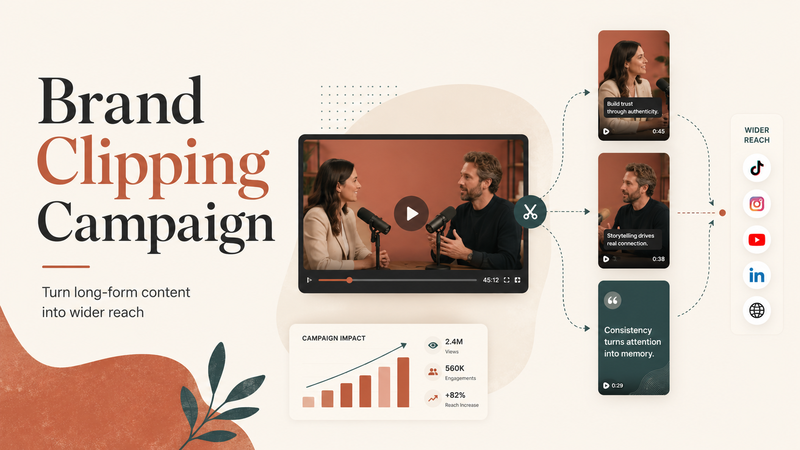

There is a quiet problem inside many brand content plans. Teams are producing more video than ever, but a lot of that video is still being used in a very narrow way. A webinar becomes one replay link. A podcast becomes one episode page. A founder interview becomes one YouTube upload. An event talk becomes a file in the content library. The brand has done the hard work of recording useful ideas, but the distribution often stops far too early.
The better question is not only how much content a brand can create. It is how well each useful idea is allowed to travel. A single recording may contain a customer objection, a founder’s belief, a practical lesson, a strong explanation, and a moment that makes the team feel more relatable. When those moments stay inside one long video, most of the audience never sees them.
A Brand Clipping Campaign gives brands a system for changing that. It turns longer recordings into short, focused clips that can be published across social platforms, newsletters, website pages, sales follow-ups, and other content channels. Instead of treating one video as one asset, the brand treats it as a source of smaller moments that can build attention over time.
This does not mean cutting everything into tiny pieces without a plan. The value comes from choosing moments carefully, shaping them for the right platform, and publishing them in a way that supports the brand’s wider message. When done well, clipping helps a brand become easier to notice, easier to understand, and easier to remember.
Why Brands Need Repeated Moments, Not Just More Posts
People rarely remember a brand because of one polished video. They remember it after seeing a pattern. They hear the founder explain the same belief in different ways. They see customer problems described clearly. They notice that the brand keeps helping with the same category of issues. Over time, those smaller moments start creating familiarity.
That is where short clips become useful. A person who has just discovered the brand may not watch a 50-minute podcast, but they might watch a 40-second clip that explains a problem they are already facing. If that clip is helpful, they may watch another one. If the next one is useful too, the brand starts to feel more familiar.
Long-form content builds depth, but short-form clipping builds repeated exposure. Both matter. The long video gives substance, while the clips carry the best parts of that substance into the places where people are already spending time.
What a Brand Clipping Campaign Actually Does
A brand clipping campaign is a planned process for turning long-form brand content into short clips that can stand on their own. The source content can come from founder interviews, podcasts, webinars, event talks, livestreams, customer conversations, product demos, educational videos, or internal thought leadership recordings.
A good campaign usually includes:
Reviewing long-form recordings with the audience in mind
Finding moments that explain, teach, prove, or humanise something
Editing clips for short-form viewing
Adding captions that work on mobile
Writing titles or captions that make the point clear
Publishing clips consistently across relevant channels
Measuring what the audience responds to
Using those results to improve the next batch
The goal is not to make the brand look busier. The goal is to help the strongest ideas reach more people in a format they are likely to watch.
What Makes a Clip Worth Using
Not every moment from a recording should become a clip. Some parts only make sense inside the full conversation. Others might be interesting to the internal team, but not very useful for a new viewer. A strong campaign is selective because each clip should have a reason to exist.
A clip is usually worth using when it gives the viewer one clear piece of value. It might answer a question, explain a mistake, show proof, share a lesson, or reveal a point of view that helps the audience understand the brand better.
A strong clip usually has:
One focused idea
A clear opening thought
Enough context for someone new
Natural delivery from the speaker
A practical or interesting takeaway
A link to the brand’s positioning
A reason for someone to save, share, comment, or watch again
The simplest test is to imagine the clip appearing in front of a person who has never heard of the brand. If they can still understand the point and get value from it, the moment has potential. If the clip needs too much background, it may belong inside the full video rather than as a standalone short.
Why Brand Clipping Is Different From Basic Repurposing
Repurposing is often treated as a quick way to make more content from one asset. That can be useful, but it can also become lazy. A team cuts a few moments, adds captions, posts them everywhere, and calls it distribution. The result may create activity, but it does not always create brand memory.
Brand clipping should be more intentional. It asks what the clip is supposed to do. Is it meant to introduce the brand’s thinking? Is it answering a common question? Is it showing proof? Is it making the founder more recognisable? Is it helping a service page feel more credible? Is it testing a topic before the team invests in a bigger content piece?
That intent changes the work. The clip is no longer just a recycled asset. It becomes a small strategic touchpoint.
Choosing the Right Source Content
The best clipping campaigns begin with strong source material. Editing can improve pacing and clarity, but it cannot create value where there is none. If the original recording has no useful ideas, no real examples, and no clear point of view, the clips will struggle.
Good source content usually has natural delivery, useful explanations, and moments that connect to audience problems. It does not need to be overly polished. A simple founder conversation can create better clips than a heavily produced brand video if the speaker says something specific and helpful.
Strong source material can include:
Founder interviews with clear beliefs or lessons
Podcasts with useful discussion sections
Webinars that explain a process
Customer conversations with real pain points
Product demos that answer buyer questions
Event talks with memorable ideas
Educational videos that simplify a topic
Behind-the-scenes content that shows how the team works
For example, a customer conversation might produce one clip about the problem before the solution, another about what changed after working with the brand, and another about what the customer misunderstood at the beginning. Each clip can stand alone, but together they create a stronger picture of the brand’s value.
Shaping Clips for Different Channels
A clip should not be treated the same everywhere. The same raw moment can work on several platforms, but it may need a different opening, caption, or framing depending on where it appears.
LinkedIn often works well for founder opinions, business lessons, category insights, and customer problems. Instagram Reels can support personality, team culture, process moments, and simple educational clips. YouTube Shorts can help with clear questions and discoverable topics. TikTok can work for sharper hooks and relatable problems. Newsletters can give more context around one strong clip. Website pages can use clips to support proof, education, or product understanding.
A simple channel plan might look like this:
Use LinkedIn for thought leadership and founder-led clips
Use Instagram Reels for culture, process, and visual moments
Use YouTube Shorts for educational clips and topic discovery
Use TikTok for direct hooks and relatable audience problems
Use newsletters to add context around selected clips
Use website pages for proof, trust, and product education
Use sales follow-ups to answer common objections with short videos
The goal is not to copy and paste the same post everywhere. The goal is to let one strong idea travel in the right form for each channel.
How to Edit Brand Clips Without Losing Trust
Short clips need to hold attention, but they should still feel credible. Some brands weaken their clips by over-editing them. The captions are too loud, the cuts are too aggressive, the music feels forced, and the original message starts to feel less trustworthy.
For brand content, clean editing usually works better. The clip should start close to the value, remove unnecessary pauses, and make the message easier to understand. Captions should be readable on mobile. The speaker should be framed clearly. Branding should be present only when it helps the viewer, not when it makes the clip feel like an advertisement.
A useful editing checklist includes:
Start near the strongest line or idea
Remove greetings, filler, and repeated phrases
Keep the clip focused on one message
Add captions that are easy to read
Frame the speaker properly
Use subtle branding where it feels natural
Make sure the clip works without sound
End with a complete thought or clear next step
The edit should serve the idea. If the editing becomes more noticeable than the message, the clip is probably doing too much.
Building a Campaign Rhythm
A single clip can create attention, but a campaign creates memory. That memory comes from consistent useful exposure. The audience keeps seeing strong ideas from the same source, and over time the brand becomes connected to a topic, problem, or point of view.
Consistency does not mean publishing weak clips every day. It means creating a rhythm that the team can maintain without lowering quality. For many brands, three to five strong clips per week from one source recording is a practical starting point. Some brands may publish more. Others may publish less. The standard should always be quality before volume.
A simple weekly workflow can include:
Choose one strong source recording
Review it for standout moments
Select six to ten possible clips
Narrow the list to the best three to five
Edit each clip for the right platform
Write captions and titles with a clear purpose
Publish across the week
Review the response before selecting the next batch
This keeps the process organised and prevents clipping from becoming rushed or random.
What to Measure After Publishing
Views are useful, but they should not be treated as the whole story. A clip can get views without bringing the right audience closer to the brand. A stronger campaign looks at several signals together.
Useful metrics include:
Watch time
Retention
Saves
Shares
Comments
Profile visits
Follows
Link clicks
Website visits
Direct messages
Leads or assisted conversions
Each signal helps the brand understand something different. Saves may show that the clip was useful. Shares may show that the idea was relatable. Comments may show that the clip started a conversation. Profile visits and website clicks may show deeper interest. Leads and assisted conversions show whether the campaign is helping business outcomes.
This feedback should influence the next batch. If one speaker gets stronger retention, feature them more. If one topic creates better comments, explore it further. If a certain platform brings more qualified traffic, build a stronger rhythm there.
Common Mistakes That Weaken a Brand Clipping Campaign
A brand clipping campaign can lose value when the team focuses only on output. More clips do not automatically create better reach, trust, or demand. The clips still need to be useful, clear, and connected to the wider brand message.
Common mistakes include:
Choosing clips that need too much missing context
Making every clip feel like a sales pitch
Starting too slowly
Using captions that are hard to read
Posting without a consistent rhythm
Reusing the same caption everywhere
Ignoring platform differences
Over-editing until the clip feels unnatural
Measuring only views
Failing to review what the audience responds to
Avoiding these mistakes keeps the campaign focused. Every clip should help the viewer understand something, remember something, or feel more familiar with the brand.
Final Thoughts
A brand clipping campaign helps brands get more from the content they already create. It turns podcasts, webinars, interviews, founder videos, event recordings, customer conversations, and educational content into short-form moments that can build reach, support discovery, and create repeated exposure.
The strongest campaigns start with useful source material, choose clips based on audience value, edit for clarity, publish consistently, and learn from the results. Over time, one recording becomes much more than a single upload. It becomes a source of ongoing visibility.
For brands already investing in video, clipping should not be treated as a quick afterthought. The long-form content holds the depth, but the clips often carry the best ideas into the places where new audiences actually find them. When those clips are selected with care and published with purpose, they become a real brand growth channel.

Comments
No comments yet. Be the first to comment!