
Short-Form vs Long-Form Video ROI: How Brands Should Compare Both
A practical guide to understanding where short videos create reach, where long videos build trust, and how both formats support better marketing results.
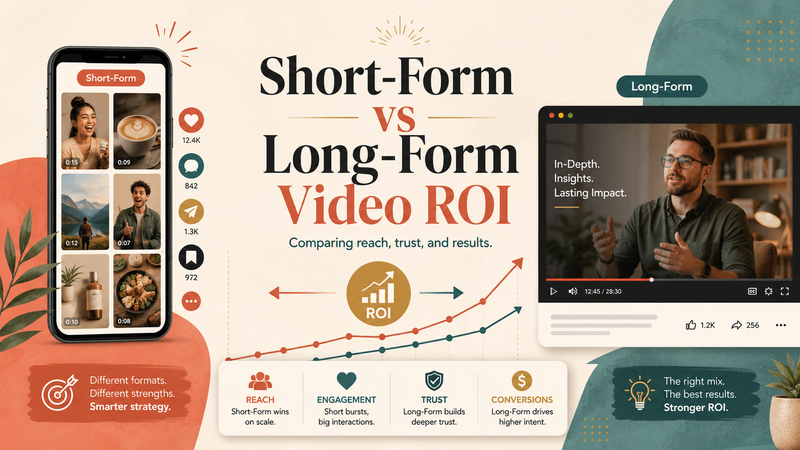

A short video can make a brand visible very quickly. A longer video can keep influencing a buyer long after the first view. That is why comparing both formats only by views, likes, or immediate leads can give a team the wrong answer. Short-form and long-form videos are not built for the same purpose, so their return should not be judged as if they are doing the same job.
A 30-second clip might be the first time someone notices the brand. It may not explain everything, but it can start the relationship. A 30-minute webinar or interview may reach fewer people, but it can help a serious viewer understand the offer, trust the people behind it, and feel more confident about taking the next step. Both outcomes matter, but they happen at different points in the customer journey.
That is the real conversation behind Short-Form vs Long-Form Video ROI. The question is not whether short-form is better than long-form, or whether long-form is more serious than short-form. The better question is how each format contributes to awareness, understanding, trust, and action. When brands measure that properly, the strategy becomes much clearer.
Why Video ROI Gets Misread
Video ROI is often reduced to whichever metric is easiest to see. If a clip gets 50,000 views, it looks successful. If a webinar gets only 800 views, it may look weaker. The problem is that those numbers do not explain who watched, how much attention they gave, what they understood, or whether the video helped move them closer to the brand.
A short clip with a large view count can still be shallow if the wrong audience watched it and moved on. A longer video with fewer views can still be valuable if the viewers are qualified, engaged, and closer to a buying decision. This is why brands should avoid treating views as the whole story.
The better approach is to measure the video against its intended role. If the goal is reach and discovery, short-form may naturally perform better. If the goal is education and trust, long-form may produce stronger signals even with fewer viewers. Both formats can generate return, but they often generate different kinds of return.
What Short-Form Video Is Really Good At
Short-form video works because it fits the way people discover content. People are scrolling, comparing, saving ideas, and moving quickly between posts. They may not be ready to watch a full product demo, founder interview, or webinar, but they may stop for a short clip that says something useful in the first few seconds.
That makes short-form video strong for reach and familiarity. It gives the brand more entry points into the market. It also helps the team test which ideas, hooks, and speakers get a response before investing more time in larger content pieces.
Short-form video is usually useful for:
Reaching cold audiences
Testing messages and angles
Creating repeated visibility
Turning long recordings into smaller discovery assets
Making founders, creators, and experts more recognisable
Driving saves, shares, comments, follows, and profile visits
Keeping the brand active without filming from scratch every day
The return from short-form often builds over time. One clip may not convert someone immediately, but repeated useful clips can make the brand easier to remember. When that person later sees a long video, visits the website, searches the brand, or hears the name again, the brand no longer feels completely new.
What Long-Form Video Is Really Good At
Long-form video gives the brand space to explain. Some ideas need more than a minute. A complex service may need context. A customer story may need a beginning, middle, and outcome. A founder’s point of view may need room to feel credible. A buyer may need to hear details before they trust the claim.
That is where long-form video becomes valuable. It is not always the best format for quick discovery, but it is often stronger for building understanding and confidence. It gives warmer audiences something deeper to engage with after they have already shown interest.
Long-form video is usually useful for:
Educating serious prospects
Explaining complex offers
Building trust through depth
Supporting sales conversations
Answering detailed buyer questions
Showing expertise in a more complete way
Creating source material for short-form clips
Helping warm audiences decide whether the brand is a fit
The return from long-form is often closer to the decision stage. It may not bring the largest audience, but it can influence the quality of the audience. Someone who watches a detailed interview, webinar, or product explanation is giving the brand more attention than a casual viewer gives a short clip.
Why Views Alone Are Not Enough
Views are useful, but only when they are understood properly. A high-view short video can be a strong signal if it also has good retention, relevant comments, saves, shares, profile visits, and link clicks. A low-view long video can be a strong signal if the watch time is high, the viewers are qualified, and the content supports sales or lead generation.
The problem starts when a team uses the same measurement for both formats. Short-form naturally has more reach potential because it is easier to consume and easier for platforms to distribute. Long-form naturally demands more attention, so fewer people will complete it. That does not make one better. It means each one should be judged differently.
Better questions include:
Did the short video reach people who might care about the brand?
Did the long video keep serious viewers engaged?
Did the clip create profile visits, follows, saves, or searches?
Did the long video answer questions that slow down buying decisions?
Did either format support website visits, enquiries, calls, or assisted conversions?
Did the performance reveal which topics the audience cares about most?
These questions give a more useful picture than views alone.
How Both Formats Work Together
Short-form and long-form video become more powerful when they are connected. A long-form video can be the source of many short-form clips. Short-form clips can introduce the best ideas from that longer video to people who would not have watched the full version first. If a clip gets attention, interested viewers can be sent toward the deeper asset.
This creates a cleaner content system. The brand does not need to choose between reach and depth. It can use short-form for discovery and long-form for trust.
A simple relationship looks like this:
Long-form content creates the full explanation.
Short-form clips pull out the strongest moments.
Short-form videos bring new viewers into the topic.
Long-form videos give interested viewers more detail.
Short-form performance shows which ideas deserve more focus.
Long-form content gives the brand authority and substance.
Both formats support the same message in different ways.
For example, a 40-minute founder interview can become a full video for serious viewers, five short clips for social media, a newsletter section, a few sales follow-up assets, and topic ideas for future content. The ROI is no longer limited to the original upload. The recording becomes a content source.
When Short-Form Usually Wins
Short-form video usually wins when the brand needs visibility. This is especially true for brands that are still trying to reach new audiences, explain their category, or create repeated exposure around a message.
Short-form may be the better priority when:
The audience is cold
The brand needs more reach
The team wants to test different ideas
The offer needs repeated exposure before people remember it
The brand has long videos that are not being reused
The team needs consistent content without constant new filming
The goal is to create more discovery points around one message
In this situation, the ROI is often measured through reach, retention, saves, shares, comments, follows, profile visits, and traffic from social. It may also be measured by how much content can be created from one original recording.
When Long-Form Usually Wins
Long-form video usually wins when the viewer already has interest and needs more confidence. This is common for B2B services, expensive offers, technical products, education-heavy brands, and any business where trust affects the buying decision.
Long-form may be the better priority when:
The offer needs deeper explanation
Buyers have specific questions
Trust is required before conversion
The sales cycle is longer
The brand needs to show expertise
Prospects need proof before taking action
The team wants one strong source asset for future clips
In this situation, the ROI is often measured through watch time, average view duration, completion rate, meaningful comments, page visits, demo requests, webinar signups, lead quality, sales team usage, and assisted conversions. The audience may be smaller, but the attention can be more valuable.
Metrics That Fit Short-Form Video
Short-form should be measured by how well it creates attention and repeat exposure. The best short-form performance is not just a large view count. It is a sign that the message is reaching the right people and creating a reason for them to take another small step.
Useful short-form metrics include:
Reach
Views
Retention
Watch time
Saves
Shares
Comments
Follows
Profile visits
Link clicks
Repeat engagement
Website visits from social
The pattern across multiple clips matters more than one individual post. If several clips on the same topic keep generating strong retention and saves, the brand has found a theme worth developing further.
Metrics That Fit Long-Form Video
Long-form should be measured by depth and intent. The numbers may look smaller, but the behaviour behind them can be more meaningful. A serious viewer who spends 15 minutes with a video may be worth more than a casual viewer who watches three seconds of a viral clip.
Useful long-form metrics include:
Total watch time
Average view duration
Completion rate
Comments with substance
Clicks to related pages
Webinar registrations
Demo requests
Sales team usage
Assisted conversions
Lead quality
Time on page when embedded
Long-form should also be measured by how reusable it is. A strong webinar, interview, or customer story can create short clips, blog ideas, email content, social posts, website proof, and sales material. That increases the total return from the original recording.
A Practical Way to Compare ROI
A useful way to compare both formats is to split ROI into three layers: reach, depth, and business impact.
Reach tells you how many relevant people the video gets in front of. Short-form is often stronger here.
Depth tells you how much understanding and trust the video builds. Long-form is often stronger here.
Business impact tells you whether the content supports leads, sales conversations, conversions, customer education, retention, or brand recall. Both formats can help, but usually in different ways.
A practical comparison may look like this:
Short-form helps people discover the brand.
Long-form helps people understand the brand.
Short-form creates repeated touchpoints.
Long-form builds deeper trust.
Short-form tests ideas quickly.
Long-form gives those ideas substance.
Short-form creates momentum.
Long-form supports decisions.
This kind of comparison stops the team from forcing one format to do every job.
Common Mistakes Brands Should Avoid
Many brands weaken video performance because they judge the format before defining the goal. They either chase short-form because it gets views or over-invest in long-form because it feels more serious. The better approach is to make the format match the job.
Common mistakes include:
Measuring short-form only by direct conversions
Measuring long-form only by views
Creating long videos but never clipping the best parts
Posting short clips without a clear message
Using the same caption across every platform
Ignoring watch time and retention
Using weak hooks for strong ideas
Over-editing clips until they feel unnatural
Making long videos that do not answer real buyer questions
Failing to connect video performance to business goals
Avoiding these mistakes makes both formats easier to use and easier to measure.
Final Thoughts
Short-form and long-form video should not be treated as rivals. They are different tools with different strengths. Short-form video is strong for reach, discovery, message testing, and repeated visibility. Long-form video is strong for trust, education, explanation, and buyer confidence.
The best ROI often comes from using both together. Long-form content creates depth. Short-form clips help that depth travel. Short clips can reveal which topics deserve more attention, while long videos can give serious viewers the detail they need before taking action.
For brands that want better video performance, the goal should not be to make everything shorter or everything longer. The goal should be to build a system where each format does the job it is best suited to do.

Comments
No comments yet. Be the first to comment!