
What a Short-Form Video Agency Should Actually Deliver
A practical guide to choosing the right production partner, building a repeatable workflow, and turning long-form recordings into useful video assets.
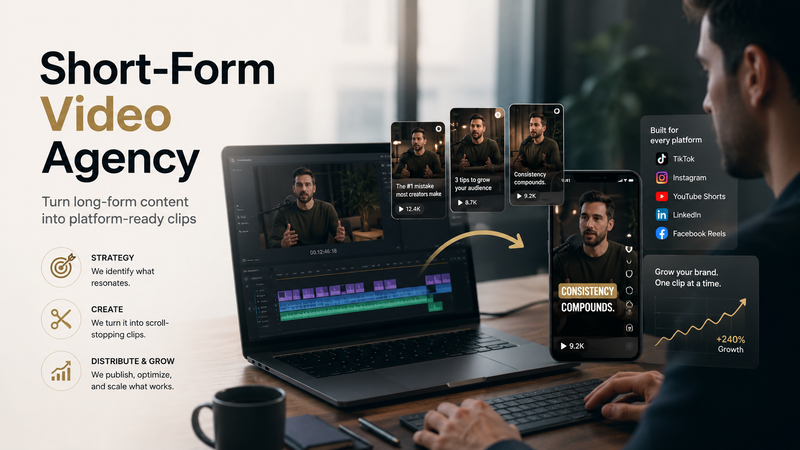

A company can have excellent podcasts, webinars, interviews, and product conversations sitting in its content library while still struggling to publish short-form video consistently. The material exists, but nobody has the time to review every recording, find the strongest sections, write clear hooks, correct captions, manage revisions, and prepare separate versions for different platforms.
This is where businesses often assume they simply need another video editor. Editing is part of the solution, but it is rarely the whole solution.
Short-form video requires editorial judgement, production discipline, brand understanding, and a clear distribution plan. A polished clip built around an incomplete idea will still perform poorly. A useful clip prepared for the wrong audience or platform may also fail to create meaningful results.
A capable agency should therefore provide more than finished video files. It should help the business build a system that turns existing expertise into content people can discover, understand, and act on.
What a short-form video agency does
A short-form video agency is a specialised content partner that converts ideas, recordings, and raw footage into concise videos for platforms such as Instagram Reels, TikTok, YouTube Shorts, LinkedIn, and Facebook.
The source material may include:
Podcasts
Founder interviews
Webinars
Livestreams
Product demonstrations
Conference sessions
Customer education videos
Long-form YouTube content
Online courses
Direct-to-camera recordings
A professional Short-Form Video Agency should understand both production and content strategy. Its responsibilities may include reviewing source material, selecting viable moments, structuring each clip, adding captions and branding, preparing platform-specific versions, managing revisions, and organising completed assets.
Some agencies also support written hooks, post copy, publishing schedules, analytics, and content planning. The exact scope varies, but the central job remains the same: turn useful ideas into short-form content that can stand on its own.
The clearest answer for businesses
A short-form video agency is most valuable when a company already has expertise, recordings, or access to knowledgeable speakers but lacks a dependable production system.
The business may know what it wants to discuss but struggle with execution. Its internal team may also be spending too much time on tasks that are necessary but difficult to scale, such as caption corrections, vertical reframing, file management, clip review, and repeated exports.
An agency can take responsibility for that operational workload while helping the business publish with greater consistency.
The arrangement is particularly useful when a company wants to:
Build a founder’s public profile
Repurpose podcasts and webinars
Support a product launch
Publish across several platforms
Increase the value of recorded events
Answer recurring customer questions
Reduce pressure on internal marketers
Add short-form production to an existing service
Improve consistency without hiring several full-time editors
The agency should not invent expertise for the client. It should recognise the strongest ideas the client already has and make them easier to consume.
How a short-form video agency works
A reliable process begins before any footage is edited. Good agencies establish the audience, purpose, creative direction, and review system before attempting to increase output.
Step 1: Clarify the audience and objective
The first stage is deciding who the content is for and what it should accomplish.
A company may want to build awareness, generate enquiries, educate customers, support sales, promote a podcast, or develop founder authority. Each objective requires a different approach.
A clip created for potential buyers may need to explain a specific problem and its solution. A clip created for industry peers may work better as a thoughtful opinion or lesson. A podcast promotion clip may highlight a strong exchange that encourages people to watch the complete episode.
The agency should establish:
The intended viewer
Priority platforms
Main business objective
Relevant products or services
Topics to emphasise
Claims or subjects to avoid
Preferred calls to action
Existing content that has performed well
This information gives the production team a reason for selecting one moment over another.
Step 2: Build a client-specific creative guide
Every brand should have its own production guide.
A useful guide may include:
Brand colours and fonts
Logo placement
Caption style
Preferred clip length
Examples the client likes
Examples the client dislikes
Tone of voice
Speaker names and titles
File naming rules
Review contacts
Revision limits
Delivery schedule
This prevents the agency from treating every account as though it belongs to the same creator.
A financial adviser, software founder, fitness coach, and entertainment podcast will need different pacing, visual treatment, caption density, and calls to action. The operating process can remain consistent, but the finished content should still feel specific to the client.
Step 3: Review the full recording
The agency then reviews the source material to identify moments that can become independent pieces of content.
Transcripts and automated tools can speed up this stage, but they should not make the final decision alone. A transcript may reveal the words without showing whether the speaker’s delivery is convincing, humorous, emotional, or visually engaging.
Strong moments often contain:
A direct answer to a common question
A practical lesson from experience
A clear opinion supported by reasoning
A customer objection and response
A useful framework
A comparison between two approaches
A mistake and its consequences
A short story with a relevant conclusion
A specific recommendation
The reviewer should understand why a moment matters before sending it to an editor.
Step 4: Shape the moment into a complete clip
A good sentence is not always a complete video.
Suppose a founder says, “That is why we stopped offering unlimited revisions.”
The statement creates curiosity, but the viewer does not know what caused the problem, how the policy affected the business, or what changed afterwards.
A complete clip would normally include:
The original situation
The problem it created
The decision the company made
The result or lesson
The editor may remove repetition, filler words, and unnecessary pauses. The context that makes the idea understandable should remain.
A clip should feel like an independent piece of content rather than a random section removed from a longer conversation.
Step 5: Create a clear opening
The opening seconds should establish the subject quickly.
This does not require exaggerated promises or manufactured controversy. A direct question, mistake, opinion, or result is often enough.
Examples include:
“The biggest mistake we made during our first launch was hiring too quickly.”
“Most businesses measure webinar success using the wrong numbers.”
“There are two reasons your short videos are not generating enquiries.”
“A client asked whether they needed to publish every day.”
When the original recording starts slowly, the agency may add an on-screen headline or begin with a later sentence. Any rearrangement should preserve the speaker’s meaning.
A useful opening creates clarity. It should not turn a balanced statement into clickbait.
Step 6: Edit for the message
The editing style should support the content rather than distract from it.
Production may include:
Removing unnecessary pauses
Tightening repeated phrases
Improving audio
Reframing horizontal footage vertically
Adding accurate captions
Switching between speakers
Highlighting important terms
Adding screenshots or supporting visuals
Applying brand elements
Preparing different platform versions
A professional service firm may need clean captions and restrained visual movement. A sports or entertainment creator may benefit from quicker pacing and more frequent changes. A founder publishing on LinkedIn may need a polished but understated presentation.
The agency should make deliberate creative choices instead of adding effects simply because short-form videos are expected to move quickly.
Step 7: Complete quality control
Every video should be reviewed before it reaches the client or audience.
The review should cover:
Caption accuracy
Correct names and job titles
Accurate figures and claims
Necessary context
Audio quality
Framing
Brand consistency
Logical beginning and ending
Platform dimensions
Export quality
This stage becomes especially important for financial, medical, legal, technical, and regulated subjects. Removing a qualifying sentence can change the meaning of the entire statement.
The business remains responsible for what appears under its name, even when an external agency completed the production.
Step 8: Prepare the clip for distribution
One idea may work across several platforms, but identical publishing is not always the strongest approach.
LinkedIn may support a longer explanation with restrained captions. TikTok may require the topic to become clear sooner. YouTube Shorts may perform well when the video answers a searchable question. Instagram may need a strong cover image and a visually clean first frame.
The agency may adjust:
Clip length
Opening text
Caption placement
Cover design
Description
Call to action
Visual crop
Supporting post copy
The message remains consistent, while the packaging reflects the platform.
Step 9: Review performance and refine the system
Production should improve as the agency learns what the audience responds to.
Useful signals include:
Average watch time
Completion rate
Saves
Shares
Comments
Profile visits
Website clicks
Enquiries
Qualified leads
Views provide context, but they are not always the most valuable metric. A video seen by 3,000 relevant buyers may create more value than one watched by a much larger unrelated audience.
Performance should influence future topics, openings, formats, durations, and calls to action.
Real business use cases
Founder-led companies
A founder can record one structured conversation each month. That recording may produce clips about leadership decisions, customer problems, product development, hiring lessons, and industry changes.
The company gains a consistent public voice without requiring the founder to record something new every day.
Podcast businesses
A podcast production company can provide the full episode along with a package of promotional videos for the host, guest, and brand channels.
This gives clients more value from each recording and allows the podcast company to add another recurring service.
Software companies
A product webinar may contain demonstrations, implementation advice, customer questions, and objections.
Those moments can become:
LinkedIn videos
Sales follow-up clips
Landing-page assets
Customer education content
Internal training resources
Product support videos
The webinar continues helping the business after the live event ends.
Marketing agencies
An agency may manage content for several founders, consultants, and professional service companies. A specialist short-form partner provides additional capacity without forcing account managers and strategists to become video editors.
Events and conferences
Keynotes, interviews, and panel discussions can become speaker highlights, educational videos, sponsor content, and promotional material for future events.
Recorded footage becomes an active content library instead of an archive.
Advantages of hiring an agency
A capable short-form video agency can provide:
Consistent production
Better editorial selection
Platform-specific editing
Flexible capacity
Clear review systems
Less pressure on internal teams
More value from existing recordings
Different creative styles for separate brands
Performance-led improvements
The main benefit is not simply outsourcing editing. It is building a system that connects expertise, production, and distribution.
Possible disadvantages
The model also has limitations:
The agency needs detailed onboarding information
Weak source material may produce few useful clips
Communication problems can create revisions
Some providers rely too heavily on templates
Confidential content requires proper protection
Costs can rise when deliverables are unclear
High output may become repetitive without strong editorial selection
A small paid test project is usually a sensible way to evaluate the relationship before committing a large content library.
Common mistakes when choosing an agency
Selecting the lowest price
Low-cost editing may become expensive when internal staff must correct captions, replace unsuitable moments, and repeatedly explain the brand.
Requesting an arbitrary number of videos
A request for 30 clips does not mean the source recordings contain 30 worthwhile ideas. The quantity should reflect the quality of the material.
Providing footage without context
A folder of videos, a logo, and a deadline are not enough. The agency needs to understand the audience, goals, offer, tone, and intended platforms.
Using the same version everywhere
Cross-platform publishing can save time, but the opening, length, cover, and call to action may need adjustment.
Measuring only views
Reach matters, but saves, enquiries, website visits, qualified comments, and sales conversations may reveal more about business value.
Clipping Agency’s Content Fit Score
Clipping Agency assesses every potential clip using four questions.
Is the idea complete?
The viewer should receive enough context to understand the point without watching the full recording.
Is the idea relevant?
The moment should connect with a genuine audience question, problem, ambition, or interest.
Is the format appropriate?
The pacing, visuals, captions, and duration should suit the speaker and platform.
Is there a useful outcome?
The clip should support a purpose such as education, authority, engagement, website visits, enquiries, or sales.
A moment that fails these checks is unlikely to become valuable simply because it receives polished captions and animation.
Frequently asked questions
How many clips should an agency deliver each month?
The right number depends on the quality of the source content, publishing schedule, platforms, and business objectives. A smaller package of strong clips is often better than a large package filled with repetitive material.
Does a business need a podcast to work with an agency?
No. Agencies can work with webinars, founder recordings, events, courses, product demonstrations, interviews, and purpose-built filming sessions.
Can AI manage the complete production process?
AI can assist with transcription, captions, reframing, and moment detection. Human review remains important for context, accuracy, brand fit, and editorial judgement.
How long should each video be?
There is no fixed duration. Many clips fall between 20 and 90 seconds, although some ideas require more time. The message should determine the length.
Should every clip include a call to action?
No. Some clips should educate, build trust, or encourage discussion. A call to action should be included when it supports the purpose naturally.
Can one video be published on several platforms?
Yes, although the opening, length, captions, cover, description, and call to action may need to change.
How should a company evaluate an agency?
Review the agency’s clip selection, caption accuracy, brand understanding, communication, turnaround time, revision process, platform knowledge, and ability to connect production with business goals.
Build the workflow before increasing output
A short-form video agency should help a company do more than fill a posting calendar. It should build a dependable connection between the company’s expertise, its recorded material, audience behaviour, and wider marketing goals.
Clipping Agency supports brands, creators, agencies, and founder-led companies that want to turn useful long-form recordings into a consistent short-form content system. A practical first step is to review the current content library, identify the questions the audience already asks, and build the first batch around the strongest answers.

Comments
No comments yet. Be the first to comment!