
White Label Clipping Service Canada: How Agencies Scale Short-Form Video
A practical guide for Canadian agencies that want to offer branded clipping services without building a full in-house editing team.
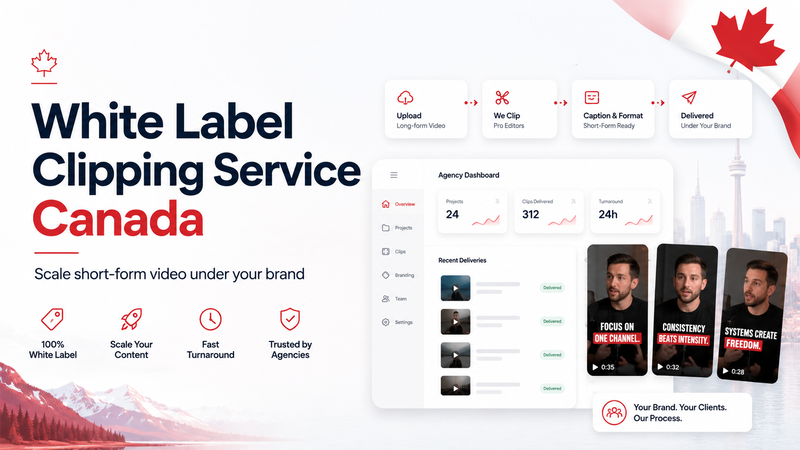

Canadian agencies are under pressure to deliver more content with the same internal team. Clients want LinkedIn clips, TikTok videos, Instagram Reels, YouTube Shorts, webinar snippets, founder videos, podcast clips, and customer proof assets. Many of those clients already have long-form content sitting unused, but turning that material into useful short-form clips requires a proper production system.
That is where a White Label Clipping Service Canada model makes sense.
A white label clipping service is a behind-the-scenes video clipping partner that helps your agency turn client recordings into short-form clips while your agency keeps the branding, relationship, communication, and final delivery. Your client sees the service as part of your agency’s offer. The clipping partner works in the background.
The definition is simple. A white label clipping service reviews long-form client videos, selects strong moments, edits them into short-form clips, adds captions, formats them for the right platforms, and delivers the finished assets for your agency to review and share under its own brand.
For Canadian agencies, this can be a practical way to offer short-form video without hiring a full team of editors, caption specialists, project managers, and video strategists.
The Straight Answer
A white label clipping service helps agencies sell and deliver short-form video clipping without doing every part of the production work internally.
Your client may send a podcast, webinar, interview, testimonial, demo, event recording, livestream, course video, or long Zoom call. The white label partner turns that source material into short clips for platforms like LinkedIn, Instagram Reels, TikTok, YouTube Shorts, email, landing pages, and sales follow-ups. Your agency then delivers those clips under its own name.
This works because many agencies already own the strategy and client relationship. What they lack is production capacity. White label clipping fills that gap without forcing the agency to build a new department from scratch.
Why Canadian Agencies Are Adding White Label Clipping
Short-form video is now part of regular client demand. A social media client wants weekly Reels. A founder branding client wants LinkedIn clips. A SaaS client wants demo snippets. A podcast client wants clips from every episode. A paid media client wants ad creatives to test. A web client wants video proof for a landing page.
The opportunity is obvious, but the workload can become heavy.
Video clipping requires more than cutting a timeline. Good delivery includes:
Reviewing the full recording
Choosing the right moments
Editing for platform behaviour
Adding readable captions
Formatting clips properly
Exporting clean files
Managing revisions
Keeping delivery consistent
If your agency does not have that system, short-form video can quickly become stressful. White label clipping gives you a production partner so your team can stay focused on client strategy, approvals, publishing, reporting, and growth.
A strong setup can help your agency:
Add a recurring service to retainers
Increase monthly client value
Repurpose content clients already record
Avoid hiring a full editing team too early
Support social, SEO, paid media, email, and website work
Keep everything delivered under your agency brand
Scale short-form video across more clients
Clipping Agency’s Angle: White Label Should Protect the Agency
Clipping Agency’s view is that white label work should make the agency look more capable, not more dependent.
The end client should not feel a gap between the agency and the production team. The experience should feel smooth. Briefs should be clear. Clips should arrive on time. Captions should be readable. Files should be organised. Feedback should be easy. The agency should stay in control.
That is the real value of a white label partner. It is not just cheaper editing. It is operational support that protects the agency’s reputation.
A good white label clipping partner should understand that the agency owns the relationship. The partner’s job is to support delivery quietly, consistently, and professionally.
Step-by-Step Process
Step 1: Choose the Right Client Content
White label clipping works best when the client already has useful long-form material. This can include:
Podcasts
Webinars
Founder videos
Client interviews
Testimonials
Product demos
Livestreams
Training sessions
Event talks
Workshops
Sales call recordings
Long-form YouTube videos
Not every recording will create strong clips. A good source video usually has clear audio, useful ideas, natural delivery, and moments that can stand alone. A poor recording can still produce some usable clips, but the agency should set expectations early.
Strong source moments often include a founder explaining a market problem, a customer describing why they bought, a consultant answering a repeated question, a guest sharing a practical insight, or a demo showing how a specific problem is solved.
Better inputs create better outputs.
Step 2: Define the Goal Before Production
Before clips are selected, the agency should know what the client wants the clips to do. A clip made for LinkedIn authority is not always the same as a clip made for TikTok discovery. A clip used in a sales follow-up may need a different tone from a clip used in paid ads.
The goal might be:
Brand awareness
Founder visibility
Lead generation
Sales education
Event promotion
Customer proof
Podcast growth
Paid ad testing
Product education
Website trust
This step matters because the goal shapes the clip selection. A SaaS company may need clips that answer objections. A coaching brand may need clips that show teaching style. A local service business may need clips that build trust. A podcast client may need clips that bring viewers back to the full episode.
Step 3: Send a Clean Brief
Once the goal is clear, the agency sends the source material to the white label partner. The brief does not need to be complicated, but it should provide enough context to avoid guesswork.
A useful brief can include:
Client or project name
Source video link
Preferred platforms
Number of clips needed
Target audience
Brand guidelines
Caption style
Logo or visual assets
Must-use moments
Moments to avoid
Deadline
Notes on tone
The process should get easier over time. A good partner learns your agency’s preferences, common client types, editing standards, and delivery style.
Step 4: Select the Best Moments
Moment selection is where white label clipping becomes more than basic video editing. The partner should look for moments that carry one useful idea and make sense without the viewer watching the full video.
A strong clip usually has:
A clear opening
One focused point
Enough context
Natural pacing
Clean audio
A useful takeaway
A reason to watch, save, share, or click
For agency clients, selection should also match the brand. A serious B2B client may need clean, direct clips. A creator-led brand may need more energy. A local business may need trust-building moments. A paid media client may need several hook variations.
The best clips are not always the loudest moments. They are the clearest moments.
Step 5: Edit and Format the Clips
Editing should make the clip easier to watch without making the content feel fake. This includes removing dead space, tightening the pacing, improving audio where possible, adding captions, applying the correct format, and making the file ready for publishing.
Common formats include:
9:16 for TikTok, Reels, and Shorts
1:1 for some feed posts
16:9 for YouTube, websites, or longer posts
Caption-first layouts for silent viewing
Branded templates for client consistency
Good editing should support the message. It should not bury the idea under too many effects.
Step 6: Review and Deliver Under Your Brand
After the clips are edited, your agency reviews them before sending anything to the client. This keeps quality control inside your process.
A clean delivery should include organised file names, preview links, final exports, revision notes, and platform-ready versions. Your agency can then send the clips to the client, schedule them, add them to a content calendar, or include them inside a larger campaign.
This final step is important because white label delivery still has to feel like your agency’s work.
Specific Examples
A Toronto marketing agency manages LinkedIn content for B2B founders. It uses a white label clipping partner to turn monthly podcast episodes into weekly founder clips. The agency handles positioning and client communication, while the partner handles production.
A Vancouver web agency works with coaches and consultants. It adds clipping to monthly retainers by turning webinars, testimonials, and training videos into short clips for Reels and LinkedIn.
A Calgary social media agency supports local businesses. It repurposes owner interviews, customer stories, and behind-the-scenes footage into short trust-building clips.
A Montreal paid media agency uses white label clipping to create ad variations from client webinars and product demos. Instead of filming new ads every week, it tests different hooks from existing footage.
A Canadian SEO agency uses clips to strengthen service pages, blog articles, and thought leadership campaigns. Video snippets help make content more useful and more credible.
Pros and Cons
Pros
Agencies can offer short-form video without hiring a full team.
Clients get more value from content they already record.
Work is delivered under the agency’s brand.
Clips can support social media, paid ads, email, SEO, websites, and sales.
Agencies can create a new recurring revenue stream.
Production becomes easier to scale across multiple clients.
Internal teams can stay focused on strategy and account management.
Cons
Weak source material can limit clip quality.
Poor briefs can create revision issues.
Cheap providers may focus on quantity over strategy.
Agencies still need to manage client expectations.
Revisions can become messy without a clear workflow.
White label work requires trust between both teams.
The model works best when the agency treats clipping as a serious content service, not a small add-on.
Common Mistakes
Many agencies add clipping services before they have a clear delivery process. That can create missed deadlines, inconsistent quality, and unnecessary client frustration.
Common mistakes include:
Promising too many clips
Accepting weak source videos without setting expectations
Sending unclear briefs
Using the same editing style for every client
Ignoring platform differences
Not reviewing clips before client delivery
Choosing a partner only because they are cheap
Treating clipping as low-value production work
If clips help a client stay visible, support sales, improve trust, and reuse long-form content, they should be positioned as a serious service.
Real Business Use Cases
For social media agencies, white label clipping can become a weekly content engine for clients who already record podcasts, webinars, videos, or calls.
For SEO agencies, clips can support service pages, blog content, topical authority, and brand trust.
For paid media agencies, clips can become ad creative for testing different hooks, offers, and messages.
For web agencies, clips can improve landing pages, testimonials, case studies, and proof sections.
For PR and personal branding agencies, clips can help founders and experts stay visible without recording new content every day.
FAQs
What is a white label clipping service?
A white label clipping service creates short-form video clips for your clients while your agency delivers the work under its own brand.
How does white label clipping work?
Your agency sends the source videos, goals, brand notes, and platform requirements to the clipping partner. The partner selects moments, edits clips, adds captions, formats the files, and sends them back for review and delivery.
Who should use a white label clipping service in Canada?
Marketing agencies, social media agencies, SEO agencies, web agencies, PR firms, paid media teams, personal branding agencies, and consultants can use it to offer short-form video without building an internal editing team.
What type of content can be clipped?
Podcasts, webinars, interviews, testimonials, product demos, livestreams, training videos, event talks, long-form YouTube videos, and recorded client calls can all be clipped.
Can agencies resell clipping services?
Yes. Agencies can resell clipping inside retainers, campaigns, social media packages, founder branding offers, content distribution services, or paid media creative packages.
Is white label clipping only for large agencies?
No. Smaller agencies can use it too, especially when they have clients asking for short-form video but do not want to hire full-time editors yet.
Final Thoughts
A white label clipping service gives Canadian agencies a practical way to offer short-form video without turning the internal team into a production department.
Many clients already have useful long-form content. What they lack is a reliable system for turning that content into short clips that travel across platforms.
Clipping Agency can help agencies deliver short-form video under their own brand, support client campaigns, and build a repeatable clipping workflow that feels professional from intake to final delivery.

Comments
No comments yet. Be the first to comment!